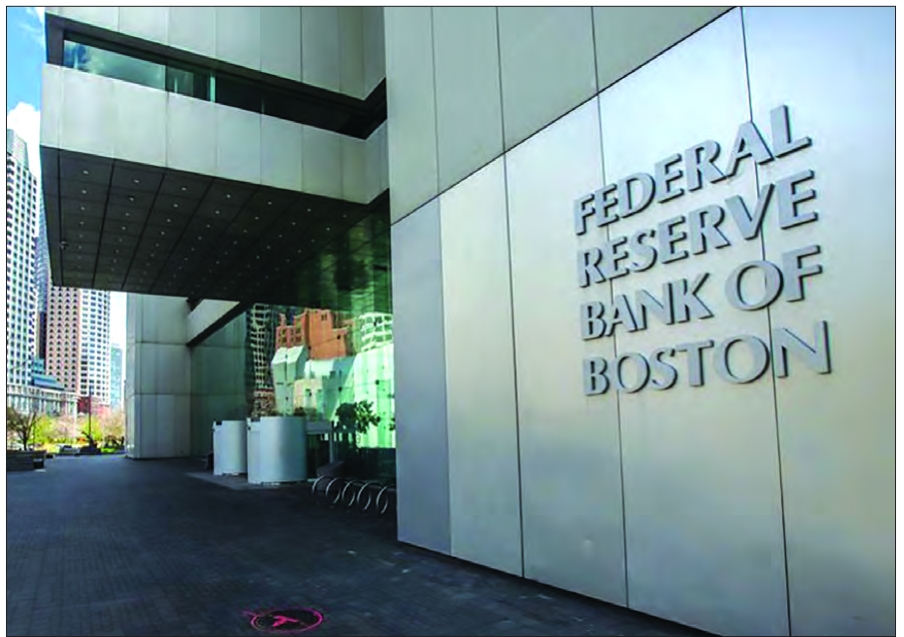
The Federal Reserve Bank of Boston.A new picture of wealth from the Federal Reserve Bank of Boston shows a deep and enduring wealth gap across the state.
A new Massachusetts Economic Conditions and Household Opportunity Survey released on Aug. 12 shows that wealth is divided on lines of home ownership, race and geography.
The project is the first from the Fed to complete picture of family resources, according to officials. The Fed previously released research showing the racial disparities of wealth in its 2015 “Color of Wealth” project. That report notably found U.S.-born Black households had a median net worth of $8, while white households had a nearly $250,000 median net worth.
Unlike the 2015 report, the new survey uses a measure called net wealth to understand the total present dollar value of all family assets such as money in the bank and home equity, minus the total dollar value of all debts like student loans and accrued credit card debt. The newly released research also uses a different and more representative sample design.
The survey collected data from more than 5,000 respondents on their family’s assets, debts and economic circumstances and shows how families were faring in the state between March and December of 2025, across demographics like education, age, race and place. The Fed worked in partnership with The Boston Foundation and TBF’s strategic partners—the Barr Foundation, Eastern Bank Foundation and Greater Boston Chamber of Commerce to acquire the data.
“This well-designed, far-reaching, and rigorously documented survey by the Boston Fed allows us to face the challenge of equity with new vigor and knowledge that our work to strengthen homeownership, improve educational outcomes, and support small businesses can and will over time strengthen the economic well-being of people across the Commonwealth,” Lee Pelton, president and CEO of The Boston Foundation, said.
More than a third of families are unable to cover emergency expenses.
An estimated 35.4% of respondent families in the state said they could not cover a $400 emergency expense with cash or its equivalent, according to the Fed.
“Having wealth is the ability to financially navigate an unexpected job loss, a serious illness,” Ali Noorani, president and CEO of the Barr Foundation, said. “It is the difference between one’s ability to live to their fullest potential and a trajectory that mires them in debt.”
Homeowners also have more than 500 times as much wealth as renters, according to the data. The owners in Massachusetts had $790,500 in net wealth while renters had $1,500 in net wealth.
Families living in rural areas and suburban areas had a net wealth total exceeding $440,000. By contrast, in the city of Boston, families had a net wealth of $110,000.
Wealthier families in 2025 were demographically most likely to identify as white with a net wealth of $549,200. Asian, Native Hawaiian, and Pacific Islander families had a median of $305,000.
Families with lower net wealth were also more likely to identify as Black or Hispanic. Hispanic families had a total net wealth of $1,200, while Black families had $7,800.
Higher net wealth correlated with more degrees. The net wealth of a family holding a graduate degree exceeded $940,000, according to the data. Older households were also more likely to have more wealth. Families with the respondent or spouse/partner 65 or older had a net of $702,500.
“This is a clear indication to us that economic inequity is so deeply rooted that solutions can only be found in collaboration,” Noorani said. “The surest way to reduce the wealth gap is by working together across sectors and ideologies to remove barriers and improve access to capital.”