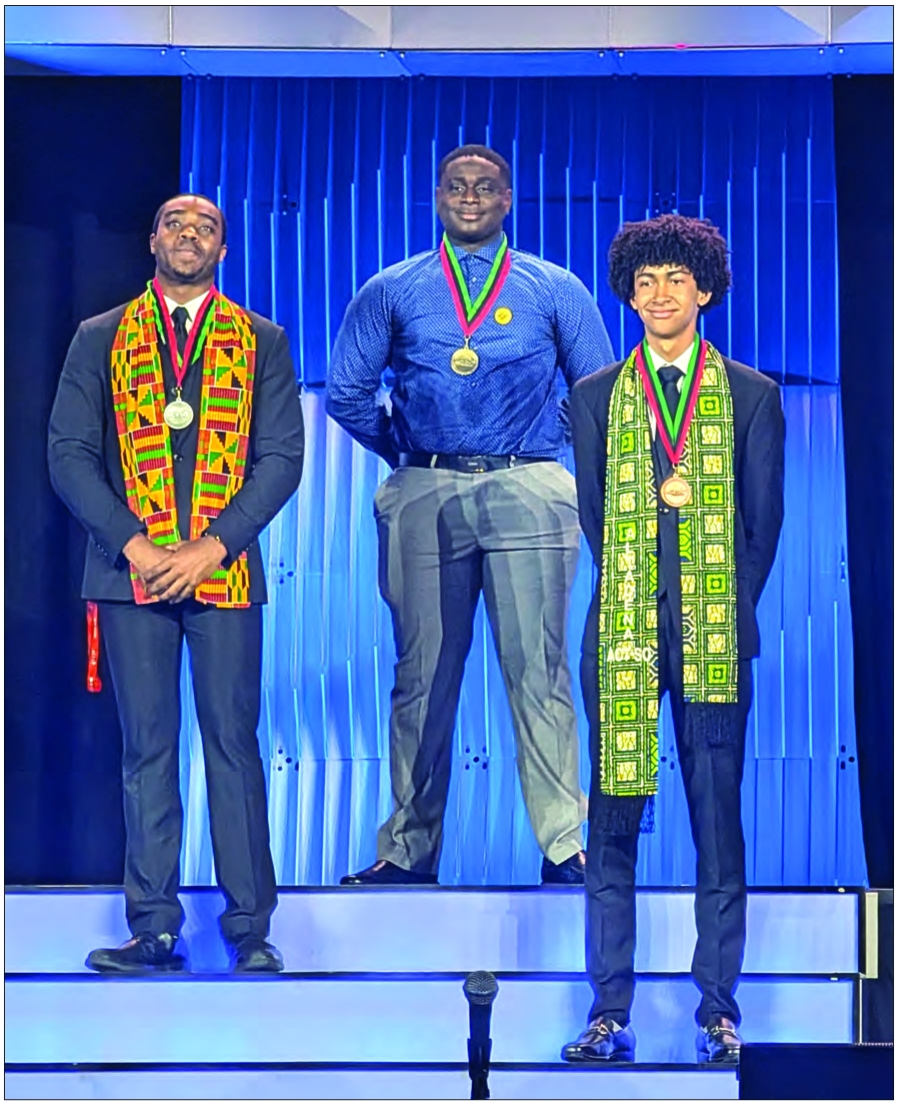
Nathan Pierre’s (center) winning design in the ACT-SO competition was inspired by an unexpected flood in Brockton, Mass. which totaled the school principal’s car.Nathan Pierre, a rising sophomore at Dessalines STEAM Academy, a microschool in Brockton, brought home gold in the Physics division of the NAACP Afro-Academic, Cultural, Technological, and Scientific Olympics (ACT-SO) national competition for his work using artificial intelligence (AI) models to predict urban flooding more accurately than existing technology.
The ACT-SO competition begins with local competitions, whose winners then move on to the national stage. The year-long competition aims to encourage excellence and stimulate interest in scientific and cultural endeavors among Black high school students across 33 disciplines, as well as recognize them for their work.
When a teacher introduced the competition at school, Pierre was the only student who expressed any interest. “I wanted to go to the competition because I thought it would be a good experience and since it would be a good look on my college applications,” he said. He competed in two Boston-based competitions and, after performing well, headed to the national competition in Chicago to present his project.
“On the day of the competition, I slowed down, focused, and made sure to mention all my points. I hoped that if I missed anything, the judges would ask me about it. I felt really nervous because I knew this was a big stage, and I’d be on TV. So, if I messed up, that would be really embarrassing,” Pierre said. His presentation was evaluated by a panel of judges using a point-based system that considered timing, preparation, and content quality, among other categories.
“You know how sometimes you feel a lot of pressure? It felt like all that pressure transformed into wings, and I was just soaring. I didn’t really cry or have a big rush of emotions, but it was a huge relief when I won,” Pierre said.
Pierre’s school principal experienced the dangers of flooding and the shortcomings of existing technology firsthand. While parked at the Westgate shopping mall parking lot in Brockton, the principal’s car was totaled after severe, unanticipated flooding.
“Flooding is one of the most costly natural disasters out there. At least in my area, the flood map was inaccurate, which is one reason my principal’s car got flooded,” Pierre said. “I thought it was necessary to research this topic more deeply, so what happened to my principal won’t happen again.”
Existing flood prediction technology is based on models from the Federal Emergency Management Agency, which focus on rising river levels and the potential for rivers to overflow and submerge nearby areas. Other flooding models are based on tidal waves and coastal flooding. However, not all flooding results from rising river levels — flash flooding, from rain, impacts urban areas more directly. For instance, the Brockton shopping mall is approximately three miles from the closest river.
Pierre’s AI model, which he built from scratch using Anaconda, a programming language, takes into account the area’s drainage and topographical characteristics. The efficacy of sewage systems and the ground’s relative absorptivity are much more relevant to urban areas such as Brockton. To study this, Pierre and his mentor, Ronald Demon, a former ACT-SO competitor and victor in the physics division, built a diorama model of the Brockton mall parking lot 1/20th of its real size. Pierre and Demon flooded the model to collect data on how the environment would respond to excess water, and fed the data to an AI model.
“AI is a useful tool. People complain about it a lot because many people like to use it. But AI is just here to help us catch small details that humans might overlook. It’s another piece of technological evolution,” Pierre said.
Demon, who met with Pierre almost every day as the competition progressed, noted that the way he flooded his model was “error-prone,” which was rectified by a computer program that cleaned up his data.
“[Pierre] ran his physical model manually. He turned a cup of water up and down on his model to simulate flooding, and then used a ruler to measure the water level. We got a lot of unstable data, so I ran a program that made the data much more consistent,” Demon said.
In the future, Pierre plans to present his research to higher-ups in the Brockton area and turn his AI model into a publicly accessible mobile app to warn residents of impending floods.
“Nathan truly stands out. For a 10th grader to tackle a complex, real-world issue like flooding is impressive, but he didn’t just take a surface-level approach. He dove deep, leveraging advanced math, physics, and statistics to truly understand the mechanics of the problem,” Demon said.
“He applied cutting-edge AI in creative ways. AI is still a nascent field, so seeing a high school student develop such innovative, practical applications for it is extraordinary.”