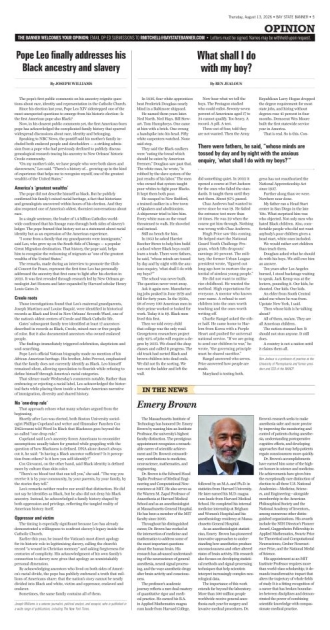
Emery Brown
The Massachusetts Institute of Technology has honored Dr. Emery Brown by naming him an Institute Professor, the university’s highest faculty distinction. The prestigious appointment recognizes a remarkable career of scientific achievement and Dr. Brown’s extraordinary contributions to medicine, neuroscience, mathematics, and engineering.
Dr. Brown is the Edward Hood Taplin Professor of Medical Engineering and Computational Neuroscience at MIT. He also serves as the Warren M. Zapol Professor of Anaesthesia at Harvard Medical School and as an anesthesiologist at Massachusetts General Hospital. He has been a member of the MIT faculty since 2005.
Throughout his distinguished career, Dr. Brown has worked at the intersection of medicine and mathematics to address some of the most important questions about the human brain. His research has advanced understanding of the neuroscience of general anesthesia, neural signal processing, and the ways anesthetic drugs alter brain activity and consciousness.
The professor’s academic journey reflects a rare dual mastery of quantitative rigor and medical practice. He earned his B.A. in Applied Mathematics magna cum laude from Harvard College, followed by an M.A. and Ph.D. in statistics from Harvard University. He later earned his M.D. magna cum laude from Harvard Medical School. He completed his internal medicine internship at Brigham and Women’s Hospital and his anesthesiology residency at Massachusetts General Hospital.
As an anesthesiologist-statistician, Emery Brown has pioneered innovative approaches to understanding how anesthetics produce unconsciousness and other altered states of brain activity. His research also focuses on developing statistical methods and signal-processing techniques that help scientists interpret increasingly complex neurological data.
The importance of this work extends far beyond the laboratory. More than 300 million people worldwide receive general anesthesia each year for surgery and invasive medical procedures. Dr. Brown’s research seeks to make anesthesia safer and more precise by improving the monitoring and control of patients during anesthesia, understanding postoperative cognitive effects, and developing approaches that may help patients regain consciousness more quickly.
Dr. Brown’s accomplishments have earned him some of the highest honors in science and medicine.
He achievements have given him the exceptionally rare distinction of election to all three U.S. National Academies—Medicine, Sciences, and Engineering—alongside membership in the American Philosophical Society and the National Academy of Inventors., among numerous other distinguished organizations. His awards include the NIH Director’s Pioneer Award, Guggenheim Fellowship in Applied Mathematics, Swartz Prize for Theoretical and Computational Neuroscience, Gruber Neuroscience Prize, and the National Medal of Science.
His appointment as an MIT Institute Professor requires more than world-class scholarship; it demands transformative impact that alters the trajectory of whole fields of study It is a fitting recognition of a career that has broken boundaries between disciplines and demonstrated the power of combining scientific knowledge with compassionate medical practice.