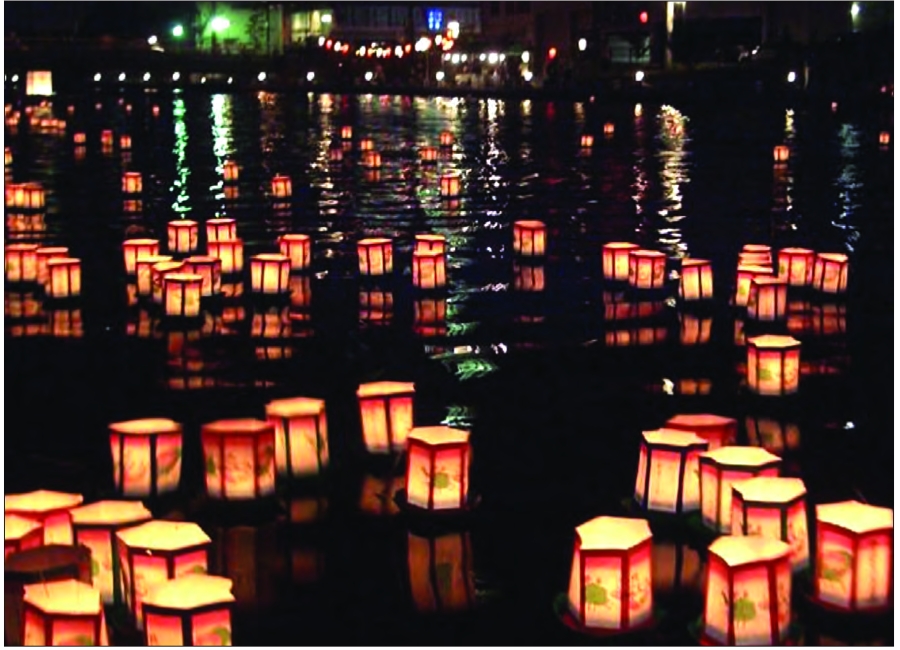
Candleboats float in memory of those who died in the nuclear bombings in Hiroshima and Nagasaki.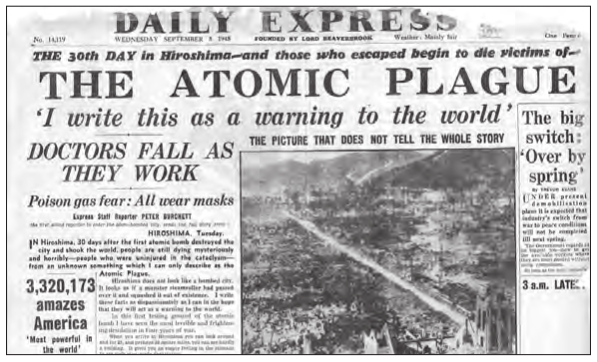
The front page of the London Daily Express, Sept. 1945.
On August 9, Watertown Square was briefly silent as dusk approached. In remembrance of the bombings of Hiroshima and Nagasaki, a gathering migrated to the Charles River dock, where speeches, music, and a release of floating paper lanterns ensued.
The event was not only a memorial for the roughly 210,000 people killed in the 1945 atomic bombs dropped by the United States on Japan, but a warning of the growing threat of nuclear warfare in today’s world.
One of the speakers was Ray Matsumiya, who recounted his grandfather’s experience as a volunteer fire captain who aided in the aftermath of the bombing. After driving towards a mushroom cloud, Matsumiya’s grandfather spent three days treating the wounded among “ashes, fire, and bodies.” He eventually lost sight in his left eye due to radiation exposure.
“He never forgot what that eye had seen,” Matsumiya said, before putting himself in the shoes of survivors of the bombing. “Everything that you know, in your town, in your communities, just gone... all ash.”
To anti-war advocates and concerned residents across the country, nuclear bombs are not a matter of the distant past, but a looming threat. Local activists hope to gather support for the “Back from the Brink” resolution, which would prohibit armed forces from using the weaponry as a first offense, end the sole authority of the president to launch a nuclear strike, and cancel the plan to refurbish the nuclear arsenal.
Nuclear non-proliferation activism is not an unfamiliar concept in New England. At the remembrance event, Watertown Citizens for Peace, Justice and the Environment (WCPJE) organizer Tod Gross mentioned the 1980s “Nuclear Freeze” movement, which started in local Massachusetts towns and eventually won over national policy changes. In a similar spirit, WCPJE recently attempted to pass a nuclear disarmament resolution in Watertown. Despite garnering over 500 signatures, the City Council rejected it on a 4-5 vote, stating it was “not a local issue.”
Event attendee and aspiring state representative Alison Leary vehemently disagreed with the City Council’s conclusion. She argued Massachusetts should invest in universal healthcare and the interests of its citizens, rather than putting funds towards the refurbishment of nuclear arms. “We have plenty of money,” she said. “It’s going to the wrong people.”
Similarly, Gross expressed the view that the immense financial cost of nuclear arms should be repurposed towards community needs, such as education.
By the docks at Saturday’s event, WCPJE organizer Jean Trubek told the crowd about the 500-year old Japanese Obon festival tradition of floating lanterns to guide spirits back to the land of the dead.
Today, there are ceremonies called “Toro Nagashi,” which began in 1946 as a way to commemorate the lives lost in the WWII bombings of Japan. This more modern practice is intended to console the souls lost in the bombings. Trubek described participants floating the candle boats as a shared wish for the abolition of nuclear weapons and a lasting world peace.
Leary, Gross, and Trubek all emphasized the disastrous impact nuclear attacks have on the environment, especially of concern given climate change, pollution rates, and extreme weather events. Matsumiya expressed that even a limited nuclear exchange could drop global temperatures by several degrees, with soot blocking sunlight, causing famine and crop failure.
In the face of these realities, and inheriting his family’s trauma and moral missions, Matsumiya chose to start the Oleander Initiative. Named after the red oleander flower, which was the first to bloom in the irradiated rubble of the destroyed cities, the initiative gathers educators and communities to reflect on the “lessons of Hiroshima,” including pacifism, resilience, and forgiveness.
The activists recognized that the United States is often seen as an aggressor in global politics, making it an ineffective lecturer for peace. Matsumiya noted that traditional peacebuilding programs funded by the American State Department frequently failed in the Middle East, because they were perceived through the lens of imperialism and occupation. He observed that an American official in a tie lecturing about peace often feels like “hollow words” to the audiences. Matsumiya recalled that when speaking to people from active conflict zones such as Lebanon, “it’s not the right time to talk about forgiveness. But it is the right time to talk about resilience.”
Trubek similarly argued that the United States lacks credibility to tell other countries what to do with nuclear weaponry, as it maintains a massive arsenal of its own and uses it as a threat. She believes that if citizens can convince the United States to agree to disarm, the rest of the world may follow suit.
As the world experiences some of its highest levels of conflict since WWII, including violence in Palestine, Lebanon, Iran, and Ukraine, recent Pew polling shows that Americans are largely pessimistic about the future.
“People are [so] overwhelmed with the awfulness that’s going on internationally, they almost can’t take anymore. They’re saturated,” said Trubek.
However, Matsumiya still regards the extraordinary reconstruction of Hiroshima, and its subsequent dedication to peace, as a sign that humans are “made to move forward.” He concluded that “peace will definitely not come if you give up.