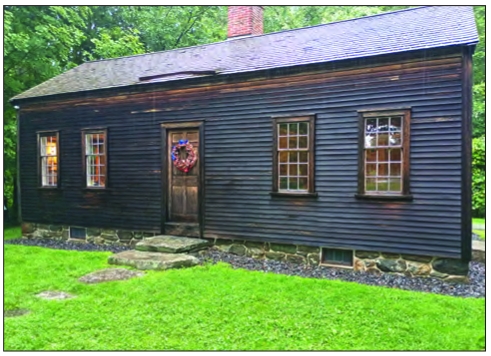
This 19th-century house in Concord originally sheltered the first-generation descendants of Caesar Robbins, a formerly enslaved Revolutionary War veteran, as well as Jack Garrison, who had escaped to freedom from New Jersey.
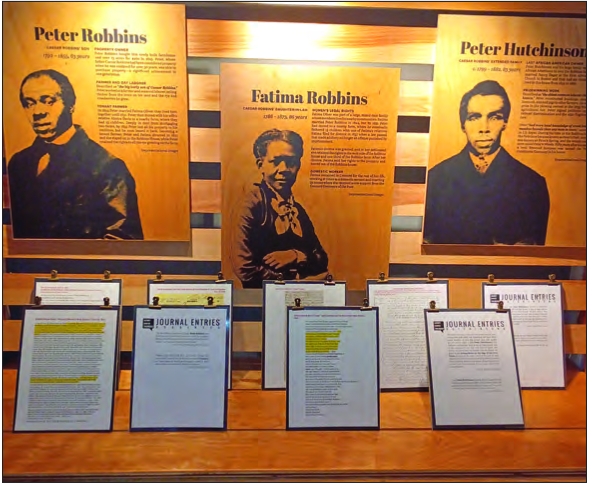
An exhibit at The Robbins House highlights the history of the home’s residents.While Black history is being erased or limited across the country, The Robbins House works to keep Concord’s African American history alive. Based out of one of the only homes in the Greater Boston area commemorating a onetime enslaved man who became a Revolutionary War veteran, the nonprofit reveals what has been hidden for, in some cases, centuries.
In the affluent town of Concord just northwest of Boston, The Robbins House raises awareness of the town’s African, African American, and antislavery history from the 17th through the 19th centuries. Through this work, its vision is to inspire conversation, expand understanding and contribute to a more equitable society.
The organization brings this history to life by sharing the stories of Concord’s earliest residents of African descent, creating educational resources based on their experiences and connecting early fights for freedom and equality with modern social justice movements.
Today, the historic 544-squarefoot, 19th-century house sits at 320 Monument Street, directly across from the Old North Bridge. It originally sheltered the first-generation descendants of Caesar Robbins, a formerly enslaved Revolutionary War veteran, as well as Jack Garrison, who had escaped to freedom from New Jersey.
In 1823, landowner Humphrey Barrett sold the 13-acre property and the newly built house to Peter Robbins, Caesar’s 30-year-old son. Peter and his wife, Fatima, occupied the west side of the house.
The property deed reserved the east side for Peter’s sister, Susan; and her husband, Jack Garrison.
Although the house originally stood a short distance to the east on a small farm overlooking the Great Meadows, it was moved to its current location in 2011 before a brief period of restoration. It opened in 2013 for visitors to explore the lives of the Robbins and Garrison families and learn how their experiences reflect the broader fight for freedom and equality in America.
“The museum basically talks about the history of Black Concord, typically through the eyes of the two families that lived here, the Robbins and Garrison families. It’s been a home mostly for African American families,” said Executive Director Jen Turner, who added that the two-room house looks like it did when inhabited by the Robbins and Garrison families.
The organization also offers engaging antislavery and African American history workshops tailored for schools, community organizations and civic groups.
“For me, I think the reason to come here is American history doesn’t take place in giant spaces all the time,” said Board Chair Nikki Turpin. Occupants Ellen Garrison, Caesar’s granddaughter, and her mother “were part of a large group of women who were talking about ending slavery and about voting rights. They were doing all this work.”
Turpin added that Concord is often only associated, historically, with white Transcendentalists like Ralph Waldo Emerson and Henry Thoreau.
“The thing that we always tell people when they come here is [that] the Robbins and Garrison families were contemporaries of those people. They were here around the same time, traveled in the same circles, and were aware of each other. They were doing some of the same work as the Transcendentalists were doing. So, we’re trying to illuminate their stories, show that they are just as important as the traditional narrative that people talk about.”
Through programs, tours and resources, the organization invites participants to connect the past with the present and to explore how ordinary people have shaped the pursuit of freedom across generations.
Turpin’s favorite part about running the museum is the public event offerings, such as a Patriots’ Day celebration that has engaged local kids and musicians for the last four years. Other museum events include the annual Independence Day tradition of reading Frederick Douglass’ famed speech, “What to the Slave Is the Fourth of July?” and the annual Juneteenth celebration on The Robbins House front lawn, featuring food trucks and musical performances by area groups.
This October, visual artist and author Willie Mae Brown will be at the museum discussing her new children’s book “My Selma,” a memoir that explores growing up in the South amid the Civil Rights Movement.
For those wishing to explore beyond the house, the Concord Visitor Center offers guided African American history walking tours that highlight key sites in the town connected to the fight for freedom, equality and community. The Robbins House is open free of charge every day from April 20 through October between 10:30 a.m. and 4:30 p.m.
“Your humanity is tied to understanding other people. We want people to come and learn about the families,” Turpin said. “Especially as a person of color, a Black woman, Concord is a safe place to come to for all to see just how we are as a people, and what we’ve done.”
ON THE WEB
Learn more at robbinshouse.org