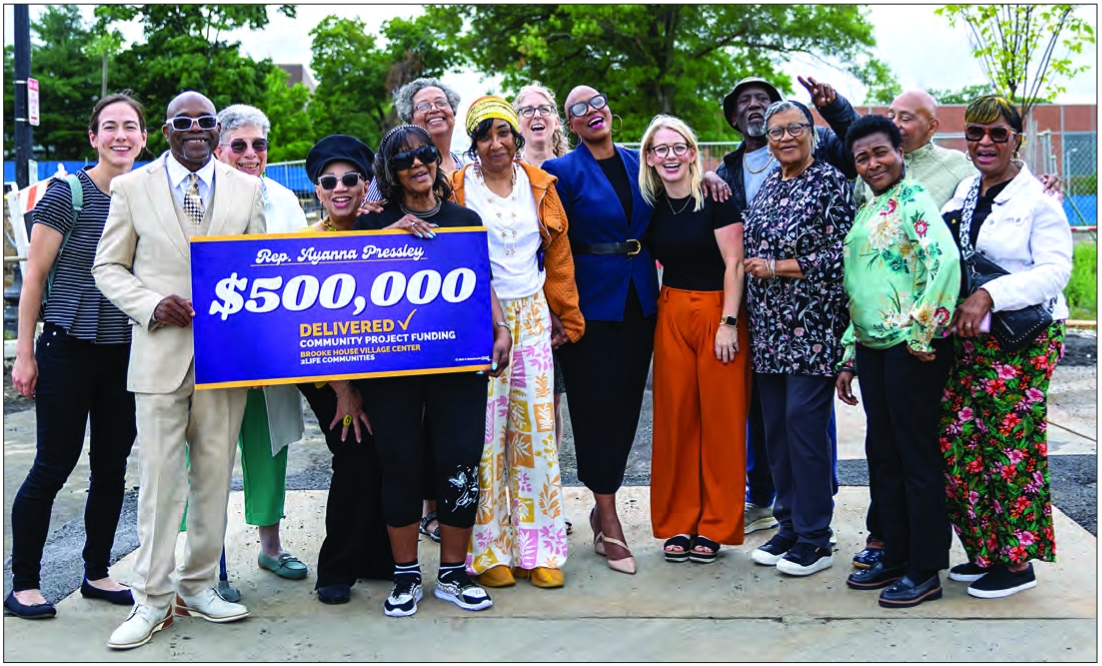
U.S. Rep. Ayanna Pressley (center) recently secured $500,000 in federal funding for an affordable senior housing facility in Olmstead Village.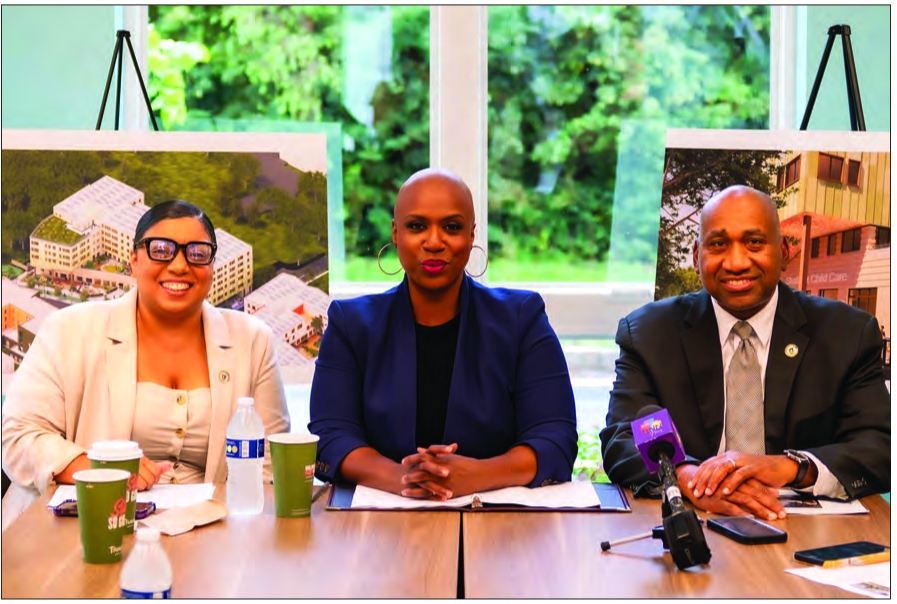
Sen. Liz Miranda, Rep. Ayanna Pressley and Rep. Russel Holmes at the Brooke House press event.
Development to include onsite child care, health care, fitness center
A new 127-unit affordable senior housing facility in Mattapan is aiming to be an intergenerational village that combines housing with child care and health offerings, alongside fitness, arts and culture classes.
Congresswoman Ayanna Pressley recently secured $500,000 in federal funds to help establish the Brooke House development, to be built on a 10-acre parcel of land from the former Boston State Hospital campus by nonprofit 2Life Communities.
The $94 million project, which exists within the broader Olmsted Village development, strives to alleviate senior isolation and preserve local wealth. Brooke House’s ground-floor hub, which also received $2 million in the state budget, will house a multi-purpose room and a fitness center to help engage residents in community activities.
At a recent press event in Mattapan, Pressley expressed that housing is more than just shelter, but rather, it’s “where you can exhale, where you can feel safety and refuge, where you can rest, where you can dream.” She added, “when I say housing is a human right, that is what I mean.”
2Life president Lizbeth Heyer said that neighborhood requests for health care and child care helped shape Brooke House’s “aging-in-community” model. The nonprofit collaborated with local leaders including state Sen. Liz Miranda to ensure the model was tailored to Mattapan’s immediate needs.
“I’m grateful to congresswoman Ayanna Pressley and to all of our seniors who are demanding and deserving of the opportunity to age in place. I don’t want to build a community without our seniors, I want to build a community where they are celebrated, valued, and loved right here at home,” said Miranda in a release.
Heyer added Brooke House’s core blueprint can be reproduced “anywhere,” so long as it makes the effort to establish the priorities of its local community.
“You don’t have a community without seniors,” said Russell Holmes, state representative and champion of Brooke House, which will be built over the next two years.
Visiting 2Life’s Brighton location, The J.J. Carroll House, Holmes was struck by the distinct community identity there.
He believed the 2Life homes were “well-maintained” and that they “care about the people who live in their home.” He hopes to see more versions of this community-oriented village built in Boston, starting with the upcoming site in Mattapan.
The MASS Design Group introduced green standards to the project, too, reducing the building’s carbon footprint by using all-electric systems, and a “tight building envelope” involving high-quality insulating and ventilation. Accordingly, utility costs are lowered.
Heyer said this money saving will allow 2Life to invest into resident programming, such as lifelong learning classes.
The project’s architects also relied on universal design concepts, incorporating features such as roll-under countertops, which allow people using wheelchairs to easily use food and workspaces.
Through a partnership with Harvard Street Neighborhood Health Center, a satellite clinic will operate out of the development. This combination of design and easily-accessible healthcare is meant to ensure residents can age in place, rather than being pushed out into nursing homes when physical changes set in.
The community’s once beloved Shattuck Child Care Center was displaced about a decade ago, and has been operating out of church basements ever since. Now, the Brooke House development will provide the Center a permanent home.
Heyer, whose own children attended Shattuck 23 years ago, believes intergenerational programming is “life-affirming,” as it allows elders to “engage and experience the joy and energy of young people.”
Aside from Brooke House, 2Life is also building a development called Treehouse at Olmsted Village, which will offer 66 intergenerational units specifically directed at foster families, youth aging out of the system, and “honorary grandparents.” Heyer described the trauma-informed care approach at Treehouse as a type of “scaffolding” to help traumatized youth feel “safe and grounded.”
A senior living in Massachusetts requires about $70,000 annually to live, according to Heyer, while median social security incomes hover around $20,000. The extreme disparity between need and reality creates an urgent demand for affordable senior housing.
The J.J. Carroll House in Brighton has doubled its original number of units, and still faces a years-long waitlist. To address this crisis, Boston Housing Authority’s Section 8 vouchers ensure rents at Brooke House will remain at no more than 30% of the seniors income.
Heyer believes the affordability of these housing units, as well as on-site care, will result in “intergenerational wealth creation.”
Holmes echoed this thinking by sharing his perspective on the “sandwich generation,” or middle-aged residents tasked with caring for both children and elders. Holmes argued that high-cost senior health care depletes these families of their assets.
Since the closure of the former Boston State Hospital campus in 1980, the site has been stewarded by the Community Advisory Committee (CAC). Of the 175-acre site, the final 10 acres were granted to 2Life for the Brooke House development. The Brooke House project also marks a victory for State Land for Homes, a Massachusetts initiative that fast-tracks housing on surplus public land to address the housing crisis in the region.
Construction for Brooke House is anticipated for late summer or fall of this year, with completion estimated for fall 2028. The affirmative fair housing marketing process and lottery is expected to begin in late 2027, about one year prior to occupancy.