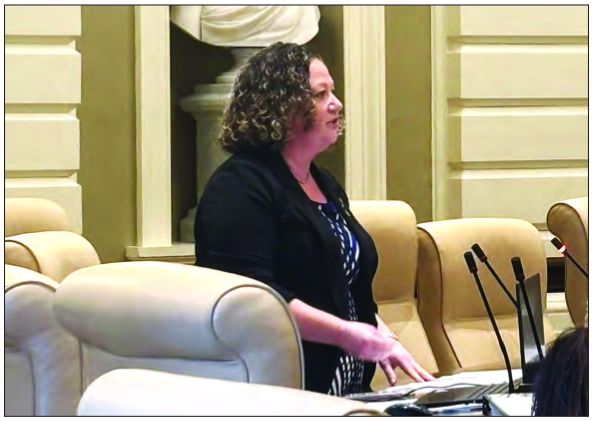
State Sen. Rebecca Rausch, sponsor of the legislation protecting journalists from being subpoenaed to reveal confidential sources.
In 1998, then-Boston Globe journalist Richard Knox faced a choice: reveal the confidential sources behind his reporting, or risk punishment for refusing to comply with a court order.
He chose to protect his sources. During the high-profile Ayash v. Dana-Farber case, in which a cancer doctor sued the Boston Globe for libel, a Massachusetts judge ordered Knox to reveal his sources. Despite the threat of a $2 million fine, Knox refused, maintaining that protecting a source’s identity is a “sacred pledge” essential to journalists’ trustworthiness.
Nearly three decades later, lawmakers are moving to give journalists like Knox protections he did not have — on Aug. 6, the Massachusetts Senate unanimously voted to introduce legislation protecting journalists from being subpoenaed to reveal confidential sources.
The measure, sponsored by Sen. Rebecca Rausch, would prevent courts, grand juries and other bodies from forcing journalists to disclose sources in many instances.
“The need for a statutory press shield law in our Commonwealth has never been more urgent,” Rausch said in a statement. “By passing this legislation, we show the federal government and our constituents that we will defend the First Amendment and support a free press, without which our democracy cannot survive.”
The shield law is part of broader legislation aimed at expanding Massachusetts’ public records law, including by publicizing votes, fiscal reports and other records from the governor’s office.
Both the House and Senate have passed versions of the bill, but differences between the two measures must be reconciled before the legislation can advance.
The protection comes amid increasing tensions between newsrooms and the federal government. In her statement, Rausch pointed to the FBI raid of a Washington Post reporter’s home in January 2026, the Trump administration subpoenaing phone records of several New York Times journalists less than a month ago and other actions.
“As Trump and his Administration accelerate and intensify their attacks on journalism and sources are increasingly afraid to speak up, the Massachusetts Senate takes an historic stand to strengthen our free press and fortify our democracy,” Rausch said.
Massachusetts is one of just nine states without statutory protections for journalists. In a statement to the Banner, the Reporters Committee for Freedom of the Press — or RCFP a nonprofit organization providing legal services to reporters — emphasized the importance of the shield law.
“This is a significant step toward bringing Massachusetts in line with the large majority of states that have shield law,” wrote Gabe Rottman, vice president of policy for the RCFP.
For Knox, the Senate’s unanimous approval was “frankly thrilling,” particularly given his own experience in court without such protections. His battle stemmed from his reporting on a fatal chemotherapy overdose at Dana-Farber Cancer Institute that killed two patients.
Lois Ayash, a doctor at the hospital, sued Knox and the Globe after an article incorrectly reported that she was the one to sign off on the chemotherapy order. The Globe published a correction a few months later. Ayash, who also sued Dana-Farber, sought the identities of Knox’s confidential sources during the trial, which could have supported her case against the hospital and set a precedent.
This type of legal shield in Massachusetts could protect journalists from facing the same dilemma, particularly when reporting on sensitive issues.
Knox understands why some people may be against providing journalists with shield protections, especially if the public believes that powerful media outlets are being exempt from obligations in courts. But, he said, such protections would not be a “blanket permission” for reporters to grant confidentiality — especially since most journalists don’t want to.
“You want to get everything on the record that you possibly can … because people, readers and listeners, deserve to know how you know something,” Knox explained. “However, many stories would not get reported if you couldn’t provide confidentiality and stick to it.”
He pointed to the Boston Globe’s 2002 investigation into the Catholic Church’s sexual abuse of children as an example of the importance of granting — and keeping — confidentiality.
“[The investigation] unleashed hundreds, if not thousands, of other stories and investigations around the world to expose that kind of abuse and cause reforms in the church and in society,” Knox said. “But a lot of those stories don’t get reported because people aren’t willing to be sources, understandably.”
Without shield protections, the financial consequences of litigation can be particularly daunting for smaller journalists and news organizations without legal resources such as institutions like the Globe.
Ultimately, journalists and advocates describe such laws as key to protecting freedom of the press. It is crucial that journalists can “report without fear or favor,” said Knox, since they impact how willing journalists are to proceed. Without the protections, many are hesitant to publish critical stories with confidential sources.
“Do we take the risk because this is an important enough thing to endure the risk and hope that the outcome will be good for us and for the public, or do we not report something … that needs to be reported?” Knox said. “And that’s a very tricky decision.”