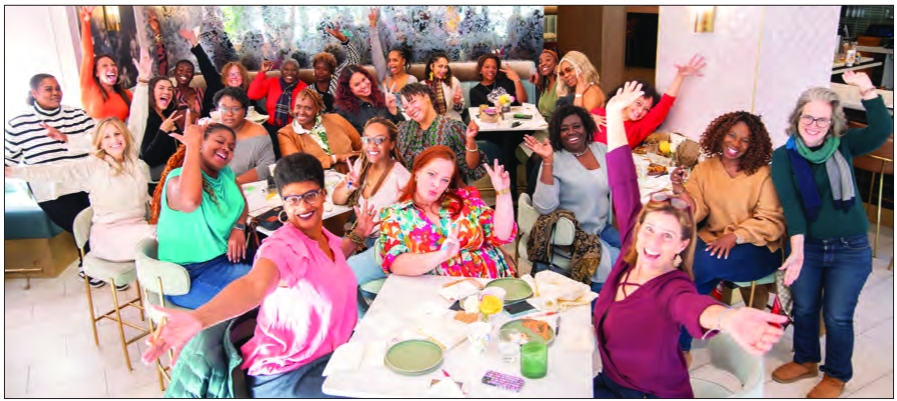
First brunch of women she spoke to that led to her launching Seed and Grow collective.A local award-winning diversity and inclusion strategist, author and entrepreneur recently launched an inaugural collective to support women of color in wellness and healing careers. The Seed and Grow program is now under the umbrella of Malia Lazu’s Sunflower Spa, dubbed a “sanctuary for all women, regardless of body or biology, where we celebrate safe healing and sensuality for everyone,” according to its website.
Members will receive support with their business infrastructure, professional growth and marketing and visibility needed to sustain long-term success.
“I hope that these healers find one another and are able to build their own mutual aid society, because that’s the only way you actually build an economy. Economy isn’t just demand and supply.
It’s who controls the demand and supply, and having a collective of healers will help us heal women quicker,” said founder Lazu, who created the platform in response to a frequent issue that professionals in the healing and wellness space face. “Meaningful work,” she said, “often gets built without enough support behind it.”
Early ideas for what the collective could look like were discussed in talks with about three hundred local women in similar careers.
Their experiences gave Lazu the affirmation she needed to step out and start this platform and collective.
“What
became obvious is that outside of women’s restrooms at clubs, there’s
not a lot of places where women who don’t know each other can come
together and love one another. The [community] response was really quite
positive,” she said.
Those
conversations revealed another reality: “the healing economy is so
fragmented.” Comparing the work to the music industry, Lazu explained
that it can be difficult to find fellow wellness practitioners, who may
be operating in niches or — barring intentional marketing strategies —
fly under the radar more broadly.
Inaugural
collective member Myisha Battle shared Lazu’s excitement of having a
shared space for support. The author of “Sexual Pleasure for Dummies”
said navigating the wellness space on her own was isolating.
“For
years, I’ve navigated the sexual wellness space largely on my own, and
that has meant dealing with platform restrictions, burnout and the
pressure to keep going without enough support. Seed and Grow offers a
community and infrastructure that can help practitioners like me stay
visible and sustainable,” Battle said.
Lazu
also spoke to why this project and collective, which centers the work
of sexual wellness and healing practitioners, is important to have in
the community.
“I
think especially as Black women, the narratives that we’re given. … The
worst thing you can be is a fast girl. We actually are quite
conservative when it comes to pleasure,” she said, adding that women
must embark on healing to build stronger, more whole communities.
“Allowing
women to be their whole selves and allowing them to not have shame
around their bodies or pleasure is the only way women are actually going
to build a world that is healed,” she said.
Lazu
believes some of the reason for the isolation in the wellness fields
has to do with shame or guilt around rest and pleasure.
“Yes, there’s the sexual pleasure, which is probably where the most shame and guilt comes from, but you’ll hear women
feeling guilty about taking a bath — giving themselves five minutes [to
bathe]. I think it’s the narrative of what it means to be a productive,
strong, Black woman in America,” she said.
She said that she also hopes to learn from the collective, sharing that she has already begun to learn much from the members.
“For
me, what I’m learning is how to continue to stand in my own power,
continue to welcome and be open to my own vulnerabilities and give
myself permission in places that society hasn’t.”
Although
Lazu has learned so much from taking on this endeavor in the healing
and wellness space, she is still overcoming the obstacle of securing
more sustained funding for the new collective, which members join for a
small monthly fee. While they have secured a couple of individual early
funders, they are seeking investors who see the vision and can help the
collective in “scaling quickly.”
Her
dreams for the resource and community collective extend well beyond the
Boston area, to reach wellness practitioners in business nationwide.
“I
hope that what we actually create is a true collective, where we have
healers from around the country who want to be accessible to Black and
brown women and want to continue to help women stand in their purpose,
power [and] pleasure,” Lazu said.