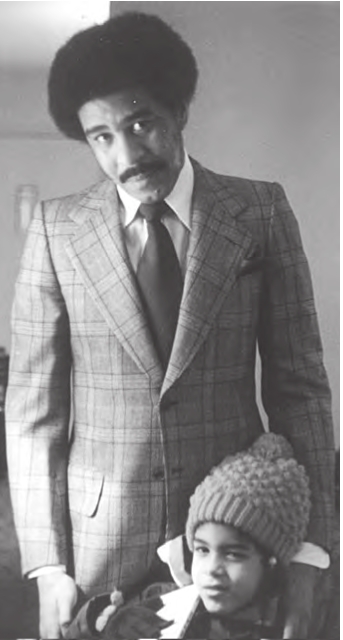
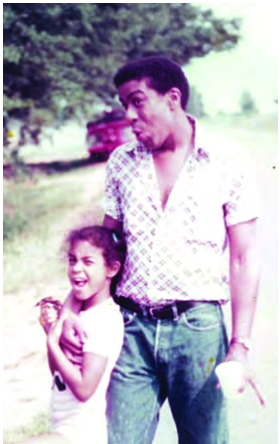
Richard Pryor and daughter Elizabeth Pryor
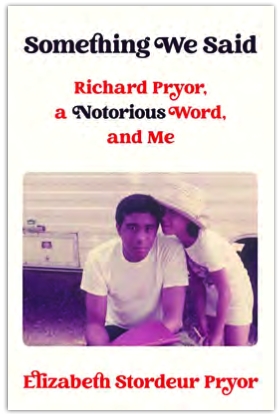
Richard Pryor’s daughter takes on the n-word in her new memoir ‘Something We Said: Richard Pryor, a Notorious Word, and Me’
“Something We Said: Richard Pryor, a Notorious Word, and Me,” is more than Elizabeth Stordeur Pryor’s story of her relationship with her famous comedian and actor father. She writes that the book is “a hybrid memoir and historical exploration of the n-word.” Pryor’s writing creates an intimacy that invites readers to feel as she felt: vulnerable, smitten by her father’s courage and genius and inspired by the danger of his honesty as a writer, performer and actor.
Growing up Black and Jewish
outside Boston, Pryor met her dad for the first time at age six, after
her mother Maxine Silverman wrote him a letter “filled with anguish,
(and) pleaded with him to do right by his daughter.”
After
an arranged meeting with him while he was on tour in Newark, New
Jersey, Elizabeth and her mother moved to Los Angeles to be closer to
Pryor. She entered his orbit and we read about his classic concert
movies, co-writing of “Blazing Saddles” and struggles with substance
use.
In “Blazing
Saddles,” director Mel Brooks wanted the n-word removed from the script.
White folks used it in the movie to confront Cleavon Little, playing
the role of their new Black sheriff, as he rode into town preceded by
the Count Basie Orchestra playing “April in Paris.” Pryor insisted that
the n-word stay in the picture, showing racism you never saw in classic
Hollywood westerns. Woven into the American consciousness, the n-word
was normalized. Pryor demonstrated the word’s abnormality.
Elizabeth
Pryor is a professor at Smith College in Northampton, where her
research focuses on 19th-century U.S. history and race. Her essay, “The
Etymology of [the N-word]: Resistance, Language and the Politics of
Freedom in the Antebellum North,” won the Ralph D. Gray Prize for the
best article of 2016 in the Journal of the Early Republic.
The Banner caught up with her last week.
Banner:
Your book has an intimate tone and readers can feel as if you’re
speaking to them. Given that the book is in measure about your
experiences with “the n-word” it provokes readers to consider their
experiences with that word. Can you comment?
Pryor:
I wanted the book to be a jumping off point for a conversation that my
students pushed me to have — it’s increasingly important as a society. I
hope the book prompts conversation about race and context. The ways in
which the racial history of the United States creates entanglements in
our lives.
You
write in the book of a white student in your classroom quoting a line
from “Blazing Saddles” and saying the n-word itself. When did that
happen?
February
2010 and it shook me. I was teaching a course in 19th-century history,
the Civil War. I still teach the course only now I call it “Emancipation
and the Afterlife.”
British author Reni
Eddo-Lodge wrote a book called “Why I’m No Longer Talking to White
People About Race.” As a professor at Smith, you must feel differently.
I
get it. One of my Black students gave me a T-shirt that reads,
“Whiteness Is Exhausting.” There’s a way in which having to explain
yourself that’s exhausting. How can you debate someone else’s experience
when you don’t know what you’re talking about?
You’re
at a unique juncture: as a historian and as the daughter of Richard
Pryor your analysis of the n-word is informed by your father and your
academic research. Was there divergence in these?
My
father had a different experience growing up than I did facing
different types of inequity and social injustice. What separates me and
my father about the word has to do with coming at it from such different
angles. In the late 1960s, my father was appearing regularly on
latenight talk shows. Then he had an epiphany in 1967: He realized that
his own grandmother would not be welcome in the audience; this was in
Las Vegas. And although he was inspired by vaudeville, he felt it was
important to tell his own
truth. He took a risk with himself and decided to tell stories that were
not respectable by American standards: about police brutality, racism,
poverty, alcoholism, corruption and growing up in a brothel. He told
these stories in an authentic Black voice.
Which was inspiring.
He
won five Grammy awards for his comedy albums. Two of the albums had the
n-word in the titles. Ice Cube and other rappers credit him with
inspiring them to use the n-word in their music as a way to confront
racism.
Then, after his trip to Africa he stopped using the n-word in his performances.
Right.
In 1979, after reading Alex Haley’s book “Roots,” he and many others
developed more interest in one’s own genealogy. He decided that in this
new context that the n-word is an expression of the wretchedness of
Black people in the United States. His decision to stop using the word
was as cutting edge as his initial decision to use it.
Was there one most difficult challenge in writing the book? Or was it a series of challenges?
It
was a series of challenges building on each other. One difficulty,
especially as an academic, was writing about myself. The honest and most
rewarding part was getting to grow up as a narrator. A lot of what
happened to me was locked in time: I’m 11 at that moment, I’m 15 at that
moment, I’m 7 at that moment. I had never brought my womanhood and
scholarly self to that conversation. Writing the book was gaining
control of the narrative. It allowed me to step into that love. I loved
my dad. Writing the book was so healing.
For
those of us who idolized your father, your descriptions of what he was
like as a father and man, independent of family, are nuanced and very
compassionate. His vulnerability, at least for me, was at the heart of
his work.
His
vulnerability was what made him able to deal with heavy stuff from choke
holds to women getting raped. Audiences went there with him. His
vulnerability makes that possible.
His humility. Vulnerability to me is the chief characteristic of my father. It’s what I aspire to, to be that real.
ON THE WEB
Learn more at simonandschuster.com/books/Something-We-Said