
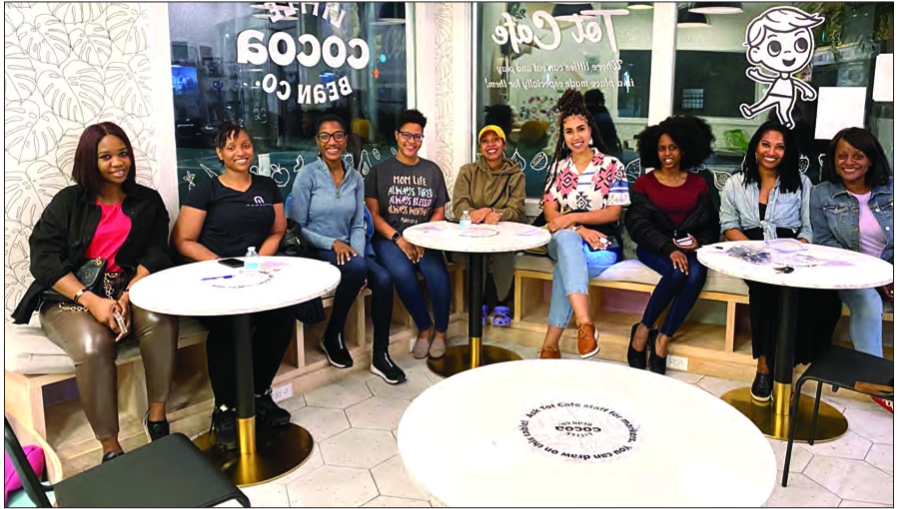
The Melanin Mass Moms neurodivergent support group in Boston.
When Julia Lotin became a mother in 2018, she went looking for community. Instead, she often found herself the only woman of color in new mother support groups.
“Postpartum can be really isolating, and I wanted community,” Lotin told the Banner.
She wanted other mothers who could relate to experiences ranging from locating a mental health provider of color to finding hair products for their babies. That November, she created a Facebook group.
Eight years later, Melanin Mass Moms has roughly 6,000 Facebook members and has grown into a nonprofit offering support groups, wellness programs, doula assistance and programming.
On Sunday, Aug. 9, from 4 to 6 p.m., the organization will host a free gathering for mothers of neurodivergent children at Modern Party Art in Dorchester; children are welcome to attend. Previous gatherings have included sensory toys, painting and coloring activities, soothing music and food while mothers talk in what board secretary Sasha Smith describes as a low-key, accepting environment.
Smith’s path to creating the support group began with her son. After he was diagnosed with autism in 2021, shortly before his third birthday, she began navigating local resources, including applied behavior analysis therapy and early intervention supports. As she learned more, she witnessed other mothers asking similar questions and seeking support.
Smith said she thought having a support group for mothers of neurodivergent children would be helpful. She acknowledged the unique and challenging journey these mothers face compared to mothers of neurotypical children, including delayed or incorrect diagnoses; an initial lack of knowledge and resources to properly care for and advocate for their children in academic and social settings; overwhelm and stress; and a lack of culturally competent teachers and medical professionals in their child’s care team.
The group began meeting in 2024. About 15 mothers typically attend, Smith said; autism is the diagnosis she hears about most frequently.
But the meetings are not solely about services or diagnoses. Smith said there is relief in being around parents who understand without requiring an explanation.
“There is a comfort there in knowing that these are moms who have been through similar situations that you’ve been through, and sometimes you don’t have to explain,” she said.
That community can be particularly important as families confront institutions that are difficult to navigate. Smith described repeatedly advocating for appropriate evaluations and school placement for her son.
“I’m still terrified. It still keeps me up at night because I know that this is going to be a lifelong fight,” Smith said.
She worries especially about what happens as her Black son grows older and may increasingly be perceived as a threat. Her concerns coexist with broader inequities facing Black mothers.
In 2024, the U.S. maternal mortality rate was 17.9 deaths per 100,000 live births, according to the U.S. Centers for Disease Control and Prevention. For Black women, it was 44.8 deaths per 100,000 — more than three times the rate for white women.
Massachusetts performs better than many states on maternal health measures, but racial disparities persist. The Massachusetts Department of Public Health reported that severe maternal morbidity nearly doubled between 2011 and 2020. By 2020, Black non-Hispanic women experienced severe complications at 2.5 times the rate of white non-Hispanic women.
The United States also trails comparable wealthy countries. A 2024 Commonwealth Fund analysis of 14 high-income nations found that the United States had the highest maternal mortality rate. It was also the only country studied without a national guarantee of paid maternity leave or postpartum home visits.
Massachusetts has expanded some supports. MassHealth now covers doula services during pregnancy, delivery and for up to 12 months postpartum. A 2024 maternal health law also expanded coverage for postpartum home visits, while eligible Massachusetts workers can receive paid family leave to bond with a child.
Yet eligibility requirements and affordability continue to leave families between systems. Lotin said mothers in Melanin Mass Moms frequently report making too much income to qualify for child care assistance while earning too little to comfortably afford care. Others struggle to find culturally competent doctors or mental health professionals.
“There’s definitely a lot of [Facebook group] posts around food insecurity,” Lotin said, along with mothers seeking child care, financial assistance and providers who understand their experiences.
Funding has allowed Melanin Mass Moms to address some of those gaps directly.
Boston Women’s Fund has supported the organization since 2023, when, Lotin said, it became Melanin Mass Moms’ first foundation funder. Before that, the organization was largely self-funded and had encountered a frustrating obstacle: grantmakers sometimes wanted applicants to already have a history of receiving grants.
“Boston Women’s Fund has definitely opened the doors,” Lotin said.
Melanin Mass Moms received $20,000 in unrestricted operating support this year, plus a $5,000 wellness grant that can support rest and well-being for its volunteer leadership.
Boston Women’s Fund CEO Natanja Craig Oquendo said smaller grassroots organizations are too often overlooked precisely because they lack the staffing and infrastructure that increased funding could provide.
“We overlook the smaller organizations and we blame them because they don’t have the bigger budget,” Oquendo said. “It’s a resource issue. It’s not a leadership issue.”
Oquendo said supporting organizations such as Melanin Mass Moms is particularly important during what she described as “a really hard political moment for women, and specifically women of color.” Her hope, she said, is not only that the nonprofit’s programs continue, but that its leaders have the capacity to rest and remain whole.
That philosophy is reflected in Melanin Mass Moms’ gatherings: Mothers can receive information, but they can also talk, laugh, share frustration and be understood.
For Lotin, that remains the heart of the organization she created because she needed the same thing herself.
“I want people to believe moms of color. Believe Black moms and listen to them, support them,” Lotin said. “We want to go into births feeling safe and joy instead of fearful. We deserve to be celebrated.”