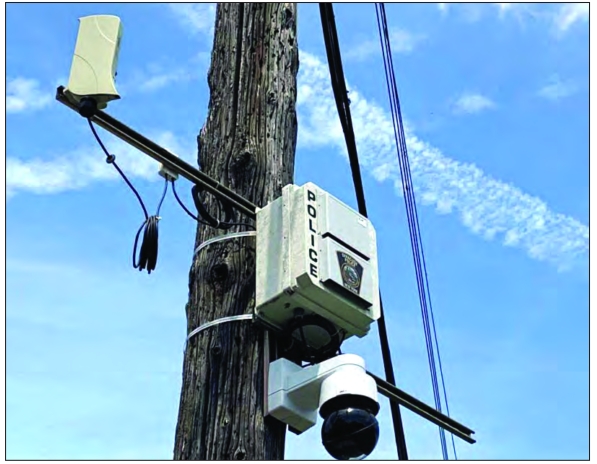
ShotSpotter equipment has received a mixed response from certain communities in combating gun violence. GBH NEWS
A fatal shooting in Cambridge on the Fourth of July that claimed the life of a 32-year-old city resident and public works employee has reignited a debate over the City Council’s recent decision to abandon the use of audio technology called ShotSpotter meant to detect gunshots and alert police.
While detectives from Cambridge police and the Middlesex District Attorney’s Office investigate the death of Xavier Bautista — whose body was found around 5:30 a.m. near the intersection of Broadway and Norfolk streets — local police say Bautista’s life might have been saved if ShotSpotter sensors were still activated in Cambridge.
“If ShotSpotter detection was received at the time of this incident, Cambridge emergency personnel would have had the opportunity to discover the scene much sooner,” stated a joint statement from the Cambridge Police Patrol Officers Association and Cambridge Police Superior Officers Association on Monday. “There was no opportunity for the victim to receive emergency aid for approximately 60 minutes. This is directly related to the City Council’s mandate removing ShotSpotter technology from deployment in Cambridge.”
Police
believe Bautista was shot shortly before 4:30 a.m., about an hour
before a pedestrian saw his body and called 911. The shooting death
comes less than two months after a majority of city councilors voted to
stop Cambridge’s use of the gunshot detection surveillance system. The
debate highlighted national concerns about gun violence as well as
heightened concerns about government surveillance.
Councilors
backing the move to end the contract said ShotSpotter risks violating
residents’ privacy and data being potentially accessed by federal law
enforcement. But other councilors pushed back, arguing the technology
helped police respond quickly to emergencies.
Cambridge
City Councilor Patricia Nolan said there is not enough information to
determine if ShotSpotter sensors could have prevented the death of
Bautista.
“It’s irresponsible to assert that (ShotSpotter) would have made a difference because we
don’t know,” she told GBH News Tuesday. “We should let the investigation
conclude and not jump to conclusions about whether any technology could
have prevented this sad tragedy. We also know it was on a Fourth of
July weekend when there’s lots of sounds that can be confused for
gunshots that may have also overwhelmed the system.”
SoundThinking
Inc., the company behind ShotSpotter, said in a statement that the
death of Bautista “underscores a devastating reality that public safety
agencies confront every day: more than 80 percent of gunfire incidents
are never reported via 911.”
“Generally,
immediate response to a gunfire incident significantly increases the
likelihood that relevant physical evidence will be recovered and
potentially life-saving medical aid administered.”
However,
Kade Crockford, director of the Technology for Liberty Program at the
ACLU of Massachusetts, has argued that gunfire detection systems
deployed in American cities have high rates of misidentifying sounds as
firearms-related, saying “ShotSpotter is not an effective tool. It
produces error rates that are astonishingly high.”
Two
Cambridge city councilors who voted to keep ShotSpotter criticized
their board’s action in May, writing in the Boston Globe that the action
was based on fear and ideology and “rejected a tool that could help
save lives.”
“People
may stay silent out of fear, confusion, or mistrust,” wrote Councilors
Tim Flaherty and E. Denise Simmons. “In recent years, shootings and
gun-related incidents involving youth from Cambridge and neighboring
Somerville have shaken neighborhoods and raised serious questions about
response time. Even if no one is killed, the damage is real: families
frightened, streets disrupted, and residents left wondering whether help
will arrive in time.”
This story first
appeared on GBH News. Chris Burrell is an investigative reporter at the
GBH News Center for Investigative Reporting.