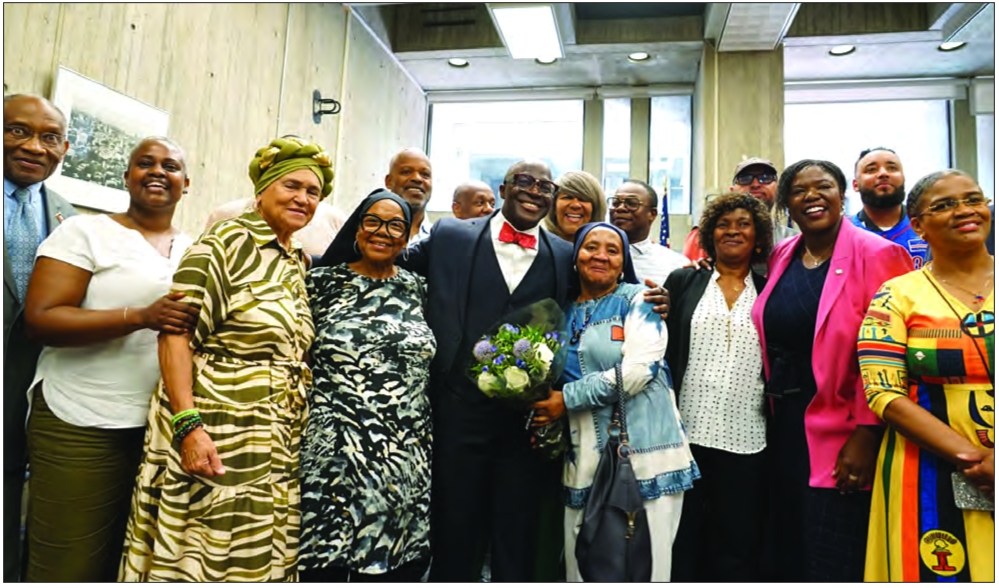
Former BPD Deputy Superintendent Eddy Chrispin is honored by friends and supporters at City Hall.City councilors and community members gathered at City Hall last Wednesday to honor former Deputy Superintendent Eddy Chrispin, who retired from the Boston Police Department after more than 26 years on the job.
A former president of the Massachusetts Association of Minority Law Enforcement Officers (MAMLEO) and founding member of the Haitian-American Law Enforcement Community, Chrispin was lauded by his former colleagues on the job as well as civic leaders active in Boston’s Black community.
“When he was up in the Grove Hall community, Eddy was one of the first officers that was really involved in community policing,” said Sister Virginia Morrison, executive director of the Grove Hall Neighborhood Development Corporation.
Morrison noted that Chrispin has joined the board of her CDC and helped the organization in its efforts to improve the area. In recent years, as people with substance abuse addiction began occupying the municipal parking lot in the area, Chrispin helped manage the situation.
“Prior to retirement, Eddie was in that municipal parking lot helping to take care of that situation,” Morrison said. “If you talk about a police officer, you might say he’s an officer, sergeant, captain, deputy superintendent, whatever — Eddie was always the community officers’ officer. He was a community person. He talked to our youth. He worked with our youth — and it wasn’t just the good ones.”
District
7 Councilor Miniard Culpepper, who is pastor at the Pleasant Hill
Baptist Church, said Chrispin was instrumental in reducing gang violence
in the Black community.
“For
me, it’s bitter and sweet because we hate to lose him on the police
department,” he said. “I can’t call him as a police officer anymore. But
the sweet part is that he’s going to be in the street with me fighting
on the outside now.”
Chrispin’s
fights weren’t just against criminal activity. As head of MAMLEO, he
fought for the rights of Black and Latino officers in a department that
for decades engaged in patterns
of discrimination and disparate treatment of officers of color. His
commitment to criminal justice reform at times put him in the crosshairs
of police brass. Last year Chrispin was demoted from his role as a
deputy superintendent after he was appointed to the Police Officer
Standards and Training board, a state-mandated entity responsible for
ensuring officers and departments are held accountable for illegal or
unethical activity.
Chrispin’s
demotion drew protests from Massachusetts Attorney General Andrea
Campbell and local elected officials and community members. But Mayor
Michelle Wu stood by Police Commissioner Michael Cox’s decision.
In
his remarks at City Hall last Wednesday, Chrispin made no mention of
his demotion, but instead said it was time for him to move on and
pledged to remain involved in community work.
“I
know for me, policing is not about just law enforcement,” he said.
“It’s really about engaging with people, regardless of what the
circumstances are. As someone who started off as a social worker, I know
firsthand that a lot of the people that police engage and interact
with, they end up in those situations based on socioeconomic conditions,
for the most part.”
Chrispin
told the city councilors, community members and police officers
gathered at City Hall that he believes the city should invest more in
crime prevention, echoing a theme many in Boston’s Black and Latino
communities have sounded in recent years.
“One of the things I always
say is that if a young person commits a crime ... we decide that we are
going to incarcerate them,” he said. “We never say there’s not enough
money to spend to incarcerate somebody. But at the same time, we always
lack the means and ability to invest in young people at the early stage
of their lives.
“If
we’re going to fix this thing that we call crime, that everybody battles
with, dysfunction, whatever it is that you want to call it, we have to
invest in young people. We have to invest in families, not on the back
end when they, unfortunately, hurt somebody, generally, who is somebody
from their communities.
“So,
I know I’m walking away from policing. I’m not walking away from
engaging and dealing with some of the social issues we deal with. I just
felt I was at a point in my career where this was no longer
sustainable. As much as I love community, it was no longer fulfilling to
me, not in that uniform.”
At-large
Councilor Ruthzee Louijeune said she is looking forward to working with
Chrispin in whatever post-policing role he takes on next.
“There
are so many people in this room and outside of this room who owe a debt
of gratitude to you for your mentorship, how to make sure we are
thinking about and always doing the work of community policing and
really centering the needs of all our residents,” she said. “We know
that this is not goodbye. We know that you are still going to be
centered in the work.”