YouthConnect
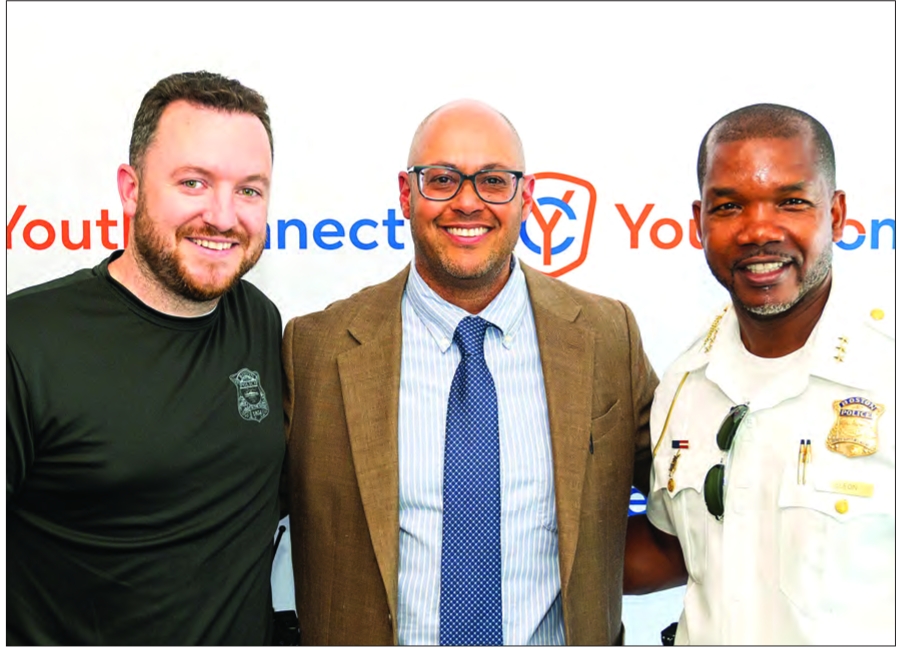
Executive Director Kevan Barton, center, stands with community partners
at a ribbon cutting on June 25. The newly independent nonprofit
connects youth to mental health services when interfacing with police.For the last 30 years, Youth-Connect operated inside Boston Police Department stations as a program of the Boys & Girls Clubs of Boston, quietly building one of the city’s most unusual partnerships between law enforcement and mental health care. On July 1, that program became an independent nonprofit — a shift its leaders say will deepen, not disrupt, the work.
“Becoming an independent organization [and] nonprofit actually allows us to expand our specialized mission,” said Kevan Barton, executive director of YouthConnect.
The organization’s work is built around a simple but rare model: licensed clinical social workers embedded in Boston police district stations, working alongside officers to reach young people and families at some of the most difficult moments in their lives.
What started with a single social worker in one station has grown to a presence across 10 district stations and citywide units, with a network of more than 275 community partners. The organization serves youth between ages 10 and 24 whom officers flag as needing support — not after a crisis has passed, but often in its immediate aftermath.
The staff works with police and community organizations to provide mental health examinations and counseling to youth who face safety concerns for themselves or others. Sometimes these patients have experienced post-traumatic stress syndrome or exhibit other mental health behaviors, which is when social workers step in.
The need is significant. An estimated 65-70% of youth involved in the juvenile justice system have a diagnosable mental health
condition, according to YouthConnect, and many of their families face
steep barriers to consistent care. One of the most deliberate choices
the organization has made to address that gap is declining to bill
insurance.
“Our
biggest driving point is that we do not accept insurance, which means
that that lessens the barriers to helping these families,” said Shakina
Coplin, a Roxbury native and clinical social worker embedded at the
Roxbury Police Station.
Families
can stay on Youth- Connect’s caseload anywhere from six months to a
year or longer without the constraints that insurance mandates typically
impose, she said. “Sometimes we really watch our clients grow up
because of the fact that we don’t accept insurance.”
Barton said operating
outside that system gives YouthConnect’s clinicians room to build
something insurance timelines rarely allow for: trust. For him, the work
carries a personal weight.
The
impact of growing up with an incarcerated parent — and the ripples of
that absence — has shaped how he thinks about YouthConnect’s purpose.
“If
I can help to change the trajectory of just one young person’s life, I
know that that’s actually changing the trajectory of an entire
neighborhood and community,” Barton said.
Being
located inside a police station, Coplin said, allows her to meet young
people at their most vulnerable moments — sometimes the instant they
walk through the door — while giving officers a close-up view of
trauma-informed care in action.
“We
get to provide them with that education about how trauma impacts the
body, and how it can lead to certain behavior manifestations,” she said.
That visibility, she added, helps officers connect differently with the
community once they’re back out on patrol.
Barton
said YouthConnect’s new independent nonprofit status won’t change the
day-to-day services families rely on. Free clinical support, case
management and wraparound resources will continue exactly as before.
What
will change is Youth- Connect’s ability to pursue mission-aligned
funding, build its own identity and deepen partnerships that were
sometimes constrained by shared branding with a larger organization.
The
relationship with Boys & Girls Clubs of Boston isn’t ending, Barton
emphasized; it’s becoming one partnership among many.
Funding
going forward will continue to come from a mix of private philanthropy,
city and state government support, individual donors and signature
fundraisers, including the recent Unity Games and an annual partnership
breakfast scheduled for Nov. 5.
Both
Barton and Coplin said success looks different for every family they
work with — sometimes it’s a teenager reenrolling in school; sometimes
it’s a family finding stable housing; sometimes it’s simply a young
person having one adult outside their family they trust enough to talk
to.
“It’s those small wins that keep us going,” Coplin said.
Barton
put it in broader terms. “Every young person deserves to know that they
matter,” he said. “Every young person deserves to know that their
narrative does not end.”