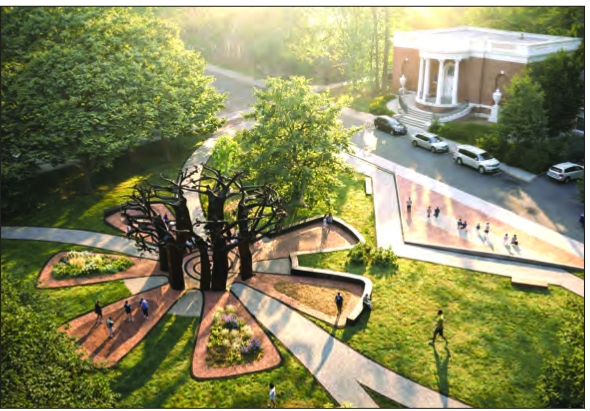
An aerial rendering of ROOTED, a forthcoming design in Charlottesville, Virginia by Boston-based architecture firm MASS.
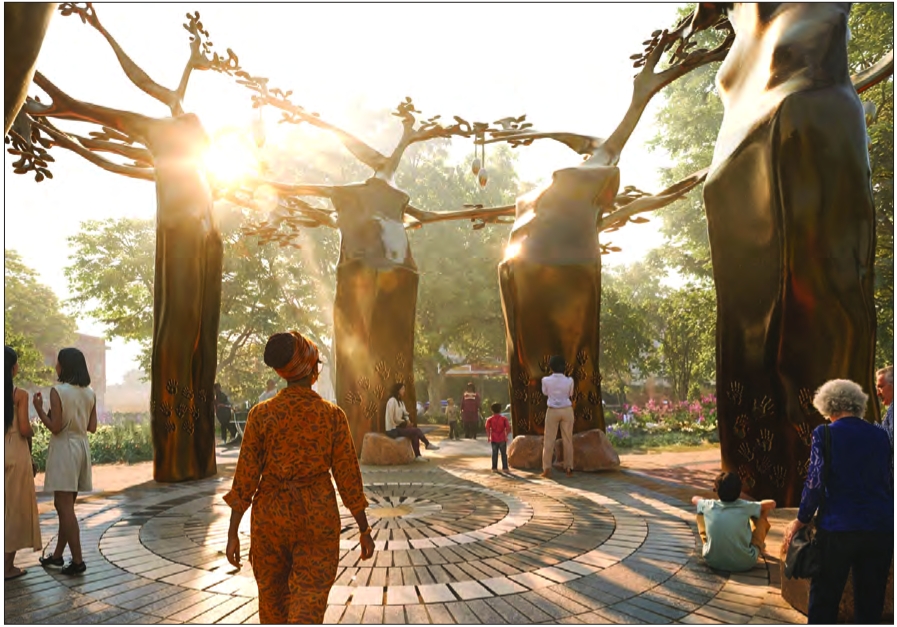
An
interior rendering of ROOTED, which will transform the melted bronze
from Charlottesville’s former Confederate monument into a new civic
landmark, designed by Boston-based architecture firm MASS.When Charlottesville, Virginia, officials announced the winning design transforming the bronze from the city’s former Robert E. Lee monument earlier this month, they selected more than a public artwork.
They chose a Boston-based architecture firm whose work has increasingly centered on how communities remember difficult histories and how public spaces can help tell more complete ones.
Model of Architecture Serving Society, known as MASS, and Oakland, California, sculptor Dana King were selected by a team at the Jefferson School African American Heritage Center to lead the next phase of Swords Into Plowshares, a community-driven effort to transform the melted bronze from Charlottesville’s former Confederate monument into a new civic landmark called ROOTED.
The MASS design proposal was selected after nearly 1,000 residents participated in a months-long public engagement process, with 64% ranking ROOTED as their first choice.
Organizers
aim to unveil completed work around the 10th anniversary of the 2017
Unite the Right rally, when white supremacists gathered in
Charlottesville to protest plans to remove Confederate monuments. The
violence left dozens injured and claimed the life of counterprotester
Heather Heyer.
For Jha
D. Amazi, who leads MASS’ Public Memory and Memorials Lab, the
commission represents an opportunity to ask what comes after a divisive
monument and symbol of violence comes down.
“The
material itself carries memory,” Amazi wrote in an emailed statement.
“Rather than pretending that history never happened, this project asks
what becomes possible when a community collectively decides to reshape
it.”
At the center of
ROOTED is a baobab tree, a symbol found across Africa and the African
diaspora that represents resilience, longevity and gathering.
Rather
than replacing one towering figure with another, the proposal envisions
a 27-foot pavilion supported by seven treelike trunks where people can
gather, rest, celebrate and reflect. Gardens, community gathering
spaces, handprints cast by residents and descendants and baobab-inspired
sculptures placed throughout Charlottesville extend the project beyond a
single monument into a celebration of the broader civic landscape.
“The
baobab embodies many of the ideas this project is trying to hold
together,” Amazi wrote. “Unlike a monument that elevates a single
individual, a tree creates space for people to come together. People
rest beneath it, tell stories, celebrate, grieve and build community.”
She noted the design intentionally avoids replacing one heroic symbol with another.
“We
wanted to imagine a place that invites participation rather than
reverence — a place where history is acknowledged, but where the future
is created collectively.”
That
philosophy reflects the mission of MASS, the Boston nonprofit founded
in 2008 to explore how architecture can advance justice, health and
human dignity.
Working
across architecture, landscape architecture, engineering, research and
public memory, the organization has completed projects throughout the
United States, Africa and Latin America.
In
2022, the American Institute of Architects awarded MASS its
Architecture Firm Award, the organization’s highest honor for an
architecture practice, recognizing its community-centered approach to
design.
The firm’s work is already familiar to many Bostonians.
MASS
partnered with artist Hank Willis Thomas on “The Embrace,” the Boston
Common memorial honoring Rev. Martin Luther King Jr. and Coretta Scott
King. The firm also collaborated with artist Harmonia Rosales on
“Unbound,” the King’s Chapel Memorial to Enslaved Persons, which
recognizes hundreds of enslaved and free Black people connected to one
of Boston’s oldest churches.
Amazi noted that Boston’s history continues to shape the firm’s approach to public memory.
“Boston
is a city where history is constantly present,” she wrote. “Every
neighborhood reflects layers of stories — some celebrated, some
overlooked and some deeply contested.”
Projects such as “The Embrace” and “Unbound,” she noted, reinforce an important lesson.
“Meaningful public memory begins with listening,” Amazi wrote. “Every community has
its own history, its own aspirations and its own relationship to place.
Our role isn’t to bring predetermined answers to Charlottesville, but
to help create the conditions for the community to shape a future that
reflects its own values while acknowledging its full history.”
That
emphasis on public participation also shaped the Charlottesville
proposal. During the selection process, residents repeatedly called for a
design centered on gathering, accessibility, education and
transformation.
“People
spoke about welcome, healing, gathering, children’s play, beauty and
creating a park that belongs to everyone,” Amazi wrote.
“Those priorities directly informed ROOTED.”
She noted that architecture alone cannot determine whether a place becomes welcoming.
“Architecture can create the conditions for belonging,” she said, “but communities are the ones who make it real.”
The
selection of ROOTED marks the beginning, rather than the end, of the
design process. MASS will continue working with the Jefferson School
African American Heritage Center, descendants, community members and
local stakeholders as the project evolves.
When
asked what she hopes someone standing beneath ROOTED will feel decades
from now, Amazi’s answer reflected beyond Charlottesville.
“We
hope they feel welcome and that they experience the park as a place
where people gather together — to play, to reflect, to celebrate, to
learn and simply to be together,” she said.
“Most
of all, we hope this is no longer groundbreaking and in more places we
see evidence that transformation is possible — that even materials once
used to uphold exclusion can become part of a place defined by
belonging, care and shared responsibility for one another.”