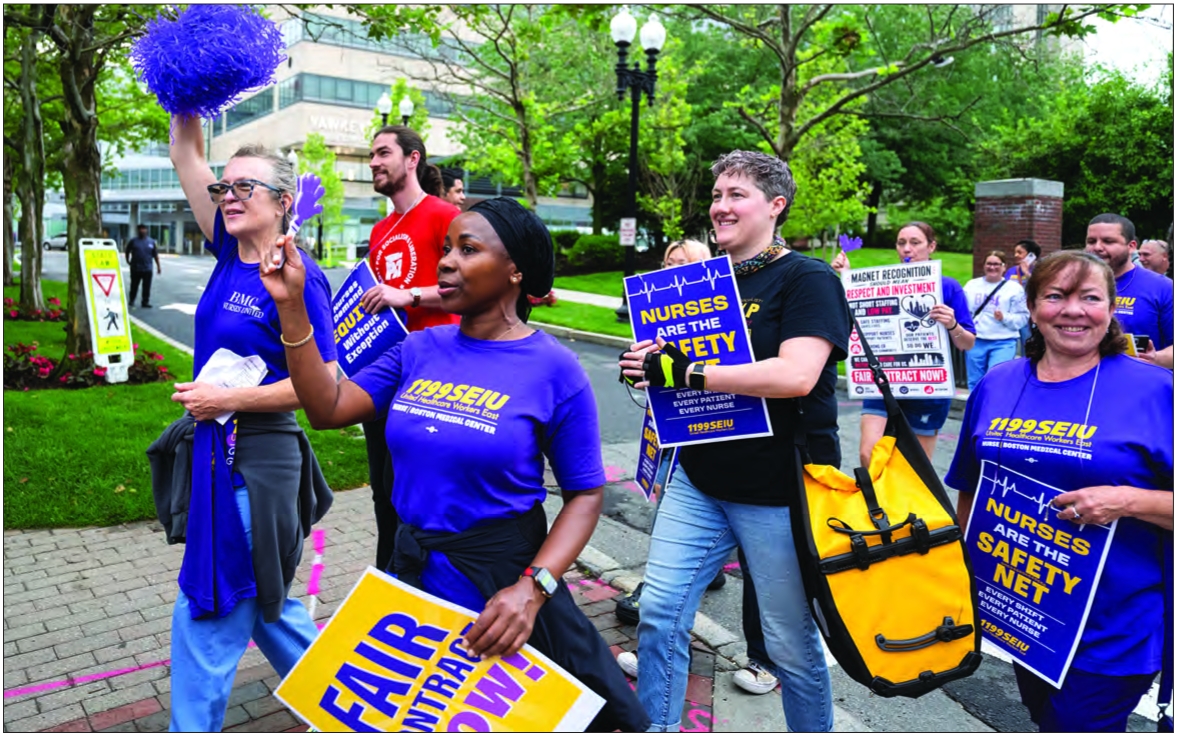
Boston Medical Center nurses and families picket as contract negotiations for safer working conditions and fair wages continue.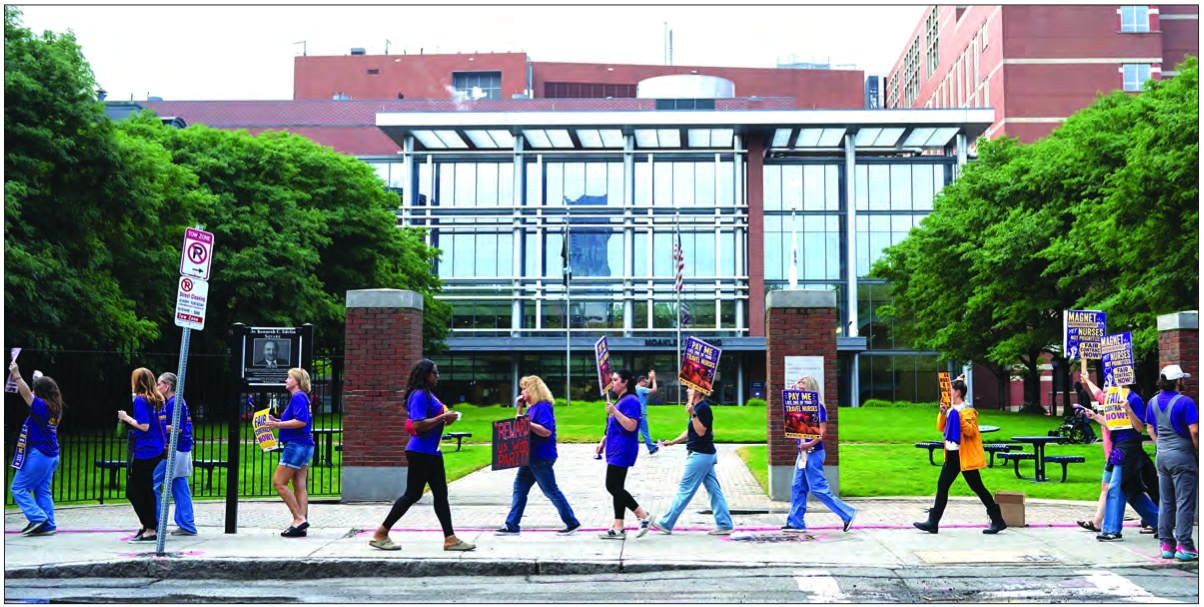
Picketing took place outside the Boston Medical Center main campus (above) and the BMC Brockton Behavioral Health Center.

Nurses say the environment has led to burnout and high staff turnover at the hospital.
Joined by their families, pets, children and several elected officials, over 1,100 Boston Medical Center (BMC) nurses picketed in front of the South End teaching hospital last Wednesday. Today they picket for a second consecutive week, now accompanied by residents and intern doctors as contract negotiations continue.
Nurses are advocating for safety provisions for travel nurses and AI in the administration of narcotics, as well as for compensation and time off in parity with other major systems locally.
“Having a fair contract would mean better retention and more sustainability. It offers a continuity of care. … We’re gonna get to know the patients even more instead of just having a new face every time a patient comes into the door,” said Julia Doherty, a pediatric nurse at Boston Medical Center who picketed last week.
“We’re fighting for a better and safer work environment as well, which will help the general public in turn. … It’s not just about the wages; it’s about the bigger picture,” Doherty said, adding that the existing contract “makes it difficult for us to truly work or live in the community that we serve.”
One of their disputes is a proposed $125 spousal charge on top of rising health insurance premiums, which could amount to an additional $250 for employees insuring family members.
Their protests come just weeks after the largest nursing strike in state history when over 4,000 Brigham and Women’s nurses stopped work on July 13. Momentum for safer working conditions at BMC has been mounting for decades.
The largest health care union in the nation, 1199SEIU United Healthcare
Workers, confirms that BMC offers the lowest wages for nurses in
Massachusetts. The system serves and employs high numbers of Black and
immigrant residents in the Boston area; many of its patients are also
unhoused or living with substance use disorders.
“Boston
Medical Center is a lifeline for families across Boston and the
commonwealth, providing care to everyone who walks through its doors,
regardless of their ability to pay or immigration status. The nurses
make that mission possible, caring for patients under some of the most
demanding conditions in health care,” State Sen. Liz Miranda, who is
also a patient at BMC, said in a statement to the Banner.
“As
someone who has been treated by these nurses and deeply understands the
importance and difficulty of the work they do, I’m proud to stand
beside them as they advocate for fair wages and better working
conditions,” she added.
Union
representatives are say they are hopeful they can reach an agreement
with the system over the last two scheduled meetings, which extend into
August, before exploring a strike.
In
a statement issued Wednesday, BMC said it values the contributions of
the nurses and will continue to work toward an agreement that affords
competitive wages and long-term sustainability for the hospital.
However,
some nurses are skeptical the system will heed all their concerns after
an early July bargaining meeting before the first picket. Originally
scheduled for 8 a.m. to ensure that some nightshift workers could
attend, hospital bargaining committee members did not arrive until 11
a.m., which was seen as union busting.
“Nurses
worked overnight and they’re taking time out of their sleep schedule to
come and hear about their future in the hospital. [Hospital
representatives] can’t even show the decency to show up on time. It’s
like a slap in the face to the staff that works here,” Doherty said.
“We’re
all just on edge about the potential of a strike. No one wants to, but
if that’s what we’re gonna have to do, then we’re all gonna do it, arm
in arm,” Doherty added.
Because
of their inadequate wages and specialty care, nurses say the
environment has led to burnout and high staff turnover, in turn creating
a reliance on travelers and contractors who are put to work with
minimal training but high responsibility.
Under
existing contracts, travelers can serve as charge nurse and precept,
providing leadership, training and mentoring in a context they may have
only worked in for days.
“Some
stay on for very long periods of time and are being referred to as
permanent travelers, and that’s unacceptable,” said Cari Medina,
executive vice president of 1199SEIU United Healthcare Workers East.
Nurses
in the emergency department, like Doherty’s husband, have been
especially concerned about the overuse and limited training for travel
nurses who do not have the institutional context or trust to support
frequent patients.
“It puts somebody in a dangerous position that is
covering the shift because they don’t know how the patient is reacting
to certain things and how to de-escalate.
It’s a huge safety thing to have the same staff be able to work here, continuously,” said Doherty.
Negotiating
representatives have, however, successfully reached agreement that
travel nurses will be restricted to 40 hours a week.
A
“point of contention with the system” remains around AI transparency
and usage for narcotics tracking, said Medina, whose union represents
2,280 BMC nurses across its main campus and behavioral health unit in
Brockton. Ultimately, she said, nurses do not want their patient care
decisions overruled by what a tracking AI might deem suspicious.
About
60 other picketing nurses are represented by the Massachusetts Nursing
Association, which declined to comment for this article.
“We’re
just hopeful that we are able to come to a reasonable contract to
maintain and stabilize the workers, so we can keep them and not have to
rely on travelers,” said Medina. “They just want what’s fair.”