
Last
weekend, Hartford Black Pride brought together over 1,000 locals across
the city to celebrate, dance and honor community organizations.
Kamora Herrington is no stranger to celebrating Black queer joy. The 54-year-old Black lesbian has made a career out of being a fierce advocate for her community, having worked in Connecticut education and social services for over 30 years.
For 15 of those years, Herrington ran a mentorship program supporting Black and brown queer youth in a group home setting. She continues to teach young people how to navigate the unique anti-Blackness within New England, so rampant that many Black queer residents opt to hang out at her nonprofit, Kamora’s Cultural Center, during citywide, predominantly white Pride events each June.
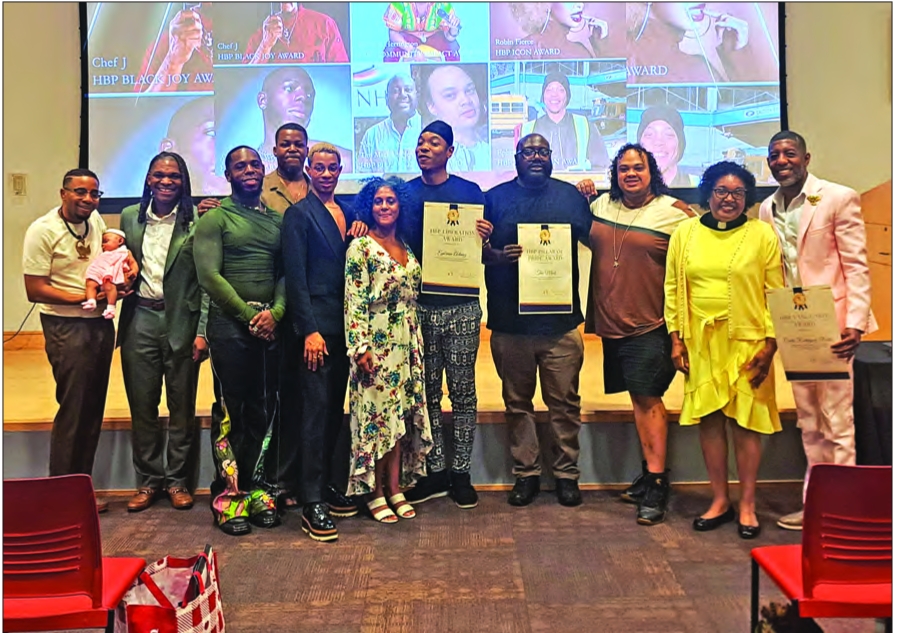
But on July 24, it was her turn to be poured into. Herrington became one of nine inaugural honorees celebrated at the kickoff event for Hartford Black Pride at the Hartford Public Library.
The Friday event was followed by a full weekend of events across six venues, including an art ball, fashion show, marketplace, youth Black pride celebration, dance parties and church service.
Over 1,000 Connecticut residents, families, young people and leaders participated in the capital city’s first Black Pride, which marked the third established in New England, following Boston and New Haven.
“In some ways it was surreal.
There’s some of the older generation that I grew up underneath, I wish that they could have been there to see it,” Harrington said, adding that some of the young people she works with picked up an elderly freedom fighter, Richard, at home to escort him to an event.
Organized by theater director NxtThursday, cofounder of Seattle’s Black Pride, and Boston native Malakhi Eason, the weekend built on a long legacy of pride as protest, liberation and community building.
Black Pride events began in the 1990s as an alternative to mainstream LGBTQ events and celebrations that marginalized and excluded Black people. As Herrington put it, “White pride doesn’t feed our souls. … This is Connecticut, right? It’s rare that we’re allowed to be Black and gay without [having to make] white people comfortable,” said Herrington.
The largest standing Black Pride event in the world takes place each September in Atlanta, garnering over 100,000 attendees. New York City and Washington, D.C., host long-standing celebrations as well.
“There’s close to 60 Black Prides in the United States, and it’s really a continuation of the civil rights movement,” NxtThursday told the Banner. “It also impacts beyond the Black queer community,” he added, naming financial and interpersonal reverberations.
“We brought a level of making things fabulous to this city for a few days, you know, bringing a different flavor to it. … There’s this moniker here that ‘Hartford has it.’ Hartford does have it,” he asserted.
Attendees and organizers described the weekend as healing and a labor of love.
“The organizers of Hartford Black Pride are doing the work of gathering community, giving hope to both young and old and celebrating the beauty of Black culture,” said Rev. Leslie Jackson, who closed the weekend of eight events with a two-hour guest service at Faith Congregational Church, followed by a gospel house dance party.
Herrington credited NxtThursday and organizers for being intentional in whom they structured the weekend around, and for.
“[He] didn’t run to the white gays to support us. He ran to the Black community to support us, and it was beautiful and wonderful. I want the Black community to think about that going forward. We are Black and gay. We are not gay people who happen to be Black.”
NxtThursday borrowed the bulk of the weekend’s structure from his experience organizing in the Pacific Northwest. He knew, he said, that a three-day, multi-location event ending with a church service was possible. “We need to be thinking bigger out here.”
The planning began with a question posed last June during an LGBTQ task force meeting with Leadership Greater Hartford: “When is Black Pride?” Having recently moved to the area for work at the time, he was surprised that the answer was that there wasn’t one, and moved to get started.
Hartford Black Pride secured NestCT as a fiscal sponsor, met with security experts and police to run threat assessments at each venue and formed a nonprofit in order to sustain donations and plan for future years.
Venues Social House and Tia’s Roommate, a hub for lesbians, nonbinary and trans locals, partnered to host two events while NoShade Productions hosted an afterparty. Notably, most events occurred without police presence.
The weekend’s closing church service centered on John 9, regarding a man born blind who was thrown out of the synagogue for telling the truth about what happened to him.
“The main thing I wanted people to take with them was that their wholeness was never waiting for an apology. That synagogue never did reopen its door. You can be found, and seen, and whole, and never walk back through that particular door to find God,” Jackson said.
The sermon was well received by attendees, including those who rarely frequent church or have been turned away. Herrington said she grew up going to that very Faith Congregational Church, but never voluntarily goes. While she said the community did not need to be affirmed, they were “called in,” singing and dancing by the end.
“What I saw from the pulpit was Blackness and queerness and faith in the same room at the same time, with nobody made to leave a piece of themselves in the car,” Jackson said in reflection after the weekend.
For residents and allies like Nancy Walker, the weekend marked a shift.
The fashion designer and owner of Rootswear Designs based in Bloomfield, Connecticut, has traveled across the region, presenting her designs at colleges from Yale to Wesleyan and partnering with locals for community theater productions.
She and two other designers, along with about 30 models of diverse gender and sexual orientations, hosted the fashion show on opening night.
“This has never happened in Hartford, period, point blank. … It was a big deal. To me it was, you know, probably one of my best experiences in fashion,” Walker said.
She was especially moved by the amount of local talent bubbling up, young singers and designers, some of whom were presenting work for the first time.
“These people are here and we don’t see them,” Walker said. “He opened a big door. And everybody’s already talking about next year.”