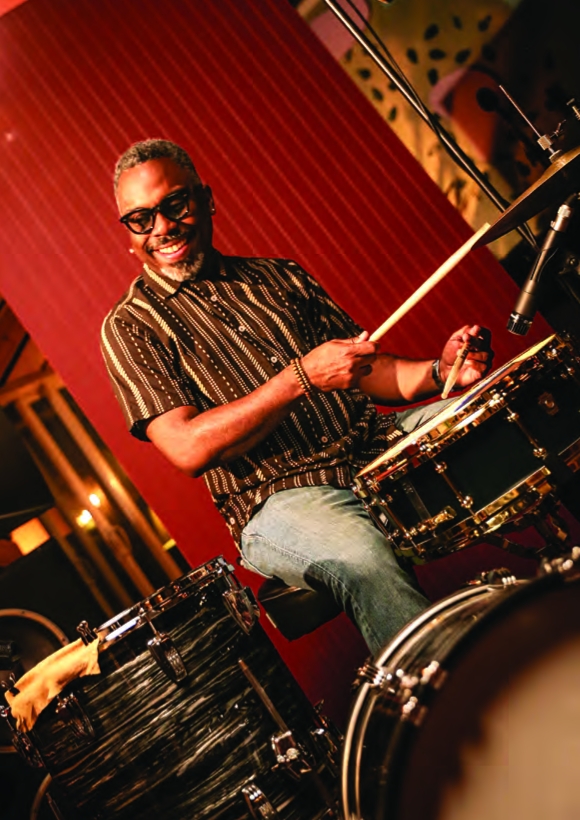
Drummer and composer Nate Smith is the new musical director of the Newport Jazz Festival. No jazz festival in the United States carries more weight than the Newport Jazz Festival
This year’s event in Newport, Rhode Island, is scheduled from Friday, July 31 through Sunday, Aug. 2. As in previous years the lineup is remarkable for the famous and soon-to-be-famous talent arrayed. Outside of the Montreux Jazz Festival, held annually in Switzerland, Newport is the pinnacle.
Newport is singular in its vision and open to expanding what jazz is and can be. This year’s lineup includes Herbie Hancock, Kamasi Washington, Robert Glasper, Linda May Oh, Thundercat, Sullivan Fortner and The Bad Plus.
“The audiences are definitely a big part of being at Newport,” performer Sullivan Fortner told the Banner. “They’re generally well informed, and we’re not strangers to them.”
May Oh, who is performing with her trio of Ambrose Akinmusire and Tyshawn Sorey, told the Banner that this is her first time as a band leader at Newport and “now more than ever,” she’s looking forward to performing tunes from her latest album, “Strange Heavens.”
What’s different this year is that the festival has a new musical director, Nate Smith, whose taste in music adds to that of previous directors. The intimacy of the Newport festival stems, in part, from its having had only two directors prior to Smith: George Wein, from 1954, when the festival started until he resigned in 2015; followed by Christian McBride, who stepped down last year.
Smith, a drummer, composer and arranger, uniquely hears sounds in genres allied with jazz and includes them in his music. His latest album, “LIVE-ACTION,” is, as he told the Banner, “a mini-festival with lots of guest musicians.” Since this year is his first time as director, what will he bring to audiences?
Smith spoke to the Banner about Newport, jazz and his work as a musician.
Banner: What I love about your work is its inclusiveness; you don’t have a canon that confines the music. You recognize its possibilities and how musicians are including awareness of their contemporary circumstances in their compositions. That said, what are you bringing to Newport that reflects the times we are living through?
Smith: I think at this moment in my career, I stand at a very interesting intersection or crossroads. Jazz, hip-hop, rock and R&B are all connected to Black music. They have the same source. All of these styles and music are branches on the big jazz tree. So, it’s a unique possibility; I reached out to my network of musicians. There is a point of entry for everyone, and it doesn’t have to be at the beginning of jazz history.
To be sure, how one discovers jazz can be through fusion, like hearing Weather Report’s song, “Nubian Sundance” or listening to Mongo Santamaria perform a Latin tune such as “Skins.”
You could draw a thread from that and how different styles of music are connected. It’s also the responsibility of the artist to explain to the audience how they do that. Because of the very interesting times we’re in, artists can connect to fans directly by telling them: Check out this music. Or check out this artist.
Are there specific ways you diverge from the former director Christian McBride’s approach to the festival?
I’m not interested in moving in the opposite way from what Christian directed. One of the things I loved about Christian was how inclusive he was. I might cast a slightly wider net by including sounds associated with rock, R&B and jazz jam bands. Just widen the circle a little bit.
How did it happen that you became the musical director?
The condensed version is that in October 2025 I was playing at Sony Hall in New York and a couple members of the Newport Festival Foundation came to the show. Christian had resigned as director in September. About a week after the show, the Foundation members asked me if I would consider replacing Christian. Yes, of course! I was surprised, taken aback. There was a process: two interviews included. The day after the Grammys, I was told that I was being made director.
So many major artists will be there. What can folks attending expect to hear?
One thing I hope people experience is a personal connection to the musicians. I don’t mean hanging out with them but hearing an artist and enjoying their music so much that they follow them for the rest of their career. Dashing from stage to stage, you might dig what a musician is doing in one place, and not another. There is definitely something for you at the festival.
Compared to other jazz festivals, what’s unique about Newport?
For me, what is most unique is that it is very grounded, rooted and very familial the way the music is presented and curated. There is something about Newport that feels like a family reunion. It’s one of the warmest places I’ve played.
ON THE WEB
Learn more at newportjazz.org