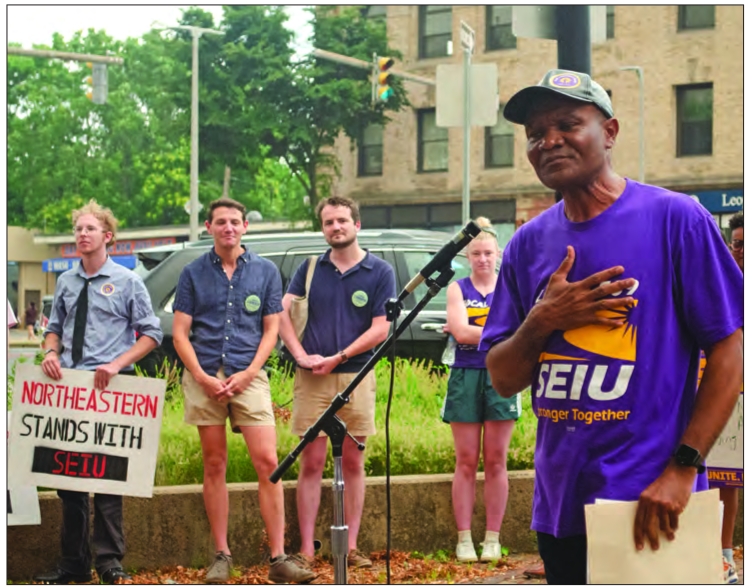
Ralph Nwafor, a MAB organizer and worker, discusses the union’s need for higher wages and immigrant protections. 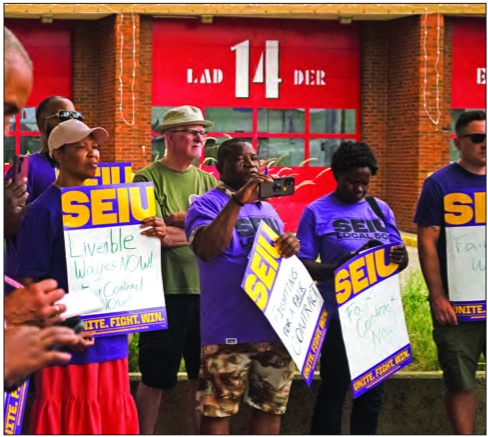
MAB Community Service employees listen to speakers who advocate for fair salaries and working conditions.
On July 15 in Allston, direct care staff who support disabled individuals in group homes protested to reach a union contract with protections for immigrant workers, better wages, and retirement benefits.
Though almost a year has passed since the MAB Community Service employees, formerly known as The Massachusetts Association for the Blind and Visually Impaired, unionized, organizers have yet to secure a first contract. Community members claim that MAB management is stalling negotiations.
The human services sector in Massachusetts is currently in crisis due to budget cuts and high vacancy rates. Employees protesting for better working conditions amid rising costs of living and changing federal immigration policies are those who administer medications, assist with personal care, plan outings, and teach life skills.
“Essential workers deserve essential respect,” said City Councilor Henry Santana to the rally of MAB Community Service workers at Union Square Park in Allston. The Boston City Council has offered MAB staff support by passing a unanimous resolution.
The gathering, in front of a local fire station, had a kinetic atmosphere with chants, speeches, BVocal’s musical performances, and passing firetrucks honking in solidarity.
Workers such as Stanley Ugochukwu arrived at 11 a.m., directly after working overnight shifts. He pointed out that poor wages result in staffers needing to work “three or four jobs,” becoming “exhausted.”
Wages presented as a central conflict within negotiations, as MAB management has offered 2% raises.
Service Employees International Union (SEIU) Local 509 President David Foley said that this number is “just too low for the affordability crisis we’re facing in Massachusetts,” adding that “this is Boston we’re talking about, the cost of living is absolutely outrageous.”
SEIU researcher Kerstin Lindgren said that on July, the state increased contracted rates for these group homes by about 10%, presumably including funds intended for retirement benefits.
“They are not swimming in money,” Lindgren said, “but yes, they should have enough to contribute to retirement and raise the rates.” Organizers at the rally questioned the financial modeling of MAB management, asking why these funds are not reaching their paychecks or benefits packages.
Workers argue that a fair contract is better for their clientele, as a burnt-out workforce with poor morale cannot offer the highest quality of care. Ralph Nwafor, a MAB organizer and worker, said that when a staffer is well taken care of, they can “work with enthusiasm” and take the best possible care of disabled residents. Without a fair contract, he expects workers will “feel they are not important in this system,” concluding that “some that have the courage may walk away.”
Like many of MAB’s workforce, Nwafor and Ugochukwu are Nigerian immigrants. A key demand from MAB workers is protections for immigrant staff, including job security to shield them from coercive tactics. Nwafor said that with a union advocating on workers’ behalf, “you can no longer be intimidated by a manager or senior worker.”
When the Banner reached out to management, Chief HR and Administrative Officer Catherine Starr responded that MAB Community Services cannot comment publicly on private ongoing bargaining negotiations. However, she qualified that MAB is engaged in “good-faith” negotiations, and is committed to finding a “fair and equitable agreement” while maintaining “long-term financial sustainability.”
Councilor Santana noted that some employees have been with MAB for over 10 years, giving their “tears and sweat” to the job out of love for their residents.
The new union has also received support from the Boston branch of the Democratic Socialists of America, whose co-chair Andie Fisher spoke at the rally. “The bosses say, ‘How dare you demand dignity for yourself at the expense of the people you care about?’” she said to the crowd. “We say, ‘How dare you divide us and exploit us?’”
Staffers and management returned to the bargaining table on July 21.
Organizers are circulating a community petition to garner further support.
“They’re asking for the bare minimum,” said Santana. “They’re asking for respect and dignity.”