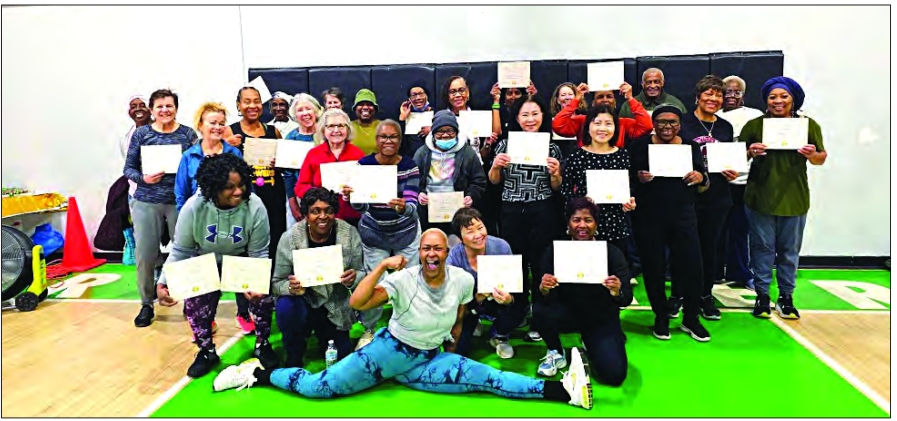
Kay Savage (front center) awarding Certificates of Improvement to participants.Before the music starts and the first marching steps begin, Kay Savage has a ritual.
She makes her way around the room, greeting every participant with a hug. If someone arrives late, she notices. If she misses someone in the crowd, she circles back. No one leaves without that embrace.
“I hug every last person,” Savage said of her wildly popular Fit for Life class at the Dorchester YMCA on Tuesday and Thursday mornings.
That simple act has become as much a part of the class as the low-impact aerobics, bodyweight strength exercises and old-school soundtrack that keeps nearly 50 participants moving each session. Together, they have transformed Fit for Life from a post-pandemic class with four participants into one of the YMCA’s busiest offerings, fueled almost entirely through word of mouth.
For Savage, the class is about much more than exercise.
Her journey began after years marked by grief, depression and a health scare, she said. Following the deaths of her father and brother, her weight climbed above 300 pounds. A physician warned that her blood pressure had reached stroke levels. After weight-loss surgery in 2018 and a commitment to fitness, Savage rebuilt her health, eventually earning her fitness certification and launching Savage Fit before joining the Dorchester YMCA.
Today she teaches Fit for Life along with Aquafitness, Body-Combat, HIIT, Core Strength, Sweat to Soca and Total Body Conditioning. But Fit for Life has developed a following unlike any other.
One participant from Dorchester, who wished to remain anonymous, has attended since Savage’s first weeks leading the class.
“She is just phenomenal,” said the resident, who joined when only a handful of people attended. “She’s dynamic, she’s friendly, she’s sweet, she’s humble. But she is good at what she does. When she came, she brought an energy, a spirit to this class that we all needed, and we’re excited about.”
That energy begins with music. Savage curates playlists filled with artists many participants grew up listening to: Whitney Houston, Lionel Richie, Rick James, Teena Marie, The Gap Band, Luther Vandross, Frankie Beverly & Maze, James Brown and Michael Jackson. Participants sometimes stop mid-workout to sing along before returning to side steps, squats, standing crunches, shoulder mobility exercises and balance work.
The participant said the playlist is one of the class’s biggest draws.
“Kay plays Prince, Freddie Jackson, Billy Ocean, Tavares, Gap Band, Earth, Wind and Fire, Al B. Sure! and Tina Turner,” she said.
“That gives you energy.”
The class format reflects what many health experts recommend for older adults. The U.S. Centers for Disease Control and Prevention advises adults 65 and older to combine moderate aerobic activity with muscle-strengthening exercises at least twice a week, along with balance training to reduce fall risk. Those recommendations become especially important for Black seniors, who experience disproportionately high rates of hypertension, Type 2 diabetes, stroke, obesity and heart disease because of longstanding inequities in health care access, neighborhood resources, nutrition and opportunities for safe physical activity.
The National Institute on Aging notes regular exercise can help lower blood pressure, improve blood sugar control, maintain muscle mass, strengthen bones, improve balance and mobility, reduce depression and anxiety, and decrease the risk of falls.
Combined with nutritious eating, routine medical care, medication adherence, quality sleep and strong social connections, physical activity can help prevent or better manage many chronic illnesses.
Savage sees those benefits firsthand.
Participants tell her their physicians ask what they have been doing differently because their blood pressure has improved. Some have reduced medications. Others report lessening back or hip pain. One participant who once relied on a walker now often arrives with only a cane. Another man recovering from a stroke has steadily regained strength and mobility by faithfully attending class.
But the physical gains are only part of the story.
Many participants are widowed or live alone after their children have grown. Savage believes the hugs matter because they communicate something deeper than encouragement.
“You don’t realize how much a hug means to someone,” she said participants have told her. “Some of them … It’s just them at home.”
That sense of belonging has spread throughout the class. Participants celebrate birthdays together, cheer one another through personal milestones and encourage newcomers.
When Savage moved into the YMCA basketball court because enrollment had outgrown the studio, class members surprised her by pooling their money to buy her a wireless microphone so she would not strain her voice teaching the larger group.
The Dorchester participant said those small gestures help explain why people keep coming back.
For Savage, helping people move again is deeply personal. She tells newcomers to begin with small, manageable steps — a walk in the park, healthier eating, or simply finding a supportive group that makes them want to return.
“We all [are] going through something,” she said. “Yesterday is yesterday. Today is a new day, and you got to live for that day. Tomorrow’s not promised.”