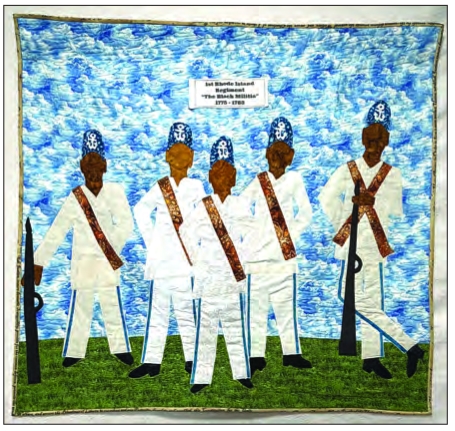
Veronica Mays quilt depicting Black 1st Rhode Island Regiment.
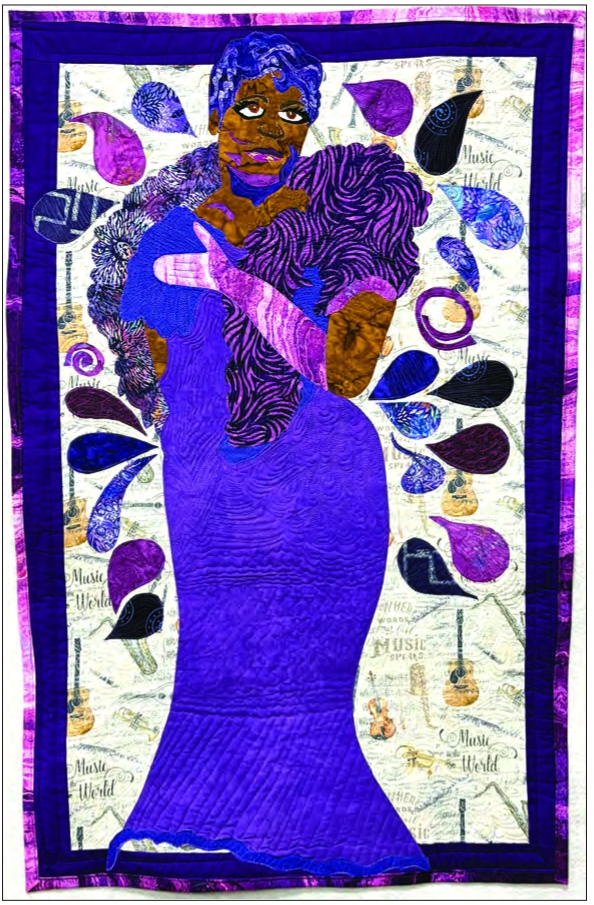
Quilt by Veronica Mays portraying singer Sissieretta Jones, the first African American to sing at Carnegie Hall in New York CIty.At Rosecliff, the Gilded Age mansion in Newport better known for hosting scenes from “The Great Gatsby,” a very different story is now on display.
“Revolution Reimagined: Evolving Stories from Newport’s Past,” which opened in June and runs through Nov. 1, marks the 250th anniversary of American independence not with fireworks and reenactors, but with a question: whose revolution has Newport actually remembered?
The exhibition, curated by Nicole “Nicki” Williams, curator of collections at the Preservation Society of Newport County, gathers scholars, artists, descendants, and community members to re-examine a city that was once occupied by the British and the launching point for the French-American march to Yorktown.
The show’s real subject is memory itself — how later generations of Newporters, and particularly Black Newporters, have had to fight to be written into that history at all.
The exhibition features contemporary work from several artists alongside historical objects on loan from institutions and private collections within the region.
Artists include Dawn Spears, of Narragansett and Choctaw heritage, ceramicist Michelle Erickson, and quilter Veronica Mays.
Their artistry primarily centers the Black, brown and Indigenous people who contributed to liberation. It further examines how later generations of the artists, writers, and activists reworked the public’s recollection of that war to fit a more authentic, inclusive truth.
Central to the project is the Rhode Island Black Heritage Society (RIBHS), the oldest African heritage historical society in the country, led by Executive Director Theresa “Soni” Guzmán Stokes.
“People have been struggling with this lack of liberty, lack of unity since the beginning. They called themselves a free republic, but only for certain people. And today we’re revisiting that, and I am hoping that this exhibit shows people that it never was the case and it isn’t now,” Stokes said.
RIBHS has partnered with the Preservation Society before, including on the 2024 exhibit “Gilded Age Newport in Color,” and this collaboration extends that relationship into the Revolutionary era. Together, the organizations have traced a lineage of Black political and cultural life in Rhode Island that predates the founding of the country itself.
“The incorporation of RIBHS was really the seed, and the kind of exemplary cause that got us thinking about all of the other important Newporters who were working in 1876, 1976, and now in 2026 … revolutionizing society and politics in their own times, by revisiting the past,” said Williams.
In Mays’ “We Were There Too,” a quilt now hanging inside Rosecliff, three histories are layered on one another using imagery from “God’s Little Acre,” a segregated section of a historic Newport cemetery, the Triangle Trade, and the first Rhode Island Regiment of 1778 — made of majority BIPOC soldiers.
Her quilting practice started almost by accident as a child. “When I was in the sixth grade, we took home ec, and that’s all I did back in the ‘70s,” she said. “I was just curious about learning how to quilt. I took a class.”
She set the hobby down for decades before picking it back up as an adult, spurred by a library find. “I found this book called ‘Scrap,’ and I made a Scrap Lady Quilt,” she said. “And I said, if I’m still quilting by Mother’s Day, I want a new sewing machine.” The bet with herself worked. She kept going, and the sewing machine came with it.
Her path to Rosecliff began at a Juneteenth celebration in 2023, where she met Williams, who purchased a quilt. A friend of Williams invited her to produce something for a Friendsgiving — that piece is the one now on view at Rosecliff.
But the roots of “We Were There Too” extend much further, to when Mays was 16 and a member of a group called the Black Militia, which introduced her to the story of the 1st Rhode Island Regiment, one of the first Black military units to fight in the Revolutionary War.
“We didn’t know a lot about Rhode Island Black history back then,” she said. That early exposure resurfaced decades later as she designed her Rosecliff piece. “I grew up thinking the North is good, the South is bad,” Mays said, describing how researching Newport’s own entanglement with slavery complicated that childhood assumption.
Mays’ design process is slow and deliberate. She points to the late quilter Lola Jenkins, who taught at the National African American Quilt Convention, as a guiding influence: “I didn’t know that there were rules, so I broke all the rules.”
That philosophy has carried Mays’ work well beyond Rhode Island — to the Bridges fiber arts festival in North Charleston, South Carolina, and the Pacific International Quilt Festival, with a new piece on Harriet Tubman currently on view in New York. For several years, she also ran a standing community project on Facebook, posting a new quilt block every two weeks so others could contribute blocks of their own to a collective African American Sampler Quilt.
Through Williams’ curatorial framing, Stokes’ institutional advocacy, and Mays’ artistic vision, they point to a fuller, more complicated Newport into public view during the city’s most-photographed anniversary year.
As Mays put it, reflecting on how long it took her to learn about the 1st Rhode Island Regiment, “Hopefully they can find that out earlier than I did.”
Revolution Reimagined is on view at Rosecliff through Nov. 1.