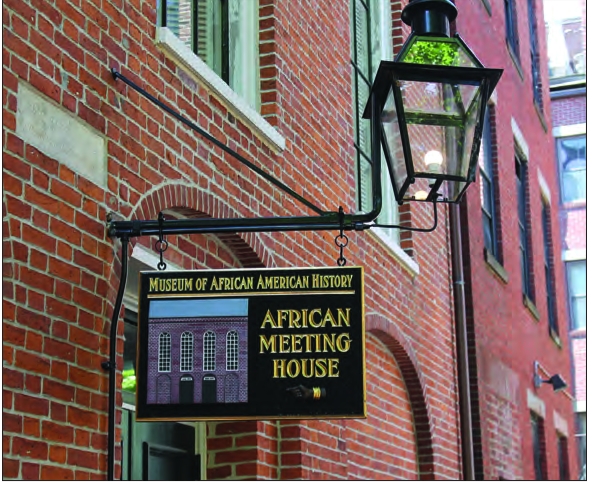
The African Meeting House on Beacon Hill has been included on the World Monuments Fund’s new “Irreplaceable America” list.
The African Meeting House on Beacon Hill has been included on the World Monuments Fund’s (WMF) new “Irreplaceable America” list as one of the country’s 10 historically significant locations essential to understanding the United States and that face preservation challenges.
WMF announced the list on June 30 in New York City. It was compiled in honor of the 250th anniversary of the signing of the Declaration of Independence.
Constructed by free African Americans in 1806 in the Beacon Hill neighborhood, the meeting house is the oldest existing Black church in the nation.
“For this anniversary, we understood that there certainly was going to be interest in the founding of the nation, so we wanted to tie in communities that define the U.S. today,” said Jon Buono, WMF North American regional director. “We were very happy to receive this nomination. It tells a critical story of the Black community and experience in colonial New England, which may not be as widely recognized within the broader American public.”
The space served as both a school and an integral community meeting space for Boston’s Black community for generations, a hotspot for abolitionist dialogue and meetings. Frederick Douglass and William Lloyd Garrison, among others, spoke there, and the Massachusetts General Colored Association, which sought to abolish slavery and general racism, held meetings there.
Operations ended at the African Meeting House in the late 19th century when it was sold to a Jewish congregation. The Museum of African American History (MAAH) purchased the meeting house from the Jewish congregation in 1972. The building is a federally recognized National Historic Landmark.
“This honor means that the work we have done and continue to do is seen as valuable,” said MAAH President and CEO Dr. Noelle Trent. “It’s an acknowledgment that the meeting house played a role in an international story, more specifically, abolitionism, and that you cannot tell the international story of the abolition of slavery without the African Meeting House. This honor is tremendous, and we are extremely humbled by it.”
MAAH is the steward of the meeting house as well as the Abiel Smith School in Beacon Hill, the nation’s oldest public school built specifically for Black students. On Nantucket, MAAH owns the African Meeting House along with the Higginbotham House, which was built in 1774 by Seneca Boston, a formerly enslaved man.
“The African Meeting House has such a high degree of authenticity that it feels like the jewel in this collection of unrivaled historic and cultural resources,” said Charles A. Birnbaum, president and CEO of The Cultural Landscape Foundation in Washington, D.C. “It is a touchstone that is a portal to powerful stories.”
Birnbaum served on the WMF jury that selected the sites for the “Irreplaceable America” list.
The process began with the submission of several materials, including plans and challenges the property faces, letters of support from external voices and documents explaining and verifying the property’s history. There were submissions from 72 landmarks.
Trent said the effect of being on the list for the meeting house is twofold. First, the recognition will boost visibility. She categorized the African Meeting House as an “invisible” site, rather than a “visible” one.
“When we have people come through our doors, many say, ‘You’re not gonna believe this. I’ve lived in Boston my whole life, and I never knew that you were here.’That doesn’t surprise us, and we’re working to combat that,” Trent said. “This sort of recognition and support from the WMF may help uplift that and take us from a hidden gem to a known treasure.”
Trent said she hopes the meeting house will begin to draw international visitors after this “Irreplaceable America” feature.
The second anticipated effect is improved financial stability. The African Meeting House has struggled with this since 2025, when it lost federal funding. Ultimately, they got it back after fighting in court, yet their financial future remains uncertain.
“We’ve seen a shift in corporate dollars, and I think that’s across the board for nonprofits, especially those dealing with culturally specific [issues]. When the conversations around DEI occurred, all of a sudden, budgets didn’t look the same — there was a withdrawal,” Trent said. “There’s renewed questioning of the value of African American history. What narratives deserve to be told and shared? Which sites should be preserved? Quite frankly, the work we represent is not always considered worthy of preservation.”
MAAH is currently amid several fundraising initiatives launched for this purpose. Beyond its campaigns to boost visibility and financial sustainability, the meeting house was the target of an arson attempt on June 4.
Boston police are still searching for the culprit, whom they have identified as a white male. Along with the National Park Service, the city police are working with civil rights groups to determine whether the arson attempt was a hate crime.
“This incident was not surprising because, historically, when we see African American institutions standing up for something, speaking truth to power and doing great work, there has always been a threat to leadership, or to the buildings or spaces they occupy,” Trent said. “We are being more cognizant of what the opposition is doing to understand what we can do to make sure our staff, visitors and buildings are secure.”