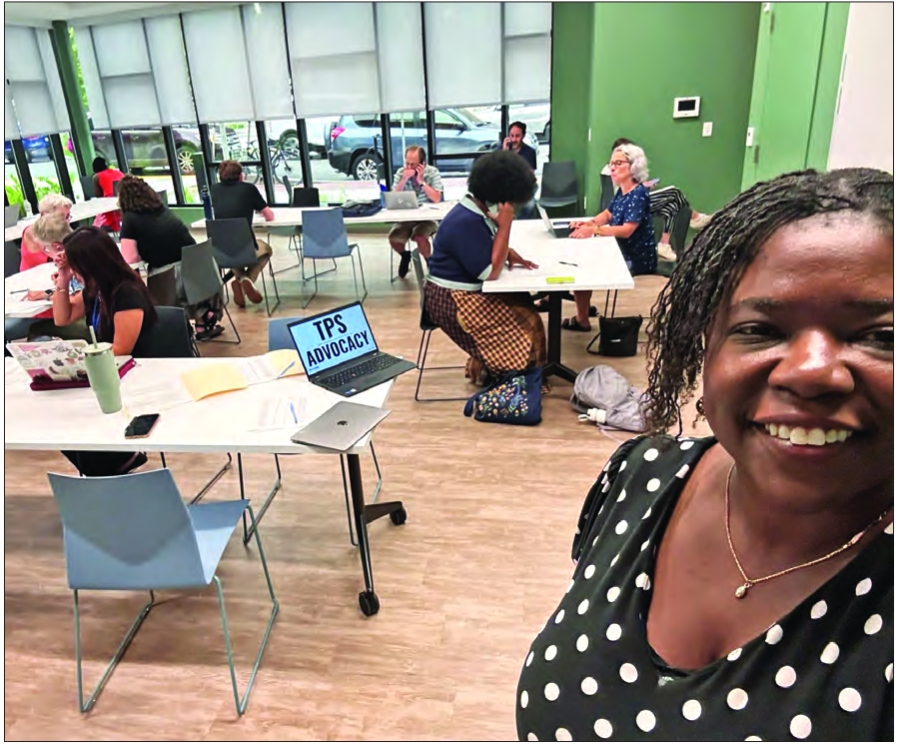
Boston City Councilor Ruthzee Louijeune has teamed with Rep. Ayanna Presley to extend TPS for Haitian immigrants for three more years.
In Boston and across Rhode Island, Haitian community leaders are meeting a moment of crisis with a familiar toolkit: organizing, mutual aid, and creative expression.
As the federal government moves to end Temporary Protected Status (TPS) for Haitian nationals after last month’s contested U.S. Supreme Court ruling, activists, business owners and artists say they are leaning on each other — and on culture — to hold their communities together.
“Right now a lot of communities are hurting,” said Ruthzee Louijeune, a Boston city councilor at-large and Haitian community organizer. “We have an administration that is anti-Black.”
For Louijeune, the pain of the TPS rollback — which will expose thousands to deportation — has been compounded by other recent blows to Haitian pride and morale. She pointed to the men’s national soccer team’s run in the World Cup qualifying as a rare moment of joy that was quickly overshadowed.
“Haiti scored its first two goals in the World Cup,” she said. “And then that was ripped away the very next day.”
The U.S. State Department recently added Haiti to its Level 4 travel advisory list, the highest warning level, signaling life-threatening conditions such as unrest, war, disease, natural disaster or terrorism.
Louijeune described the reasoning behind the TPS termination as contradictory; how can nationals be safely deported to a place on the Level 4 list?
That contradiction is what pushed Louijeune and other organizers to act. Working alongside Rep. Ayanna Pressley’s office, advocates helped push for legislation — Senate Bill 4114 — that would extend TPS protections for Haitian nationals by three years. The fight, she said, isn’t over.
“Continue to urge Senate members and Congress members,” she said of the pressure campaign aimed at lawmakers on Capitol Hill.
That advocacy has taken shape through phone banks, letter-writing drives and fundraising pushes for grassroots groups doing direct-service work. Organizers are steering donations toward organizations serving Haitian immigrants directly, including a Haitian association for women and churches that supports families.
Louijeune is quick to frame the response as more than crisis management.
“Mutual aid efforts” have become, she said, “a source of strength and taking care of each other,” a way of building infrastructure that doesn’t depend on federal protection to function.
She also pushed back on the narrative that Haitian immigrants are outsiders to the American story.
“Haitians are an intrinsic part of this country,” she said, pointing to a history that predates most people’s assumptions. “Neighbors, classmates and Haitians stood with America during the Revolutionary War,” she said, referring to the Chasseurs-Volontaires de Saint-Domingue, Haitian soldiers who fought alongside American forces at the Siege of Savannah in 1779.
That same instinct to build parallel support systems runs through the work of Bernard Georges, executive director of New Bridges for Haitian Success, whose business has become an informal resource hub for immigrants navigating the TPS revocation.
Georges started the organization in 2013, drawing on his own experience as an immigrant who arrived in Rhode Island in 2000 at age 16. With no Haitian organization to help him navigate American education and social pathways, he was inspired to act after graduating from Community College of Rhode Island and working security and factory jobs.
His experience shapes the organization’s mission today: bridging the gap between American institutions and Haitian immigrants. As a result, they offer a wide array of social and legal services to the neighboring community.
“So many have lived here for years, raised families here and contribute to the local economy,” Georges said. “They deserve dignity, fairness and the opportunity to continue contributing.”
While Louijeune and Georges represent the political and economic front lines, Vanessa “Vie” Ciné is working the emotional one. Ciné is a Haitian American visual artist, community facilitator, snack crafter and soap maker and the founder of Paint Your Truth, a process-painting workshop series that uses creative expression as a tool for healing, self-discovery and collective care.
Rooted in Haitian heritage and cultural awareness, Ciné’s workshops give participants space to explore identity, resilience, and transformation through art — an approach she sees as inseparable from activism.
For Ciné, storytelling itself is a form of resistance. Her workshops don’t shy away from the weight of the current political moment; instead, they create room for participants to process it collectively, through brushstrokes rather than only through protest signs. It’s a model of care that complements, rather than competes with, the legislative pressure campaign Louijeune is running and the direct services Georges provides.
“We work together, we divide everything that we grow or benefit or have. … And these systems are built around community respect, mutual aid and collective care. Haitian culture has always challenged systems that try to reduce people into labor, resources or statistics. We have always understood our humanity,” Ciné said.
Taken together, the three approaches — legislative advocacy, economic support and creative healing — point to a community responding to federal abandonment by deepening its infrastructure. None of it replaces what TPS provided, but organizers say it’s what sustains people while the fight for protection continues in Washington.