Boston
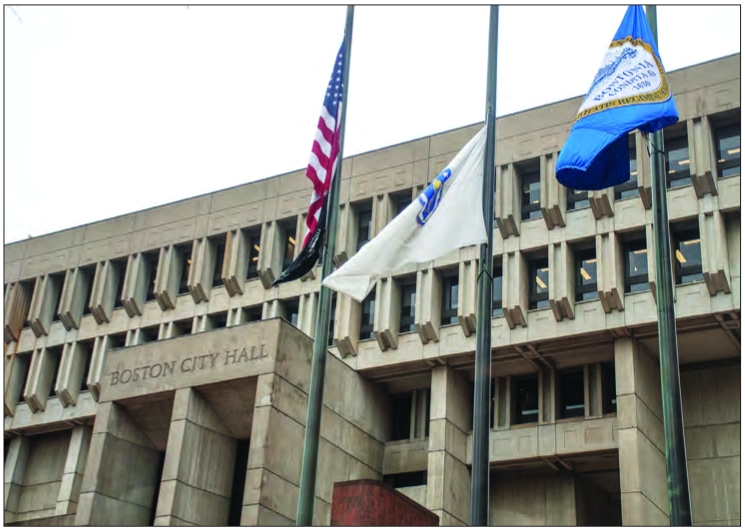
City Hall, shown in December 2024. The city announced the launch of its
third participatory budgeting cycle, which will use $2 million to fund
resident-developed projects.Boston residents can again share their thoughts on how the city spends part of its budget.
On July 1, the city opened submissions for its latest round of participatory budgeting, a process through which residents submit ideas for services, amenities or other projects to benefit Boston. Those ideas are voted on and the most popular are funded through a portion of the city’s annual spending.
“Participatory budgeting empowers community members to directly shape city investments, from strengthening youth programs and expanding access to community resources, to improving public spaces across Boston,” Mayor Michelle Wu said in a statement announcing this year’s round. “We encourage residents to share their ideas and help shape the investments that will be made in communities across every neighborhood.” In its most recent cycle, the city allocated $2.2 million to fund eight projects, including a legal defense fund for immigrants, an initiative to help local organizations increase communities’ access to fresh foods and a funding pool to support residents at risk of homelessness.
This cycle is the city’s third. The Office of Participatory Budgeting was formed in 2023 and the program launched in 2024 after Boston residents in 2021 voted in favor of the resident-guided process.
“Every idea submitted helps us better understand what residents are experiencing, what neighborhoods need, and where public investment can have the greatest impact,” said Renato Castelo, director of the Office of Participatory Budgeting. “As we continue this work, our goal is to make participation simple, accessible and meaningful for residents of all ages, backgrounds and neighborhoods.”
Expanding resident input in the city’s budget has also been a priority of the
Better Budget Alliance, a coalition of local organizations advocating
for increased community voice in how the city spends its money.
In
November 2025 and March 2026, the coalition ran two “People’s Budget
Assemblies” where residents had the opportunity to offer perspectives
and feedback on their priorities for the city. Through a survey of
nearly 700 residents — over half of whom
came
from Dorchester, East Boston and Roxbury — the coalition identified
food access, housing and immigration support as community priorities.
Khalil
Howe, an organizer with the Youth Power and Justice Union, a member of
the Better Budget Alliance, said the process is becoming more
comfortable and familiar.
“It’s
becoming more of a regular thing and less of a hassle around figuring
out, ‘How does this work? How many rounds is it?’” he said. “It’s
getting easier to pitch and get people involved.”
The
first phase of the participatory budgeting process, where residents can
submit ideas to the city, runs through the end of July. For the
remainder of 2026, those ideas will be refined into bspecific, eligible
proposals. In early 2027, residents will be able to vote from a slate of
proposals to select the final set of projects that will be funded with
this year’s $2 million.
There
are certain limits to what can be funded through the process. Project
ideas must be a one-time expense; for example, a proposal can’t create a
new salaried position. They must also be within the city’s purview, not
the state or federal governments.
The
Better Budget Alliance has also advocated for an expanded pool of funds
for the participatory budgeting process. Since the process was
launched, the group has called on the city to allocate 1% of the budget —
about $49 million in the most recent budget — toward the
resident-guided budgeting. Last year’s $2.2 million was the
largest allocated so far. But the most recent city budget process — a
contentious affair that tested the City Council’s ability and
willingness to reject parts of Wu’s budget after the mayor made cuts to
funding for housing assistance, immigrant services, the city’s Human
Rights Commission and other areas while increasing funding for the
Boston Police Department — has left Howe feeling skeptical about how
much the city is listening to resident concerns outside of established
processes like participatory budgeting.
“It
allows for some great ideas to get funded, but also it shows and makes
it undeniable that this is a very important process to the people,” he
said. “It can really give us the leverage to get more funding for it, so
that our ideas in the future can be bigger and brighter.” Residents can
submit ideas to the city online at participate. boston.gov, by phone at
617-635-3059, in-person at City Hall or select Boston Centers for Youth
and Families and city-sponsored idea collection.