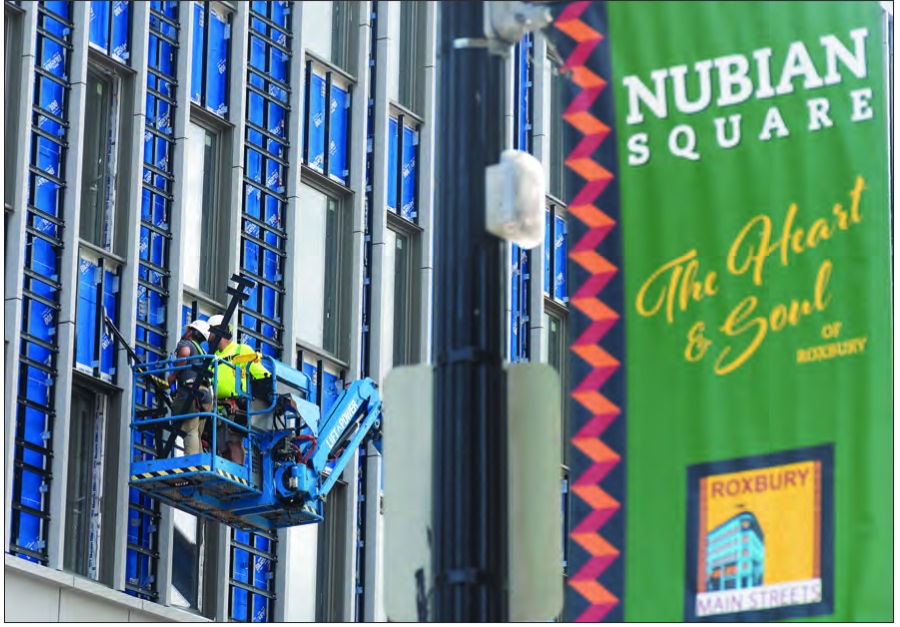
A
construction team works on a building in Nubian Square, July 10. As the
area sees new development, community and city leaders are looking to
identify ways to support the businesses in the square as part of a
broader revitalization effort. 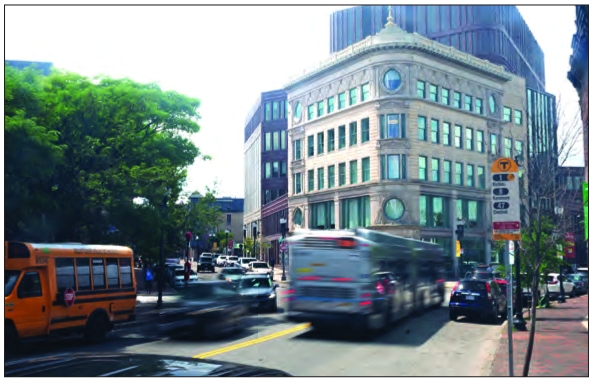
Traffic drives in front of the Bruce C. Bolling Municipal Building in Nubian Square.
Community, city look to foster business growth in Nubian Sq. revitalization
For the past decade community and municipal leaders have pushed for new efforts to breathe new life into Nubian Square. That effort has promised large developments with new housing as well as arts and culture and economic development opportunities.
But for a group of community leaders, just as important as the big projects is the need to make sure that existing smaller businesses continue to survive — and that new businesses can fill gaps to bring the neighborhood to its full potential.
“It does matter what is going to go into an area to help it thrive and sustain itself,” said Nicole Obi, president and CEO of the Black Economic Council of Massachusetts.
Some of those businesses already exist in the community; others could fill significant needs as leaders aim to reshape the area into a more vibrant and active hub. Obi pointed to businesses like dry cleaners and pharmacies, sit-down restaurants and day care centers.
Filling those gaps isn’t an alternative to big projects coming to the neighborhood, but an important addition, advocates said.
“The vibrancy of a community is contingent on a both-and perspective,” said Aisha Francis, president and CEO of Benjamin Franklin Cummings Institute of Technology, the vocational school that moved to Nubian Square in January.
Devoted business support could also be one way to make sure that longtime community members get to benefit from revitalization efforts.
“Revitalization isn’t just about getting new buildings,” said Rev. Willie Bodrick, senior pastor at Twelfth Baptist Church. “It’s about creating new opportunity.”
To
miss the mark could mean “another missed opportunity,” said Bodrick,
who is also president and CEO of The American City Coalition, an
economic development nonprofit in the neighborhood. Losing out on the
moment could damage the community’s “identity and authenticity,” he
said.
“I think we
don’t want to miss this chance to create because if we don’t do this, we
lose more than we can ever regain quickly,” he said.
Addressing
business expansion in the neighborhood — what Obi called the “remaining
20%” of vacancies — has been one focus of a new task force assembled by
Mayor Michelle Wu in April. That task force includes officials from a
handful of city
departments as well as nonprofit organizations, business-serving
organizations, members of the Roxbury Strategic Master Plan and other
community leaders, including Obi, Bodrick and Francis.
“We
have a broad base of folks who are part of this task force with
specific skill sets,” said Donald Wright, Boston’s interim chief of
economic opportunity and inclusion.
Over
a six-month period, the task force is supporting new and existing
businesses. It is also focused on the other facets of the
revitalization, like activating the cultural district, spurring
construction and development in key parcels, promoting investment and
ensuring the area gets all the basic city services it needs, Wright
said.
Despite the
timeframe, Wright said he thinks the work of the task force will be
effective in setting up the area for future success.
“I
know six months is not a long period of time, but I think that we’ll
have some deliverables at the end that will allow for us to springboard
into the next phase of the process,” he said.
At
the center of the vision is the long-dreamed-of “18-hour community”
that many advocates think Nubian Square could be, a place where someone
doesn’t just come to take a bus or sleep at night, but a place where
community members can spend a whole day.
“It’s
a place that they choose to work and play and to stay and to be
entertained, and they feel safe,” Obi said. “That’s what makes a
community work.”
Right now, many of the community needs are outside the neighborhood, leading to what Bodrick called “economic leakage.”
“Definitely
we want people to experience the beauty of the city of Boston, but we
don’t want people to feel like they have to leave their neighborhoods to
get their basic necessities,” he said.
For
members of the task force, that last wave of business and storefronts
will be central to the vision of reducing the leakage and creating an
18-hour community.
“I
don’t want this, when it’s all said and done, to just be a place where
people get up in the morning, they go to other parts of the city or the
area, and they’re really only coming back here to sleep,” Obi said.
Francis
said that at Franklin Cumming Tech’s South End campus, faculty, staff
and students could walk to a wide range of stores if they had a break to
run an errand, including a hardware store, a bike repair shop, a pet supply store, dry cleaners and childcare.
“I
think if you’re talking about helping to add to an institution’s
ability to market itself as being located and situated in a convenient
neighborhood, people need to be able to run practical errands during
their lunch breaks, or before work, or after work,” Francis said. “Those
types of businesses would certainly add to the fabric of what’s here.”
The revitalization of Nubian Square has been a priority in the community
for decades.
In the
past 10 years, the effort has seen new force as a variety of projects
have broken ground or looked to start construction in the area.
“The
fact that we’re even having this conversation now is because we stand
upon the shoulders of so many others who have been advocating and
fighting for generations to get the changes that we do have at this
particular juncture,” Bodrick said.
In
January, Franklin Cummings Tech officially opened its new campus on the
northeast edge of Nubian Square, marking the culmination of an almost
six-and-a-half-year move from its former South End home. Other
organizations, too, like the Community Music Center of Boston, are
moving to the square.
The
opening of venues like Jazz Urbane Cafe in the Bruce C. Bolling
Municipal Building are taking steps toward that “18-hour community”
vision by adding arts offerings to the community. Jazz Urbane held a
soft-opening party in June. The Nubian Square Ascends project is slated
to bring artists housing, a food market and a life science training
center to the neighborhood. And the area is slated to see new housing
developments in the square, including a 110-unit building funded in part
through city and state investments.
For Bodrick, having the city involved is an important step to properly instigating change.
“It’s
important to have the city support behind projects like this and to
make sure that the investments that are there cannot only be
accelerated, but also what’s needed from the city side can really be
bolstered in this community to actually activate the change that we want
to see,” he said.
Wright
said he sees an important role for the city to play, given city-owned
parcels in the area, as well as their role in the development process
that would allow officials to engage with developers in fostering a
stronger
business ecosystem in Nubian Square. The city’s approach to work in
Nubian Square hasn’t always been favorably received. In January, the
city announced it was pulling the approval for a development project
from HYM Investment Group and My City at Peace that was slated to bring
housing, lab space and a museum to the long-vacant Parcel 3 at the
northwest side of Nubian Square. That decision spurred intense community
pushback.
At the
time, the Wu administration said of its decision that it was
prioritizing first the construction of an updated campus for Madison
Park Technical Vocational High School. The remaining space on the parcel
would then be reopened for economic development efforts.
Efforts
like the task force, Wright said, can be seen as a sign that the city
is engaged and listening. The makeup of the task force, he said, points
to the city’s willingness to engage with the community in this effort.
“These
are folks that have done work in the neighborhood and continue to do
work,” Wright said. “You can see their work in our community.”
Obi
said that a concerted effort is important to make sure that storefronts
don’t end up filled by franchises, which she said could risk
“gentrification, in the worst sense.”
“You
get places that have no connection to this community — they can be
anywhere —that would be a big loss culturally and economically for
entrepreneurship and ownership,” Obi said.
But members of the task force said they see an opportunity to bring new growth to the area without displacement.
“We
know a lot more at the urban development level and at the level of city
management than we did 60 years ago about how to strike that balance,”
Francis said.
Wright,
too, said he thinks there are ways to grow the economic vitality of the
neighborhood without displacing residents, including by incorporating
language that would foster development without displacement into
proposals and bringing building owners into the process.
For
Bodrick, it’s important that the business support can be another way
that the revitalization of Nubian Square can serve the residents who
have stayed in the area through its highs and lows.
“If
we get this right, revitalization will not replace the community that
built Nubian Square,” Bodrick said. “It’s going to strengthen the
community and the people that built Nubian Square.”