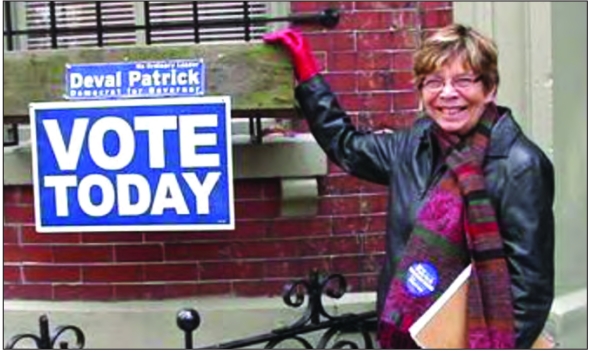
An architect by trade, Joan Wood led a life dedicated to civil rights.Architect and activist Joan Klawans Wood died on May 9. She was 93.
She was surrounded by family in a room that also featured a cutout of the New York Times headline “NIXON RESIGNS” and a poster featuring the work of radical nun Corita Kent.
The daughter of a pharmacist and piano teacher, she was born on the South Side of Chicago and moved to Boston to attend Harvard’s Graduate School of Design, where she met her former husband, Henry Wood.
The genesis of Wood’s activism can be traced to their first house search with an African American couple, two of her colleagues, in the North End. Once the realtor saw the Black couple, he claimed that the house had already been sold. Enraged by this blatant racism, Wood’s career crystallized into one defined by change-seeking.
She eventually settled in the South End in 1963, where her neighborhood served as a hub for change. It was composed of myriad like-minded activists, such as Mel King and Marty Golden, who would frequently meet at Wood’s home.
“Our
house was this amazing, crazy place filled with all these people,
meetings and activities,” said her son, Josh Rose-Wood. “Her whole life
was dedicated to politics, activism, affordable housing, equal rights,
the Equal Rights Amendment and abortion rights. She cared about treating
people decently.”
The 1960s and 1970s were fraught
with racial tensions and violence, and affordable housing was scarce.
Wood operated at the intersection of these two problems, using her
architectural skill to build over 150 row houses that offered better
conditions and to combat slumlords.
“She
also worked with many institutions, including the South End Community
Health Center and the Casa Mirna Shelter for Battered Women. She also
did housing for the working homeless in Dorchester,” Rose-Wood said.
Wood’s
impact can be seen in how she uplifted others around her, especially
women. She had a rocky relationship with her own mother and greatly
feared reproducing this relationship with a daughter of her own,
Rose-Wood noted.
“But
since she’s died, I’ve heard from just countless people about how she
has mentored young women and been an inspiration to them,” he said. “She
showed everyone that you could be a strong, smart woman in the world
and not compromise.”
Boston Mayor Michelle Wu corroborated that sentiment in a speech at Wood’s funeral on July 11.
“At
first, Joan was a very intimidating presence, but then she was someone
who really took me under her wing,” Wu said. “When I first met her, I
was new to the neighborhood. I was trying to get through a crazy family
situation, and there was so much going on, and she was one of the
matriarchs of the neighborhood. I remember the conversations that we had
in person were always full of energy. I’m just incredibly moved to be
here. I miss her, and I am grateful to Joan for [her contributions to]
the South End and the place in history it holds in our city.”
Wood’s
legacy today lives on through the continued operation of her
architectural firm, now under Rose-Wood, who seeks to keep his mother’s
activism alive.
“She
was certainly a model for how I want to run the firm and treat the
world,” he said. “She spent 50 years fighting, one zoning hearing, one
demonstration and one fundraiser at a time, to keep the neighborhood and
country she loved a place for everyone — not just those who could pay
the most. Together, people can fight and make a difference.”