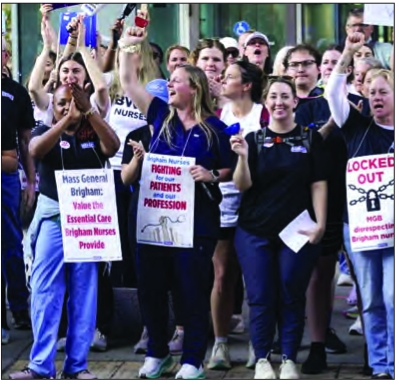
Massachusetts Nurses Association members hold signs and cheer outside of Brigham and Women’s Hospital in Boston, July 13. 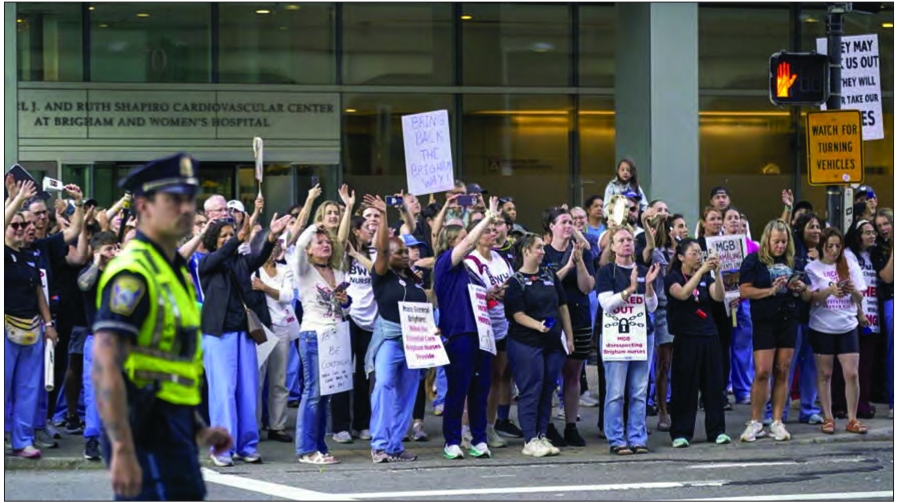
Members
of the Massachusetts Nurses Association cheer and wave across the
street to Brigham and Women’s Hospital nurses as they returned to work
following a strike and lockout on Monday, July 13 in Boston.
GBH NEWS
Thousands of nurses at Brigham and Women’s Hospital in Boston returned to work early Monday morning, marking an end to the largest nurses strike in Massachusetts history.
But five days after 4,000 nurses declared a one-day strike over higher wages, nurses are expressing concern as they walk off the picket line still without a contract.
“It’s exciting, but also frightening,” said Christine Forgeron, a cardiac nurse at Brigham and Women’s Hospital. “I don’t know what to expect when we go back to our patients, what happens next, because we still don’t have a contract is the most unsettling part.”
The Massachusetts Nurses Association initially authorized the strike for one day, but hospital management extended the work stoppage, keeping nurses off the job for five additional days.
The hospital brought in 1,300 replacement nurses to cover shifts.
The
nurses continued to picket outside of the hospital each day — and some
overnight — until they could return to work on Monday.
“This
is so emotional and so overwhelming,” said Jen DeVincent, an MNA union
representative and labor and delivery nurse at Mass General Brigham.
“There’s not even words for how unified and supportive these nurses have
been of each other. We are so supportive of each other, and this has
brought us so close together.”
The
strike followed seven months of labor negotiations between the union
and Mass General Brigham, which operates the hospital. Both sides have
been stuck on wages, health care contributions and more investment in
permanent staff instead of temporary travel nurses.
Nikki
Murdock, a postpartum nurse at Brigham and Women’s Hospital, said she
feels anxious for her colleagues who are returning to work because
nobody knows what they are walking into.
“The
people [replacement nurses] that are there are nurses, but they haven’t
been trained to the Brigham way of doing things with policies and
procedures and the type of care that is needed for each type of
patient,” said Murdock, who returns to work Monday night. “It’s a little
daunting to think what you might walk into.”
Murdock said it also feels overwhelming going back to work without a contract.
“If we need to do it again, I would do it again because we ultimately just want to be respected,” she said.
Murdock adds that a lot of her colleagues have said they don’t feel safe working in their departments.
“They don’t feel supported by the hospital sometimes for safety reasons, so getting that taken care of...,” she trailed off.
In
a statement, a spokesperson said the hospital system values its nurses
and remains “committed to reaching fair and responsible agreements that
recognize their essential contributions while sustaining our ability to
care for the patients and communities who rely on us.”
Noonan,
who is also a MNA representative, said he’s concerned returning to work
without a contract will feel uncomfortable for his colleagues.
“But it’s not a situation we created. We were forced into the situation,” he said. “They pushed too hard and we walked.”
Noonan
said now “it’s business as usual” since nurses are back at work, but he
hasn’t heard anything from Mass General Brigham about setting up their
next bargaining sessions to arrive at a contract.
“I
certainly do hope management understands that we’re willing to do this
for our patients and for what we believe to be right and necessary,” he
said. “We will do it again if we’re forced to.”
The
transition this morning marking the end of the work stoppage went
“smoothly and successfully,” a Mass General Brigham spokesperson said in
a statement.
“BWH
underwent careful and comprehensive planning to guarantee nursing
coverage in every area of our hospital throughout the transition and
ensure
care for our patients and a safe and coordinated handoff for our nursing
teams in the best interest of our patients and the care they trust us
with,” a spokesperson said.
Mass
General Brigham has also attended more than 20 bargaining sessions
since November 2025 and that nurses already receive a 5% raise each year
for 20 years, according to the statement.
Separate
from the nurse strike, roughly 450 Mass General Brigham home care
clinicians also walked off the job last week, with their strike expected
to end Tuesday evening, according to the MNA.