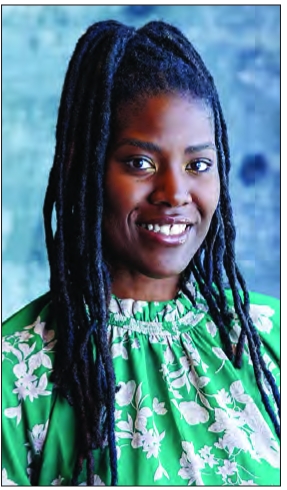
Mayowa “MO” Osinubi, founder and president of Mics for the Missing Inc.
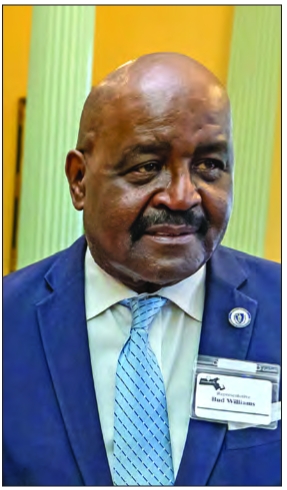
State Rep. Bud Williams, co-sponsor of the Ebony Alert bill.
Legislation would strengthen response for missing Black youth, women
Lawmakers
have until July 31 to advance legislation that would establish an Ebony
Alert notification system for Black youth and women under 25 who go
missing under suspicious circumstances.
If
the final vote is successful, advocates believe Massachusetts could
serve as a model for advancing protections of missing and exploited
people, sparking a wave of change in the Northeast. California was the
first state to implement an Ebony Alert system in 2024.
State
Rep. Bud Williams co-sponsored Bill H.2732 in May 2024 to establish a
similar setup in Massachusetts; however, despite media coverage and
public momentum, the bill has stalled.
While
missing white women often receive ample media attention, cases
concerning Black women struggle to hold “traction,” Williams told the
Banner. He attests that police may take hours to respond to a report in a
community like Roxbury, compared to a “timely” response in a suburban
setting. He hopes that by instituting an alert for Black youth and women
ages 12 to 25, the state can work to “balance the scales of justice.”
According
to the Black and Missing Foundation, 40% of all missing people
nationwide are Black or brown. Local advocate Mayowa “MO” Osinubi,
founder and president of Mics for the Missing Inc. (MFTMI), said that in
Boston the number is even more disproportionate. Her organization
pulled data from the National Crime Information Center (NCIC) to find
that 70% of people reported missing in Boston are Black or brown.
Osinubi
highlighted that California saw an 87% success rate: it was issued 31
times in its first year, resulting in 27 recoveries. This track record
suggests the system could do a great deal to address the
disproportionately high numbers of missing people of color and girls in
Massachusetts. Williams said that to save even “one life” goes “a long
way.”
When Black girls go missing from
state care, they are considered runaways, or marked as absent, as
opposed to officially missing. As such, police treat such cases with
less urgency. Osinubi contends that labeling a child a runaway is both
dismissive and dangerous, as those fleeing challenging circumstances are
even more vulnerable to exploitation.
“Let’s
say they did run away,” she said. “That doesn’t mean they’re less
endangered. Oftentimes, data shows that they’re even more endangered.”
The
nonprofit president said human traffickers target Black and brown
girls, as they anticipate less effort will be put into finding them.
While
authorities frequently adopt a “wait and see” attitude when children
flee from care, Osinubi points out that “somebody can go missing in
Massachusetts, and they can be in D.C. in under six hours.”
Williams
corroborated that when a child is taken, in “two or three hours, they
could be in New York City.” As such, the pattern of youth of color going
missing in Massachusetts is not merely a local issue but is related to
the wider issue of human trafficking and exploitation.
In addition to an alert system, H.2732 would establish an Executive Office of Missing and Murdered Black Women and
Girls in the Department of Public Safety. Williams describes this as the
“hub” or “brain” of the endeavor, a command center to collect data and
coordinate cases. The office would be required to gather comprehensive
data on missing person cases, incidents of trafficking and homicides.
The measure would also create a community-centered advisory committee to include survivors and family members of the missing.
“There’s no better teacher
than experience,” said Williams, adding that survivors and family
members “walk the walk, talk the talk and live these experiences.” Plus,
grants would be issued to community-based organizations for prevention
and victim services.
Supporters
of H.2732, including advocates at MFTMI, believe that passing the bill
could have a ripple effect throughout the tristate area and the East
Coast more broadly.
“A
rising tide lifts all boats,” said Osinubi. “By helping the most
vulnerable, we help everybody that is missing and exploited.” Turning
this bill into law would “set a precedent for neighboring states to get
on board, expanding the power of the network to protect the missing and
exploited,” she added.
While
the Amber Alert has strict criteria, the Ebony Alert has a lower
threshold to prevent people from falling through the cracks. The
notification may be triggered if the missing party is in danger due to
health, disability or signs that their disappearance was involuntary.
Williams hopes that gathering data through this program will help
advocates identify the “systematic causes … behind violence to black
women and girls.”
Osinubi, who previously researched femicide at Tufts University, agrees with the need to dedicate funding to data collection.
Boston
community groups have been protesting Mayor Michelle Wu’s $4.9 billion
city budget proposal, which would increase police spending while cutting
social services. It is through such cuts that bills comparable to
H.2732 wind up languishing in the Ways and Means Committee.
At
the same time, the federal government has rolled back grant programs
that target resources toward minorities or women. Even so, Williams
voices pride in how the state has tried to stand by immigrants, protect
health care, and preserve SNAP benefits in recent months. He holds hope
for the passage of H.2732, believing it is “long overdue.”
To
keep legislation “on the front burner,” the state representative has
met with leadership, presented data, gathered testimonies and organized
public hearings. MFTMI has held vigils, speeches, community gatherings
and performances. Supporters have garnered press coverage, made calls to
politicians, signed petitions and kept discourse alive.
Osinubi
says that if the bill fails to advance in Massachusetts through this
year’s cycle, supporters will continue to apply pressure on lawmakers.
She added that her organization may also advocate for the Ebony Alert in
neighboring states.
Putting
legislation aside, Osinubi believes that raising “community
consciousness” on this topic ultimately makes conditions safer.
“Awareness is prevention,” she said.