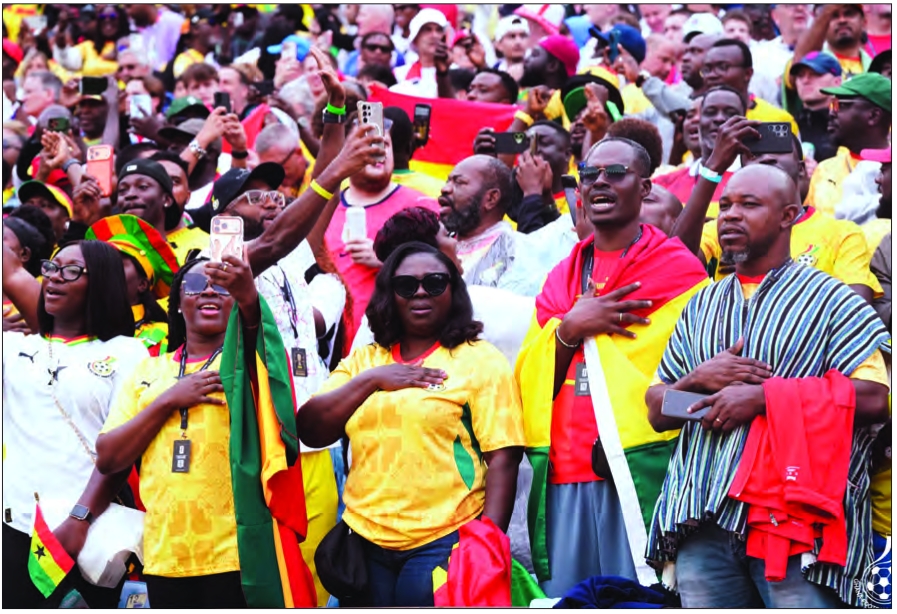
Ghanaian fans await their matchup against Croatia.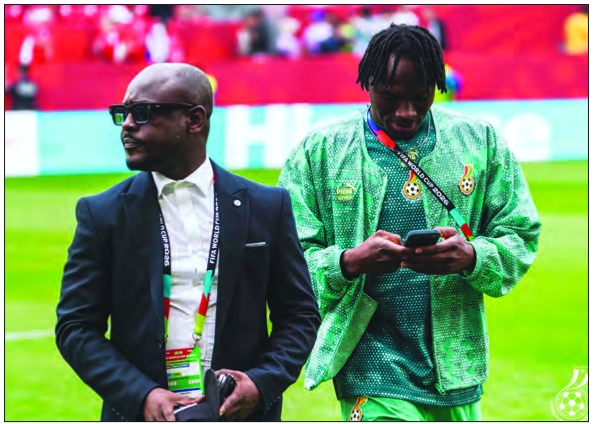
Director
of Communications for the Ghana Football Association, Henry Asante Twum
(L) surveys the field before the match with Black Stars defender
Emmanuel Antwi.
Henry Asante Twum is director of communications for the Ghana Football Association (GFA) and team media officer for the Black Stars. Ahead of their July 3 match against Colombia, Twum discussed his position, role, and upbringing.
A sports journalist of more than 22 years, he previously worked with Ghanaian clubs Tema Youth and Dreams FC before joining the GFA. He spoke about the team’s connection to diaspora communities in Massachusetts and Rhode Island, the “Bring Back the Love” campaign and Ghana’s run to the Round of 32 in the FIFA World Cup.
Banner: How long have you been with the Black Stars, and what brought you to this role?
Twum: I’ve been in this position since 2020, six years now.
Football has been my whole professional life, including work with clubs like Tema Youth, which produced Thomas Partey, and Dreams FC. In 2019, when the current GFA president ran for office, I helped develop his campaign message. After he won that October, he brought me on board, and I have no regrets.
Worcester, Massachusetts, has one of the largest Ghanaian populations outside Ghana. How has the team engaged with diaspora communities here, before and during the tournament?
We began this process months ago, working across different fronts. There are real constraints: when players are in camp, their schedules are tightly controlled between hotel, training and games. So, we found other ways to make the team accessible, including fan parks and autograph sessions. On our third day of training, we opened it to the public for free.
Players signed autographs, took pictures and spent an hour with kids in the community, in partnership with the United Nations and FIFA. Since then, we’ve seen interest not just from Ghanaians but from Liberians, Cape Verdeans and others across the African diaspora.
When
we played in Boston against England, we saw a huge crowd from the
Worcester area. In Philadelphia, the hotel was packed with supporters
the morning of the game and they followed our bus to the stadium,
shouting the name of Ghana.
What’s been the messaging strategy behind this World Cup run, especially in reaching second- and thirdgeneration Ghanaian fans?
We’ve
had a difficult stretch, missing the last Africa Cup of Nations and
exiting in the group stage in Qatar and Côte d’Ivoire. When results are
inconsistent, fans start to lose trust. So, we launched a campaign
called “Bring Back the Love,” meant to reassure the public that we’re
committed to changing the narrative and fixing what’s broken. Our two
core messages have been “bring back the love” and “creating wealth for
all.” Even now that qualification has restored some trust, we still say
we need the love.
Why do you think players choose to represent Ghana over other countries they have ties to?
We’ve
lost talent before. Gerald Asamoah chose Germany, Marcel Desailly chose
France, David Odonkor chose Germany. Even now, Nico Williams plays for
Spain while his brother Inaki Williams plays for Ghana. Sometimes by the
time we reach out, players have already made up their minds.
So,
one strategy has been going directly to countries with large Ghanaian
populations and engaging parents early. We recently met with parents of
England-born boys between 11 and 15, and Antoine Semenyo’s mother spoke
to that group and shared her son’s story. We plan to do the same in the
U.S., wherever Ghanaians live.
How has the team managed the coaching transition to Carlos Queiroz just weeks before the tournament?
It
wasn’t easy. Parting ways with a coach who had already qualified the
team for a major tournament is difficult, but we felt it was necessary.
Queiroz wasn’t in the picture initially, but his experience and
professionalism made him a strong candidate once the search began. He
took the job knowing he’d have only three weeks to prepare, watching
over 170 videos of matches before settling on a 26-man squad. We won our
opener against England in Boston, lost our third match, but still
advanced to the Round of 32.
How did you manage team and fan momentum heading into the knockout round against Colombia?
The
most important thing is to keep dreaming big. Not many people believed
in this team coming into the tournament, given our recent inconsistency.
But we came out of a difficult group with England and Croatia and
qualified before our final group match.
Colombia
is a strong, experienced side: goalkeeper David Ospina is playing in
his fourth World Cup, and James Rodríguez has been a fixture since 2014.
We [went] into that match with a positive mindset, ready to fight for a
win.
What’s the broader message you want this World Cup run to send about Ghana and African football?
I’d tell Ghanaians born
abroad to look back and come home, to be part of the story… Brandon
Thomas-Asante and Antoine Semenyo were born in England and Iñaki
Williams was born in Spain — they’ve all found their way back and have
beautiful stories to share.
To
parents whose children are dreaming of coming home: we’re building an
environment where they can showcase their talent for the world. I also
want people to keep believing in the story of Africa. Nine of the 10
African teams in this tournament advanced to the Round of 32, a
remarkable trajectory, even without key players like Mohammed Kudus,
Alexander Djiku and Thomas Partey in our first match. Let’s continue to
believe, continue to support the team, and I believe we will go places.