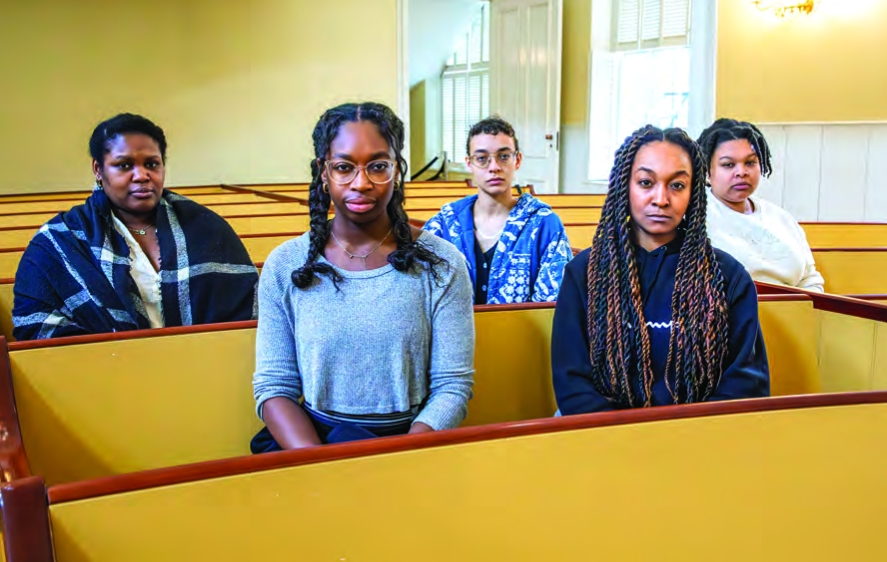
‘A New Era’ cast members gather in the African Meeting House sanctuary.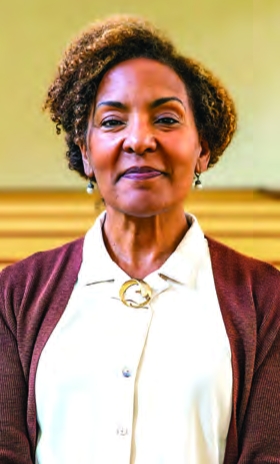
Patrice Jean-Baptiste plays Josephine St. Pierre Ruffin in ‘A New Era.”
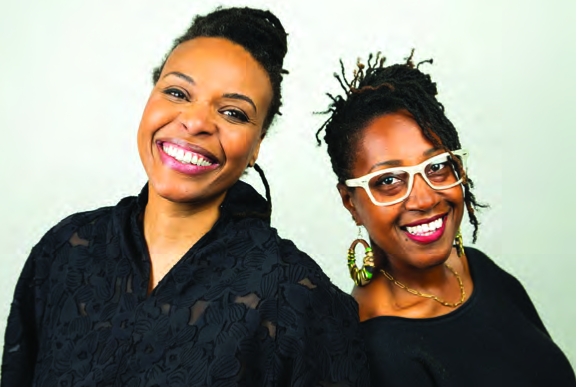
Playwright Miranda Austen ADEkoje (left) and director Summer L. Williams
At the Charles Street Meeting House, an 1807 building at 70 Charles St. that was once home to Charles Street AME Church, a pillar of Beacon Hill’s Black community, a plaque honors one of its leaders, Josephine St. Pierre Ruffin (1842-1924). Citing her activism of 130 years ago, it describes Ruffin as an “African American civil rights leader, editor the Woman’s Era Journal [and] convener in 1895 of the first convention of African American women.”
On July 27, 1895, Ruffin convened a three-day conference in Boston to press for legislation that would criminalize lynching. She and others then gathered at Charles Street AME Church and formed the National Federation of Afro-American Women to bring about “a new era to the colored women of America.”
Ruffin lived to see Congress begin work on anti-lynching legislation although it took more than a century to produce a law: the Emmett Till Antilynching Act of 2022. The organization which she and other conference members founded was a precursor to the National Association of Colored Women’s Clubs, which remains active today.
Ruffin and her companions will come to life on stage July 18 to Aug. 8 at the Strand Theatre in Dorchester in the Company One Theatre (C1) world premiere of “A New Era,” written by Miranda Austen ADEkoje and directed by Summer L. Williams, C1’s cofounder and associate artistic director. All tickets are “Pay-What-You-Want” for this production.
C1’s robust track record and stature in the community —
including access to the more than 1,000 seat Strand Theatre — came in
handy when federal funding was slashed for the National Park Service,
which had commissioned “A New Era.” The play was to be a site-specific
historical reenactment in a 40-seat venue on Beacon Hill. When the
project was cancelled, ADEkoje and Williams had been working on it for
three years.
“This is a
story about Black women in Boston written by a Black woman of Boston,”
said Williams. “And it’s gorgeous. So, I was like, ‘We’re doing this.’
We now have the opportunity to make it larger for the Strand.”
An
actress and playwright, ADEkoje is a fourth-generation Bostonian. Her
paternal grandfather, Boston Police Department Superintendent Herbert A.
Craigwell, was a founder of the Soul Patrol, an all-Black unit that in
1971 policed Dorchester and Roxbury.
Each
of ADEkoje’s eight characters is a Black woman. Six, including Ruffin,
are drawn from history, and two are fictional. Together, they represent
the widely contrasting perspectives of the conference’s 53 delegates,
who represented 26 Black women’s clubs from 14 states and Washington,
D.C.
Set in 1895, the
play opens as they gather in the Beacon Hill home of Ruffin. The
daughter of biracial parents, Ruffin is married to George L. Ruffin, the
first Black graduate of Harvard Law School and the first Black judge in
New England.
“Josephine is in her 50s while the other women are in their 30s,” ADEkoje said during a phone interview.
“I
had all these writings from these women’s pens. Some began their lives
enslaved — two conceived by rape. They had lived through plantation
life, Emancipation, the Civil War and Reconstruction. Then they became
writers and pioneers in Black feminism. With the rise of the KKK, Jim
Crow and lynching, they saw their rights being snatched away. Josephine
is very much aligned with white women abolitionists in Boston while to
the 30-year-olds who had experienced enslavement, aligning with white
women sounds crazy.”
Williams finds that ADEkoje’s play turns a historic event into an urgent contemporary story.
“Our
current political moment feels akin to that of 1895, when
Reconstruction was fading away to a new reality under Jim Crow,”
Williams said. “Then and
now, people see hope and opportunity being erased from this country.
There’s no better way to equip ourselves to resist this than to know
that history and to understand it.”
Williams intends to conjure the urgency in ADEkoje’s script.
“We
want to bring this story to the Strand in a way that feels as large as
that space and also finds its closeness and immediacy — so that when
everyone on stage is yelling, trying to vote for something, the audience
might want to yell, too. The theater is so big that there sometimes
seems to be a divide between the actors and the audience. I’m interested
in disrupting that and blurring the lines a bit.”
The play endows these women’s words with the immediacy and rawness of truth being told.
“Women
in 1895 are figuring out how to build a coalition across race and class
for the greater good,” Williams said. “It’s not common knowledge and it
should be. But we don’t want the veil of history to rub out the
difficulty, the frustration, the joy, the laughter and the tears that
make theirs a very human story.
“It’s
also fun and funny. It’s women talking. Women are funny. We’re quick.
We see what’s coming, name it and get right to the point.”
ON THE WEB
Learn more about the production at companyone.org/a-new-era