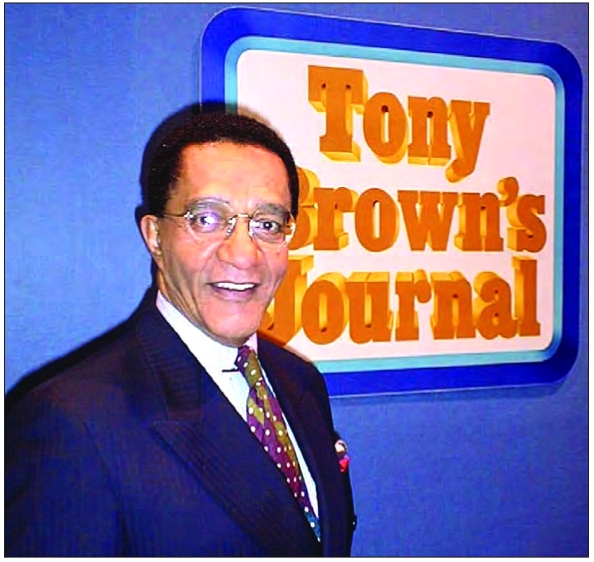
Tony
Brown, journalist, broadcaster, educator and civil rights advocate,
helped redefine Black public affairs journalism and inspired generations
of media professionals. For nearly four decades, millions of Americans welcomed Tony Brown into their homes each week. But Brown was never interested in simply hosting another television program. He wanted to transform the way Black America saw itself—and the way the nation saw Black America.
Brown, the pioneering journalist, broadcaster, educator and civil rights advocate, died June 17, at his home in Newport News, Va. He was 93. His death marked the end of one of the most influential careers in Black media history, but his impact continues to resonate throughout journalism, public broadcasting and higher education.
Long before diversity became a corporate buzzword or television executives embraced inclusive programming, Brown fought to place Black voices, Black issues and Black leadership at the center of the national conversation.
His landmark television program, “Tony Brown’s Journal,” became the longest-running Black-produced public affairs television series in American history.
Airing nationally for nearly 40 years, the program tackled race, politics, economics, education, criminal justice and culture with an honesty that was rare on American television.
Brown interviewed more than 1,000 newsmakers during his career, including the Rev. Jesse Jackson, Lena Horne, Angela Davis, Sammy Davis Jr., President Ronald Reagan and countless scholars, activists, entertainers and elected officials. Yet he often said the most important question guiding every broadcast was remarkably simple: “Will it help Black people?”
That philosophy distinguished Brown from many of his contemporaries.
Rather
than chasing celebrity interviews for ratings alone, Brown viewed
television as an instrument of empowerment. He believed media could
either reinforce damaging stereotypes or become a powerful force for
education, economic advancement and self-determination.
His commitment to changing media was rooted in personal experience.
Born
William Anthony Brown on April 11, 1933, in Charleston, W.Va., Brown
overcame poverty and segregation before serving in the U.S. Army and
earning degrees from Wayne State University. After working as a social
worker and journalist in Detroit, he entered public television at a time
when African Americans were virtually invisible in television newsrooms
and executive offices.
Brown never forgot those early barriers.
Reflecting
years later on his career, he recalled that when he entered
broadcasting there were virtually no Black producers or on-air
personalities.
“When I
started out in television, television stations had almost zero
producers, zero Black faces on the air,” Brown said in an interview
reflecting on his career. “I never dreamed I would ever work in
television.”
He
remembered approaching a Detroit television station as a young man
after being encouraged by a college friend to pursue broadcasting.
Rather than receiving encouragement, Brown was laughed at by a station
executive who considered the idea of a Black television host
unimaginable.
Instead of accepting rejection, Brown helped change the industry.
After
producing Detroit public television’s first program focused on African
Americans, he was recruited in 1970 to lead “Black Journal,” the
groundbreaking national public affairs program produced by New York
public television station WNET. Under Brown’s leadership, the program
grew in influence before eventually becoming “Tony Brown’s Journal” in
1977.
Week after week,
Brown challenged viewers to confront difficult conversations about
race, inequality, economics and public policy. His interviews often
generated controversy because they addressed issues many national
programs ignored altogether.
Brown also understood that representation behind the camera mattered as much as representation in front of it.
He
consistently advocated for more Black producers, writers, executives
and decision-makers throughout the television industry. He argued that
authentic storytelling required diverse leadership in newsrooms and
production offices.
His work extended beyond broadcasting.
Brown
served as the founding dean of the School of Communications at Howard
University before later becoming the inaugural dean of the Scripps
Howard School of Journalism and Communications at Hampton University,
where he helped mentor a new generation of journalists committed to
public service and ethical reporting.
He
also wrote books, syndicated a newspaper column and hosted radio
programs while encouraging Black entrepreneurship and economic
independence.
Not
everyone agreed with Brown’s evolving political views or philosophy.
Throughout his career, he challenged conventional thinking across the
political spectrum, drawing criticism from both liberals and
conservatives. Yet even critics acknowledged his willingness to ask
difficult questions and spark conversations that mainstream media often
avoided.
Perhaps Brown’s greatest legacy lies in the doors he helped open.
Today’s
television landscape— with Black news anchors, network executives,
producers, documentary filmmakers and nationally recognized
journalists—is dramatically different from the one Brown entered more
than six decades ago.
He often credited public television, particularly WNET, for giving him an opportunity when few others would.
“It
helped shape my life in a direction nothing else was prepared to do,”
Brown said while reflecting on the station’s commitment to diversity and
public service.
For
generations of viewers, however, Brown did far more than shape his own
career. He proved that Black public affairs journalism could command a
national audience without compromising its mission. He demonstrated that
television could educate as well as entertain. And he reminded America
that telling Black stories truthfully was not a niche endeavor—it was an
essential part of documenting the nation’s history.
He
reminded America that telling Black stories truthfully was not a niche
endeavor—it was an essential part of documenting the nation’s history.
In
an era when conversations about media representation continue to
evolve, Tony Brown’s career serves as a reminder that progress often
begins with those willing to challenge the status quo.
His
voice may be gone, but the platform he built—and the journalists he
inspired—continue carrying forward the conversation he began decades
ago.
Based on reporting by Chicago Crusader. Originally published by Black Press USA Wire.