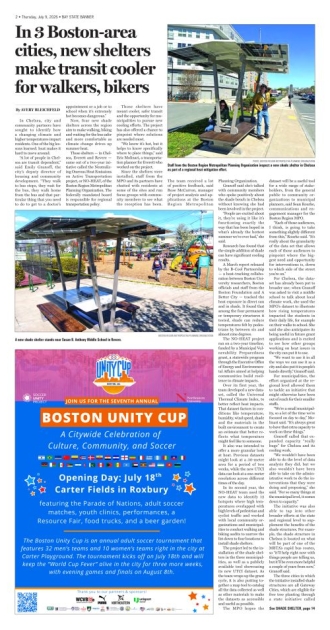
Staff
from the Boston Region Metropolitan Planning Organization inspect a new
shade shelter in Chelsea as part of a regional heat mitigation effort.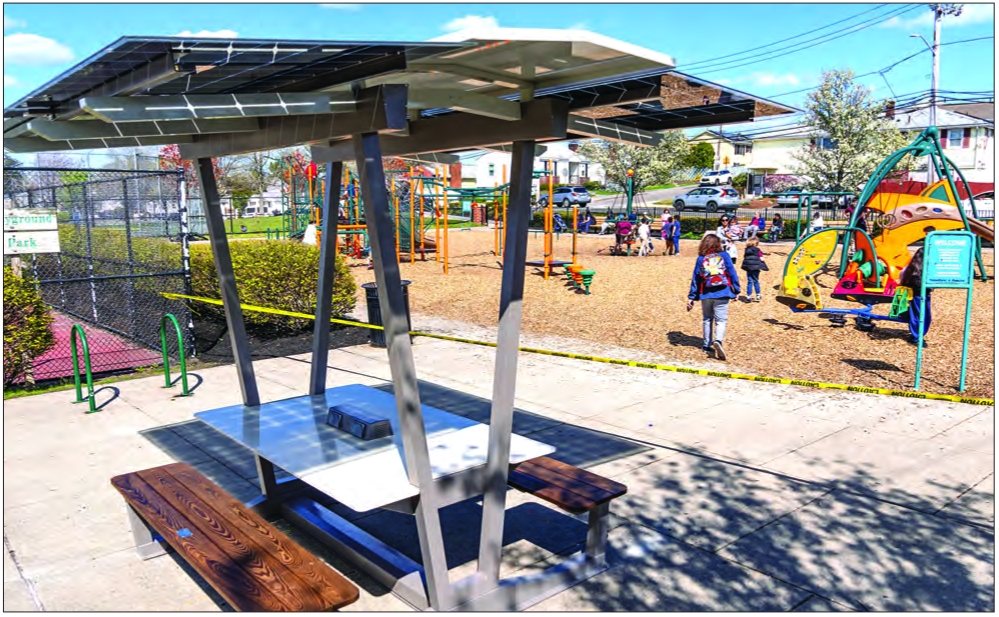
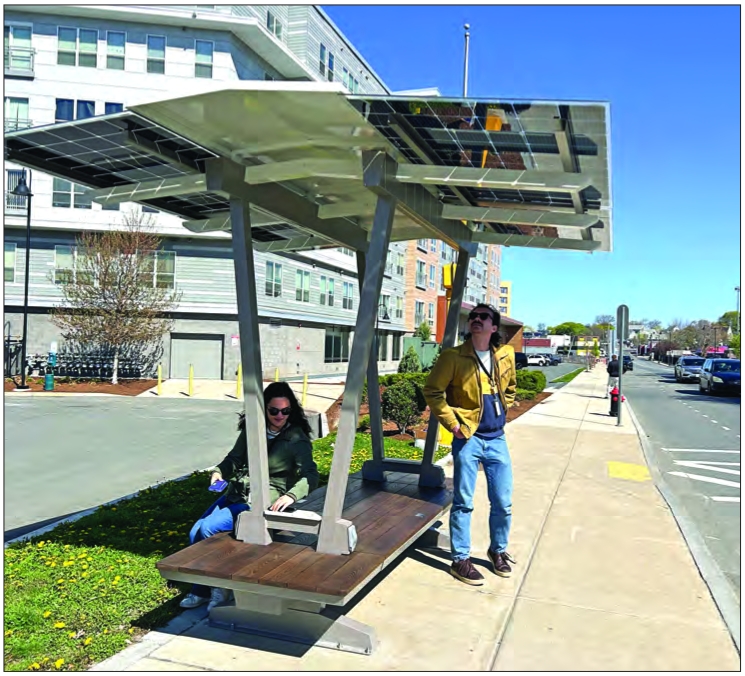
A new shade shelter stands near Susan B. Anthony Middle School in Revere.
A
new shade shelter stands by a bus stop in Chelsea. The two-year
initiative included data collection and new shade interventions to make
transit cooler for pedestrians, cyclists and people waiting for public
transit.
In Chelsea, city and community partners have sought to identify how a changing climate and higher temperatures impact residents. One of the big lessons learned: heat makes it hard to move around.
“A lot of people in Chelsea are transit dependent,” said Emily Granoff, the city’s deputy director of housing and community development. “They walk to bus stops, they wait for the bus, they walk home from the bus and that particular thing that you need to do to get to a doctor’s appointment or a job or to school when it’s extremely hot becomes dangerous.”
Now, four new shade shelters across the region aim to make walking, biking and waiting for the bus safer and more comfortable as climate change drives up summer heat.
Those shelters — in Chelsea, Everett and Revere — came out of a two-year initiative called the Neutralizing Onerous Heat Emissions on Active Transportation project, or NO-HEAT, of the Boston Region Metropolitan Planning Organization. The federally mandated board is responsible for regional transportation policy.
Those shelters have meant cooler, safer transit and the opportunity for municipalities to pursue new cooling efforts. The project has also offered a chance to pinpoint where solutions are needed most.
“We know it’s hot, but it helps to know specifically where to place things,” said Eric Molinari, a transportation planner for Everett who worked on the project.
Since the shelters were installed, staff from the MPO and its partners have chatted with residents at some of the sites and run focus groups with community members to see what the reception has been.
The team received a lot of
positive feedback, said Rose McCarron, manager of project analysis and
applications at the Boston Region Metropolitan Planning Organization.
Granoff
said she’s talked with community members who spoke positively about the
shade bench in Chelsea without knowing she had been involved in the
project.
“People are
excited about it, they’re using it like it’s functioning exactly the way
that has been hoped in what’s already the hottest summer we’ve ever
had,” she said.
Research has found that the simple addition of shade can have significant cooling results.
A
March report released by the B-Cool Partnership — a heat-tracking
collaboration between Boston University researchers, Boston officials
and staff from the Boston Foundation and A Better City — tracked the
heat exposure in direct sun and in shade. It found that among the four
permanent or temporary structures it tested, shade can reduce
temperatures felt by pedestrians by between six and almost nine degrees.
The
NO-HEAT project ran on a two-year timeline, funded by a Municipal
Vulnerability Preparedness grant, a statewide program through the
Executive Office of Energy and Environmental Affairs aimed at helping
communities build resilience to climate impacts.
Over
its first year, the team developed a new dataset, called the Universal
Thermal Climate Index, to better reflect heat impacts. That dataset
factors in conditions like temperature, humidity, wind speed, shade and
the materials in the built environment to create an estimate that better
reflects what temperature might feel like to someone.
It
also was intended to offer a more granular look at heat. Previous
datasets might look at a 30-meter area for a period of two weeks, while
the new UTCI data can look at a one-meter resolution across different
times of the day.
In
its second year, the NO-HEAT team used the new data to identify 12
hotspots where high temperatures overlapped with high levels of
pedestrian and cyclist traffic and worked with local community
organizations and municipalities to conduct walking and biking audits to
narrow the list down to four locations to install shade shelters.
The
project led to the installation of the shade shelters in the three
municipalities, as well as a publicly available tool showcasing its new
UTCI dataset. As the team wraps up the grant cycle, it is also putting
together a map tool to catalog all the data collected as well as other
materials to make the datasets as accessible and useful as possible.
The
MPO hopes the dataset will be a useful tool for a wide range of
stakeholders, from the general public to community organizations to
municipal planners, said Sean Rourke, communications and engagement
manager for the Boston Region MPO.
“Each
of those audiences, I think, is going to take something slightly
different from this,” Rourke said. “It’s really about the granularity of
the data set that allows each of those audiences to pinpoint where the
biggest need and opportunity for interventions is, down to which side of
the street you’re on.”
For
Chelsea, the dataset has already been put to broader use; when Granoff
was asked to visit a middle school to talk about local climate work, she
used the MPO’s dataset to illustrate how rising temperatures impacted
the students in their daily life, for example on their walks to school.
She said she also anticipates its being useful in future grant
applications and is excited to see how other groups working on heat
issues in the city can put it to use.
“We want to use it in all the ways we can use it as a city and also put it in people’s hands directly,” Granoff said.
For
municipalities, the effort organized at the regional level allowed them
to tackle an initiative that might otherwise have been out of reach for
their smaller staffs.
“We’re
a small municipality, so a lot of the time we’re focused on day to
day,” Molinari said. “It’s always great to have that extra capacity to
work on these things.”
Granoff called that expanded capacity “really huge” for Chelsea and its cooling work.
“We
wouldn’t have been able to do the level of data analysis they did, but
we also wouldn’t have been able to take on the administrative work to do
the interventions that they were doing and proposing,” she said. “For
so many things at the municipal level, it comes down to capacity.”
The
initiative was also able to tap into other broader efforts at the state
and regional level to supplement the benefits of the shade structures.
For example, the shade structure in Chelsea is located on what will be
part of one of the MBTA’s rapid bus routes, so “it’ll help right now
with things people are telling us, but it’ll be even more helpful a
couple of years from now,” Granoff said.
The
three cities in which the initiative installed shade structures are all
Gateway Cities, which are eligible for free tree planting through a
state initiative called Greening the Gateway Cities.
“That
is not overnight shade, but it is thinking of the long term,” said
Brendan Kearney, executive director of WalkMassachusetts, which
partnered with the MPO on the work. “We can walk and chew gum; we can
get immediate shade but also be thinking about longer-term planning for
the future.”
While new
shade trees weren’t the central focus of the first twoyear round of the
NO-HEAT program, McCarron said the Chelsea and Everett sites included
new tree plantings.
As
a grant-funded initiative, the NO-HEAT project faced some time
constraints. With the twoyear timeline of the grant, and the first of
those years dedicated to the data work underpinning the effort, the MPO
team was limited in what types of interventions it could choose to try
to implement.
“Anytime
you’re going into the ground or digging and installing things, that can
really slow things down — getting permitting, making sure the soil is
safe, all of those elements,” McCarron said. It made the shade
structures — which were brought to the site in pieces and, in some
cases, required at maximum pouring concrete — an effective, fast
solution.
That kind of
limitation was recognized by the municipalities too. For example,
Granoff said that Chelsea has already identified three priorities —
shade, seating and water — in its ongoing work around making bus stops
cooler. The new shade shelter checks two of those boxes, but a step like
adding a water fountain is harder to incorporate in a short timeline.
“It
would be great if we could see more water fountains going in in high
transit areas, so people can stay hydrated as they’re moving around, but
it’s true that that also carries added complications because you need
to tap into a water line,” Granoff said.
McCarron said the team would be interested in
considering shade interventions that could be installed along a walking
or biking corridor. She pointed to options like new trees — which for
this project were limited by the time it takes them to grow — or shade
sails, heavy duty fabric canopies — which would have required installing
posts in the ground or getting buy-in from the owners of neighboring
private properties.
Regional
staff members from the MPO said they’d like to see the program
continue, but its exact route forward is currently in a “wait-and-see
mode.”
McCarron said
the Boston Region MPO has applied for a new round of funding through the
state and is waiting to see if they’ll be able to pursue the project
further with that support.
If
they receive the funding, she said future work could include expanding
the types of interventions used, as well as working with new municipal
partners. And, without needing to spend the first year of the grant to
develop the data set, the team would have more time to work on a broader
set of solutions.
Rourke, however, said that funding isn’t a deal-breaker for further work under the NO-HEAT initiative.
“We
are going to be pursuing funding for another phase of this work, but
regardless, we’re not going to let that stop us from doing something
with the data in the next phase of this project, he said. “The scale of
it will just depend on the resources that we have.”