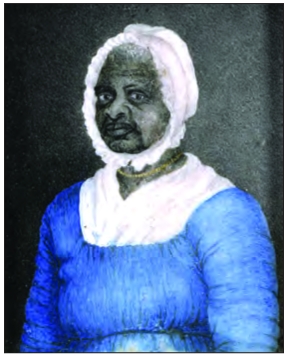
A 19th-century portrait of Elizabeth Freeman by Susan Anne Ridley Sedgwick. 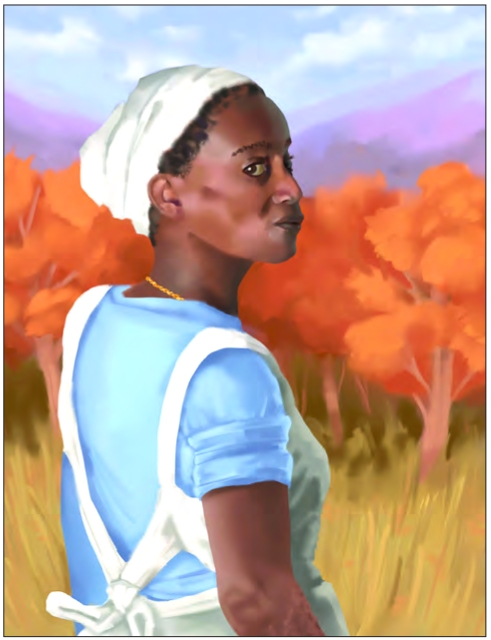
Portrait of Elizabeth Freeman by MassArt student Emma Sunnerberg.
This summer, the Du Bois Freedom Center (DFC) will kick off a series of collaborative community-based celebrations of Elizabeth Freeman, the first enslaved African American woman to sue Massachusetts and win her freedom.
DFC will display an exhibition featuring artwork created by students from the Massachusetts College of Art and Design
(Mass- Art) honoring Freeman. At summer’s end, the project will
culminate with a permanent historical marker erected in front of the
Great Barrington Town Hall, the site of the original courtroom where
Freeman’s case was heard in 1781. This marker will include two digitally
painted artworks by MassArt students Emma Sunnerberg and Abby Glover,
whose art was selected by DFC.
Freeman’s lawsuit was a
bellwether case for many other enslaved individuals who later sued for
their freedom and won. This series of lawsuits led the Massachusetts
Supreme Judicial Court to abolish slavery in the commonwealth in 1783.
“This
collaboration with the DFC is a really beautiful example of the type of
reciprocal and mutually beneficial collaborations that we do at
MassArt,” said Elena Belle White, director of
MassArt’s Center for Art and Community Partnership. “We got to know the
folks at the DFC. The students got to learn and understand the history
and had multiple conversations with historians about this work.”
Freeman,
also known as Mum Bett, was enslaved by Colonel John and Hannah Ashley
in the western Massachusetts town of Sheffield. During the American
Revolution, she attended a public reading of Massachusetts’ first
constitution, taking note of the first article, which proclaimed, “All
men are born
free and equal.” Instead of being struck with inspiration by this
promise, as others around her were, Freeman was enraged by its blatant
hypocrisy.
Less
than a year later, Freeman, lawyer Theodore Sedgwick and Brom — an
enslaved man also from the Ashley household who was added to the case to
ensure that Freeman’s argument was not dismissed due to sexism — argued
that the language used in the new Massachusetts Constitution made
slavery an illegal practice in Brom and Bett v. John Ashley.
The
court sided in her favor, which prompted Freeman to change her name
from “Mum Bett” to “Elizabeth Freeman” to signify her free status.
“Elizabeth Freeman epitomizes what it is to be a true patriot and a believer in democracy,” Belle White said.
“It’s
really important that as we celebrate the [250th anniversary of
America’s independence], we honor this kind of patriotism in our
country.”
All 16
students who participated in the art exhibition were enrolled in
professor Irena Roman’s “Professional Illustration for the Community”
course. Students were asked to produce a historically accurate portrait
of Freeman, as well as a similarly accurate courtroom scene.
Roman
noted that this was a challenging task, as only one portrait of Freeman
exists, which is “very small and was painted towards the end of her
life.”
The DFC,
historians and a live model helped students pursue historical accuracy
through critiques, conversations and posing, respectively.
Students
focused on telling Freeman’s story through art, achieving this by
paying close attention to detail. Some students included a scar on
Freeman’s forearm, which she incurred while intervening in a violent
conflict between a servant girl and Hannah Ashley, who threw a heated
coal shovel at her.
Others focused on Freeman’s posture and body language to convey courage and strength.
“Through these creative partnerships, students discover how illustration extends far beyond commercial markets,” Roman said.
“Ultimately, they see how
their artistic contributions can deepen their understanding of
themselves and their communities, while serving as a powerful catalyst
for change.”
Belle White corroborated that sentiment.
“Contemporary art can be part of historical conversations and explorations, both in terms of thinking through what our
contemporary society is all about and what our past teaches,” she said.
“Artists have a great responsibility, especially in a democracy like
ours where freedom of speech is threatened, to understand that when they
choose to tell a story of this magnitude and importance, they can shift
culture and educate others.”