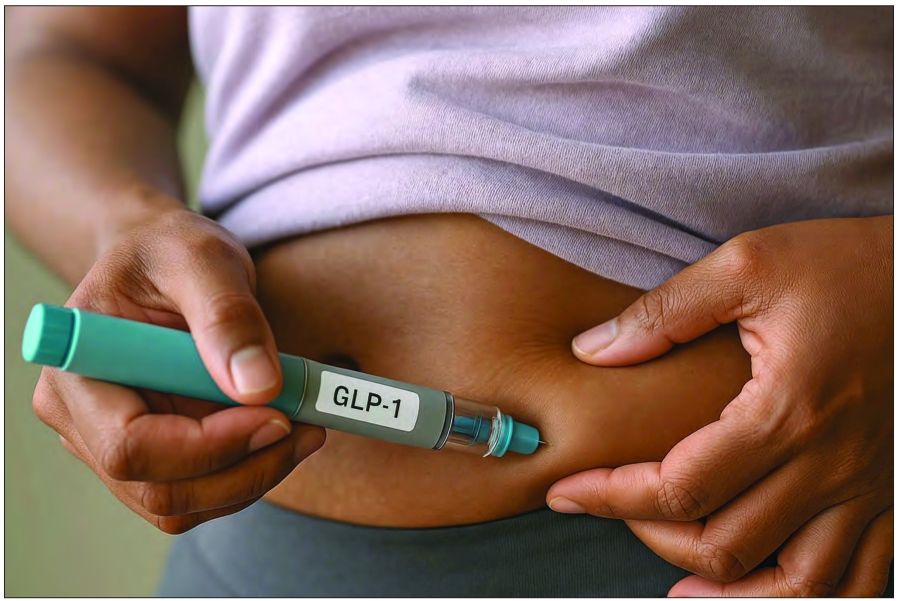
Glucagon-like
peptide-1 receptor agonists, commonly known as GLP-1s, were first
developed to treat type-2 diabetes. Since entering the market in 2005,
they have exploded in popularity as weight loss medications.
In terms of her health, Rachel Harris has felt like the cards were stacked against her.
A 35-year-old Brockton resident and GLP-1 medication user, Harris had three grandparents with type 2 diabetes; all four had heart conditions. Both of her parents had serious heart and bone issues and she was predisposed to develop high cholesterol.
Half her family is “Southern Black from Louisiana, Mississippi, where everything is deep fried,” while the other half of her family is “Russian Jews, where if you even turn down the concept of being given a meal, it’s an offense.”
Besides being overweight since childhood, Harris experiences chronic pain from endometriosis and four bulged discs in her back, making mobility challenging. For years, she tried tactics to bring her weight down, going to the gym, leading an active lifestyle, and diets such as Weight Watchers. Despite her efforts, her progress plateaued.
“A lot of people think that being overweight [means] you have awful willpower, when a lot of times it’s just your body’s chemistry,” she explained.
Harris was prescribed the GLP-1 Ozempic in April 2024, before transitioning to Wegovy and then Zepbound. The glucagon-like peptide-1 receptor agonists, commonly known as GLP- 1s, were first developed to treat type 2 diabetes. Since entering the market in 2005, they have exploded in popularity as weight loss medications.
The most well-known side effects of GLP-1s are temporary gastrointestinal problems, such as nausea, vomiting and constipation. However, a fraction of users has
complained of behavioral changes, such as an inability to feel
pleasure, low motivation or a loss of libido. This flattening of
emotions is anecdotally called “Ozempic personality.”
As
their mass consumption surged in the 2020s, GLP-1s produced a boom in
the biotech ecosystem of Massachusetts, with Boston-area startups,
pharma giants, hospitals and academic centers keen to study the drugs.
However,
insurance providers are introducing a slew of coverage cancellations
and restrictions, citing skyrocketing costs. Starting this July,
MassHealth is axing standard coverage of GLP-1 drugs prescribed for
weight loss, impacting a projected 22,000 low-income and disabled
residents.
The Group
Insurance Commission, which provides coverage to 460,000 Massachusetts
public workers and retirees, voted to do the same. Major local private
insurers, such as Blue Cross Blue Shield of Massachusetts, have made
similar moves. And due to federal funding cuts to grants for clinical
trials and academic research, opportunities are diminishing for the
incoming generation of metabolic disease researchers.
GLP-1
drugs alone cannot produce huge weight losses in a vacuum, with
physicians citing lifestyle changes like movement and eating adjustments
as necessary companions. That said, Harris considers the drugs the
“missing piece” she needed to lose 60 pounds.
That change reduced the massive strain on the knee injury that had cut short her cheerleading days, as well as her bad back.
She
found herself stretching and moving in ways she hadn’t been able to
achieve in a decade. This change is owed not only to the metabolic
impact of the drugs but also to their lesser-known neurological effects.
Many
patients describe how GLP-1s made them stop experiencing “food noise,”
or persistent cravings that occur independently of physical hunger.
Recipients often compare the effect of the drugs to wearing
noise-cancelling headphones, allowing intrusive thoughts of food to fade
away.
Having
experienced a turbulent childhood, Harris recounts that food became a
way for her to selfsoothe. On top of chronic illnesses sapping her of
the time and energy to prepare healthy meals, she found herself eating
compulsively as a source of comfort. The reduction of this food noise
played a major role in Harris’ weight-loss journey.
This
change to patients’ neurochemistry is not permanent. Studies show
cravings often come back in full force after a patient stops taking
medication, resulting in weight gain. Though GLP-1s quieted the constant
“urge in the back of [her] head,” Harris reports that in weeks when she
cannot afford her medications, she would start “consistently looking
for a snack.” She compared it to smokers craving a cigarette, claiming
that it’s similar to “trying to quit an addiction.”
Though
GLP-1s are not yet FDA-approved for addiction treatment, there are
globally over 15 clinical studies into the subject. Mary Shen, a
resident physician at Brigham and Women’s Hospital, studies the
relationship between GLP-1s and addiction at the hospital’s Suzuki lab,
which examines substance use disorders.
“Anecdotally,
physicians were starting to see that their parents were reporting, ‘Oh,
I haven’t smoked in a while,’ and ‘Oh, I haven’t had alcohol in a
while,” Shen told the Banner.
Because GLP-1 receptors dwell in the brain’s reward
centers, the drugs can dampen the dopamine spikes associated with
addictive substances, she explained. When an alcoholic gets a drink, for
instance, the region of their brain associated with reward “lights up.”
This
region, Shen said, shares “a lot of the same circuitry” with other
behaviors regarded as compulsive, such as gambling, nail biting, or
doomscrolling. Indeed, patients have reported a reduction in all manner
of cravings on these medications, beyond food-related urges. Because of
this neurological mechanism, researchers are exploring the possibility
of using GLP-1s as an “adjunct” to assist in the rehabilitation of
addicts.
Most of the research on
GLP-1s has focused on combating negative behaviors rather than
considering the chance of “dampening the reward for healthy behaviors.”
The same reward pathway that allows GLP-1s to blunt unwanted cravings
may also theoretically mute the desire to indulge in hobbies,
socialization or sex.
Medical
experts emphasize that these side effects are rare and large-scale
studies show the drugs overall positively impact mental health. Though
Shen believes behavioral side effects are “definitely worth counseling
patients about,” she affirms that the FDA has extensively reviewed the
safety of the drugs.
Harris
noted that rather than dampening her personality, the medication
allowed her to be “more authentically” herself, because it granted her
greater energy, confidence and self-control.
Beyond
addiction, some users, including Harris, have reported surprising
relief from another chronic condition: endometriosis. The systemic
disease affects about 10% of women of reproductive age, whose uterine
tissue becomes inflamed and can grow on other organs.
Harris
calls it “cancer without the cancer,” referring to how the lesions
spread through the body, causing inflammation, scarring and organs
sticking together. Lesions can also develop their own blood supply,
mimicking the behavior of tumors.
Endometriosis
is not a solely gynecological issue. The tissue can grow throughout the
body, including the bladder, the lungs and even the brain and eyes. The
persistent inflammation can cause extreme pain.
12
years to diagnose, with hospitals frequently dismissing women’s
symptoms. The gold standard treatment is excision surgery, but estimates
suggest that fewer than 200 endometriosis excision experts exist
worldwide. The lack of treatment options, training and research on
endometriosis forms a clear modern example of medical misogyny.
In
such a grim landscape, GLP-1s may offer a glimmer of hope. Anecdotally,
users such as Harris have spoken out about how the medication offered
relief for their inflammation. Studies on animals show GLP-1s can quiet
pain from nerve signaling pathways, calm the body’s inflammation alarms,
soothe the brain, reduce cell damage, enhance cell repair, block scar
tissue formation and prevent the immune system from guarding lesions.
Data from human subjects show GLP-1 drugs can suppress inflammatory
proteins related to endometriosis and cut off the fuel supply of lesions
by reducing estrogen production in fat tissue.
Despite
this promising preclinical research, there are still no large-scale
human clinical trials evaluating GLP-1s as a primary treatment option
for endometriosis. Some endo patients, too, find that the
gastrointestinal side effects of GLP-1s exacerbate their chronic pain.
The drugs require large clinical studies to be considered a legitimate
treatment option for the condition.
With
the lack of funding afforded to women’s health care, Harris is not
expecting to receive GLP-1 coverage for endometriosis any time soon.
“It’s like the light at the end of a tunnel, but...every time you walk forward, it just keeps pulling back,” she said.
In
2023, the American Academy of Pediatrics released new guidelines
permitting GLP-1 weight loss medications for adolescents as young as 12.
In response to the uptake in GLP-1 usage amongst adolescents,
researchers developed the Provider Attitudes on GLP-1 Decision in
Adolescents (PRADA) Study to interview primary care and weightloss
specialized pediatricians from Boston Children’s Hospital, pediatric
private practices and community health centers.
Idia
Thurston, a licensed clinical psychologist and professor of health
sciences and applied psychology at Northeastern University, is part of
the PRADA study team. She emphasized that there is a “real tension”
between the urgent need to treat obesity and the unknown long-term
consequences of suppressing dopamine during critical windows of brain
development.
The
demand for prescriptions, she said, has “outpaced” both data and
available training. Many pediatricians do not feel equipped to reckon
with the challenges of administering these drugs for youth patients —
including the potential for eating disorders to develop, drug
interactions with other substances such as attention deficit
hyperactivity disorder (ADHD) medication and psychological support.
The
PRADA study highlights that marginalized groups tend to rely on
clinical settings that lack the tools to offer “holistic care.” Thurston
observed the greater burden upon community
health centers, compared to those in academic medical centers. Unlike
the former, the latter could more readily refer patients receiving
GLP-1s to behavioral health services. Insurance also played a major role
in whether patients could access resources such as mental health care.
Providers
who serve Black, brown, low-income and immigrant communities had
stronger awareness of the structural issues infringing on their
patients’ health but had fewer resources to address them.
“If
community health centers by default are having less resources, less
training, less opportunity to understand whether GLP-1 medications are
even right for their patient population...we should all be concerned,
because it is a structural barrier that is not equitable care,” Thurston
said.
Black people in
America face persistent disparities in both health care and health
outcomes. In 2022, they were 35% more likely to die from heart disease,
according to the federal department of Health and Human Services. The
same year, Black Americans died from diabetes 78% more often than the
overall population. They are also more likely to avoid going to the
doctor due to fees or being uninsured, and mistrust of the medical
profession because of historical exploitation or mistreatment.
Thurston
points out that structural factors, such as “being stuck in food
deserts,” can be determinants of health, impacting diabetes and obesity
rates. Under these circumstances, there is a dire need for research on
weight loss, especially within the context of communities of color.
Historically,
when Black people are included in research, they are involved as
unwilling early test subjects — as in the Tuskegee Syphilis Study, or
the stolen cancer cells of Henrietta Lacks. Thurston acknowledges that
America has a history of “unfair medical practices on Black bodies.”
Where GLP-1s are concerned, she hopes these medications will be properly
researched in advance, rather than released to communities of color
without prior data.
“We should not be the ones to experiment on the path,” Thurston added.
Harris
understands why Black communities would be mistrustful or fearful of
going to doctors. She concludes the reality is “doing us a disservice,
because so many of us are not getting the treatments that we actually
need.”
As insurance
companies, including her own, are cutting weight loss coverage for
GLP-1s, Harris is growing more frustrated. She previously relied on an
amphetamine for weight loss, which she described as “legal speed,” but
it interfered with her heart rate. On top of being less effective than
GLP-1s, the amphetamine concerned her due to her family history of heart
problems. Harris also has ADHD and fears the risk of taking a stimulant
on top of her Adderall medication.
Doctors
presented her with one other option: gastric bypass surgery, an
invasive procedure that would take her out of work. She recalled
witnessing a cousin suffer complications, getting hospitalized
frequently. Even with coverage, the surgery remains expensive for Harris
because, for an insufficiently obese patient, it is considered
cosmetic.
Blue Cross Blue Shield’s new restrictions will limit Harris’ ability to afford GLP1s.
“So,
you’ll pay for it when I have the diabetes, but you won’t pay for it
before,” Harris said. “That’s the point. I’m trying to avoid that. …
It’s like it’s penalizing us for wanting to be healthy.”
She
voiced concerns about having to pay out of pocket to order medications
through shady thirdparty websites, some of which are facing lawsuits.
She orders generic Adderall from GoodRx, where it costs about $30,
because copay under her insurance would be $120.
“I’m seeing that you’re jacking up the prices and not wanting to cover medications,” she said, alluding to her insurer.
Unreliable access to insurance coverage was one of the focal points of the PRADA study.
“Can
people stay on these medications long term? What happens if insurance
cuts off after two years?” Thurston said. “We know the data on weight
cycling and how it impacts heart health and other cardiovascular
outcomes.”
For Brigham
and Women’s physician and researcher Shen, the concern, too, remains
what happens for patients with addiction facing inconsistent access and
rebounds. For example, if an alcoholic resumes drinking after a long
period of abstinence, she points out, “their tolerance goes way down.
And so, it can pose a much more dangerous issue.”
To
support Massachusetts patients like Rachel Harris now living those very
scenarios, there is renewed urgency to invest research and resources in
GLP-1s.
Physicians worry changes in coverage may undermine patients’ longterm mental and physical health.
If
Harris develops diabetes, she will require expensive insulin
treatments. If she begins having heart attacks or strokes, she’ll face
hospital bills.
“It’s just mind-boggling, and it’s upsetting,” she said of the shortsightedness.