Wyatt
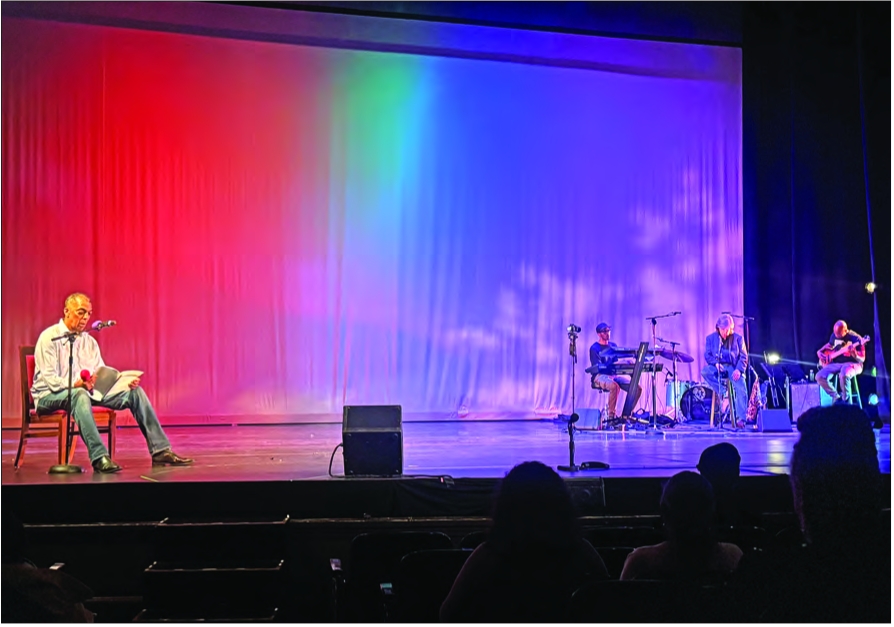
Jackson leads the audience in affirmations and meditations with a live
band during “Harmony & Healing” at the Strand Theatre on June 18. 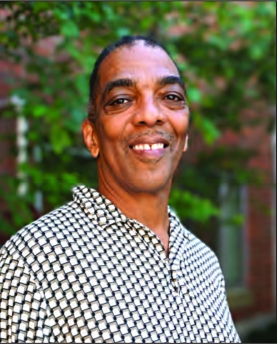
Wyatt Jackson, executive director of We Move in Color Collaborative.
Note: Last week we mistakenly ran the Harmony & Healing preview story from our June 11 issue, and misidentified the writer. We apologize for the mistake.
For several minutes inside the Strand Theatre on a recent Wednesday night, as nearly 250 people sat quietly in their seats waiting for the show to begin, nothing happened.
No music played. No speaker approached the microphone. In most performance venues, the pause would have felt like a technical malfunction. At this show, “Harmony & Healing,” that vacuum was intentional.
“The silence is healing,” said Wyatt Jackson, executive director and story designer of We Move in Color Collaborative Inc., the nonprofit arm of a traveling, multimedia immersive art performance that documents the history of Black Americans from precolonial Africa to the present. Jackson was describing one of the core principles behind the event’s “Can We Talk” storytelling sessions, a facilitated storytelling process built around listening rather than fixing. “It helps people who have been traumatized and dealing with a lot to calm everything down, get their thoughts together and know they’re in community.”
The first “Harmony & Healing” event was held in 2024 in Nubian Square’s Bolling Building in collaboration with Berklee College of Music and attracted roughly 250 participants. Organizers brought the gathering back this year after nearly two years of planning.
This second “Harmony & Healing” gathering, held June 17 and18, blended wellness practices, community dialogue and artistic performances in a program produced by Jackson in partnership with the Roxbury Presbyterian Church’s nonprofit, the Social Impact Center.
While June 18 program featured poetry, music, dance, affirmations and meditation, opening night on June 17 explored a larger question: Why do the expressive arts help heal communities?
That discussion, moderated by Rev. Liz Walker of Roxbury Presbyterian Church, brought together many health care leaders and mental health experts from around Massachusetts, including Dr. Michael Curry, president and CEO of the Massachusetts League of Community Health Centers.
For
Jackson, the panel represented more than a collection of experts. It
reflected relationships built through more than a decade of community
healing work in Boston.
The
roots of that work go back to 2014. Seeking ways to help families
process grief following a death from gun violence, church leaders,
including Walker, partnered with clinicians and artists to create what
eventually became the “Can We Talk” model.
Walker invited Jackson, then known primarily as a performer and arts educator, to participate.
“She
called me out of the blue and said, ‘We’re doing this gathering for a
family who lost their son through gun violence,’” Jackson recalled.
“‘Can you come and dance and do your art in between stories?’”
The
format challenged his assumptions about what to expect after a
performance. “I thought you would get a response,” Jackson said.
But audience members did not applaud. Facilitators resisted filling moments of silence.
People simply approached the microphone, shared stories and listened.
“No
response, just people sitting there.” Later, a woman approached him in
tears and told him, “You have no idea what that dance just did for me.”
Those
experiences eventually inspired “Harmony & Healing,” which Jackson
said was created to move community healing conversations beyond church
basements and meeting rooms.
“We need to get this out of the four walls of a church or a community center,” he said.
The panel explored the connection between art and well-being from multiple perspectives.
Dr.
Joy Allen, clinician and researcher at Berklee College of Music, spoke
about rhythm as humanity’s earliest artistic experience, arguing that
people encounter music before birth through the sounds and vibrations of
their mother’s heartbeat surrounding them.
Dr.
Kevin Simon, a psychiatrist and Boston’s chief behavioral health
officer, discussed research showing how artistic engagement can support
mental health and combat isolation. President and CEO Imari Paris of
Embrace Boston — the organization responsible for “The Embrace” statue
on the Boston Common — focused on the role that art and public monuments
can play in creating spaces that inspire hope in Black and brown
communities.
One of the night’s most animated discussions centered on technology.
Boston Arts Academy Head of School Tyrone Sutton, for instance, warned that artificial intelligence could weaken
the social connections that creative collaboration traditionally
fosters. Sutton argued that young people risk losing opportunities to
develop empathy and interpersonal skills if technology replaces human
interaction in the creative process, Jackson said.
Afterward,
attendees participated in a “Can We Talk” session, where community
members stepped forward to share personal stories. Between speakers, the
room returned to silence.
“This
is necessary,” said Jackson. “It’s needed. We’re at a time in our world
history where all these practices have come to the surface — deep
breathing, dancing, being and spaces where positive energy flows.”
The June 18 program shifted from discussion to artistic practice.
Singer
Deannah Blemur, dancer Aiden Williams, musicians Pat Loomis and Stephen
O’Neal and Jackson himself guided audience members through an evening
of poetry, movement and reflection.
Among
the highlights was Jackson’s poem “Abundant Africa,” adapted from his
multimedia production “We Move in Color.” The poem traces African
history from humanity’s origins to the present day and reflects
Jackson’s broader mission of using storytelling and art to explore Black
history and identity.
Attendee
Ellise LaMotte said Jackson’s performance of “Abundant Africa” stood
out because of its message about the historical contributions of Africa
and people of African descent.
Audience
members also participated in theater-wide affirmation exercises,
reflecting on statements such as, “My experience deserves joy. My body
deserves movement. My mind deserves peace.”
Those affirmations were the evening’s most memorable moment for first-time attendee Jasmine LaMotte of Stoughton.
“I wanted to reflect on my life and everything that has brought me here and just spend time in community,” she said.
Jackson said the event’s purpose extends beyond any single performance or conversation.
For Jackson, healing is ultimately less about solving problems than choosing a different way to approach them.
“No
fixing,” Jackson said. “We’re not here to fix anybody. We don’t tell
you that you have to think this way or that way. It’s a nonjudgmental
space.”