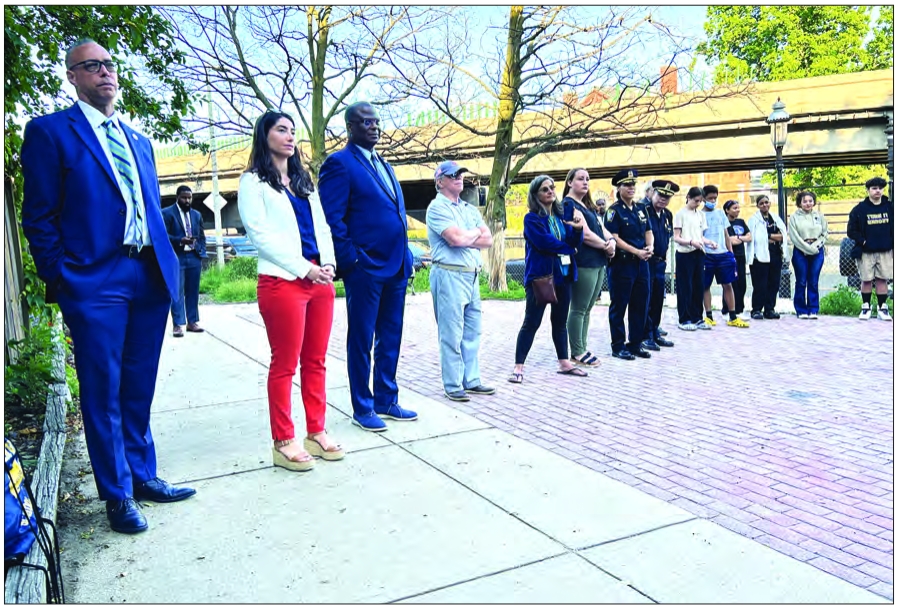
District
Attorney Kevin Hayden, City Councilor Gabriela Coletta Zapata, Boston
Police Commissioner Michael Cox and other local leaders and Charlestown
residents participated in last year’s Race & Equity Dialogues. Charlestown In Solidarity: Race & Equity Dialogues returns to Peace Park
Charlestown youth, health care workers, police and community members gathered on Tuesday, June 30, at Peace Park to celebrate the sixth anniversary of Charlestown In Solidarity: Race & Equity Dialogues.
The event series, co-hosted by the office of City Councilor Gabriela Coletta Zapata, the YMCA and the Charlestown Coalition, brings residents together each month for youth-led conversations about race, equity and community.
The dialogues were on hiatus for the past year during a reorganization of the Charlestown Coalition, before Zapata’s office partnered with the YMCA to bring them back. Now, Zapata said, the Youth Ambassadors who lead the dialogues will even be paid for their work.
“It’s my favorite space that we’ve been able to create as a city councilor,” Zapata said. “We’re building up the program, but we’re also building up [the kids’] leadership, too, and building up their financial coffers.”
The dialogues began in summer 2020 following the murder of George Floyd. Turn It Around, a Charlestown youth leadership program, partnered with the Charlestown Coalition and then- City Councilor Lydia Edwards to launch the initiative.
“At the time, we saw, particularly in Charlestown, that there was a breakdown in conversations around difficult topics including race and equity and diversity and inclusion,” Zapata said. “So, we wanted a space for the youth to lead and to hold adults accountable.”
Many of the conversations in 2020 centered around race and police, Zapata said, with dialogue questions such as “Have you ever acknowledged that you have certain biases?” or “How do you see police in society?”
This year’s conversations have questioned current events, including immigration. Zapata said program leaders have also worked to incorporate more members of different Charlestown sectors, such as health care, the criminal justice system, faith partners and more.
The
dialogues include people who have been on the “other side,” such as
those who have been charged for hate crimes. However, Zapata said, this
does not change the open and welcoming nature of the dialogues.
“It
was such a vulnerable and nonjudgmental space, and everybody there
knows that folks are there to reflect and to be better and learn from
each other,” Zapata said. “The folks that I learned the most from were
the youth, because they are so articulate, they’re so strong, and
they’re opinionated. They’re the ones that really push the adults to
confront hard truths.”
With the dialogues back in effect, the Youth Ambassadors are eager to continue their work breaking down barriers.
Cristhy
Adujar, a Youth Ambassador who became involved with the dialogues
through Turn It Around, said they are especially important at a time
when people are often isolated from perspectives different from their
own.
“There’s so much
division being pushed on everyone, and I think social media is an echo
chamber where people … aren’t being exposed to diverse thoughts and
experiences,” Adujar said.
For
Mswati Hanks, the youth programs manager at Charlestown Coalition, the
dialogues provide an opportunity to break through divisions while
reflecting Charlestown’s diversity. Hanks said divisions across racial,
class and social lines make it especially important to host these
conversations.
“We end
up learning about each other,” Hanks said. “I think everyone gets to
see that, no matter our differences, we’re so much more alike.”
The
Youth Ambassadors help organize each dialogue by developing discussion
questions, promoting the events and encouraging other young people to
attend, gaining the experience to potentially lead future dialogues.
If
there’s one thing Adujar hopes participants leave with, she said, it’s
the understanding that “We’re not so different. …We’re all just human,
no matter what, just trying to get by,” she said.
Zapata
said the dialogues have become more than just about having tough
conversations — they’re an opportunity for the community to come
together and break barriers.
“Folks
that have lived there for 70 years, and folks that have lived there for
seven months, have found commonality in that vulnerability,” Zapata
said. “It has grown into this welcoming and inclusive space where
neighbors can meet each other. …They come as strangers and end up like
friends and family.”
Hanks
added that the goal of the conversations is to inspire participants to
continue discussing the topics, encouraging them to “leave and speak to
other people in their life about this.”
Although
non-Charlestown residents are always welcome, Hanks said he hopes other
neighborhoods will develop similar dialogue series.
“This
has been such a sacred place for Charlestown residents,” Hanks said.
“Everyone’s invited and we do have people that come from different
places all the time, but we’ve never made a big push to Greater Boston.”
Adujar
said she believes communities across the city could benefit from
creating similar programs, especially as Charlestown in Solidarity has
become a “staple in the downtown community” for them.
“It
really helped transform generation-long stereotypes and racial
divisions in such a small community,” Hanks said. “It’s really just a
chance to celebrate the community, celebrate the youth that have taken
part and celebrate a neighborhood that has come together.”