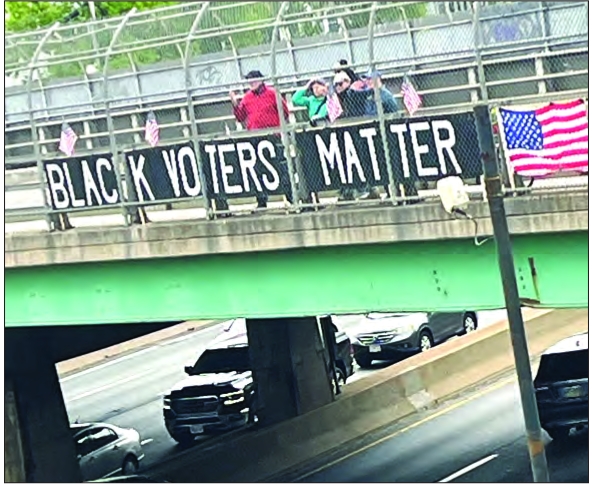
Protesters stand on an bridge showing loyalty to voting rights.As the 2026 midterms approach, voting rights advocates across Massachusetts are sounding the alarm — not only for Election Day, but about the structural forces quietly eroding Black political participation long before anyone casts a ballot.
From the legal corridors of the ACLU of Massachusetts to the neighborhood streets of Jamaica Plain, organizers say the threat to democracy is real, urgent and demands response at every level.
Traci Griffith of the ACLU of Massachusetts said that while the commonwealth lacks the aggressive voter ID laws seen across the South, she cautions against complacency. “We’re voting in place of people who can’t — our young people, our incarcerated family members, our neighbors who aren’t citizens. We have to vote to protect people who can’t,” she said.
However, for those who can vote, voter roll purges is a major worry.
In Brockton, a majority Black city, as many as 60,000 residents were placed on inactive voter rolls ahead of the last municipal election, she said. The system ties voter eligibility to the municipal census, disproportionately penalizing renters, students and lower-income residents who move frequently or miss the mailer.
“It just so happens that a lot of those voters happen to be within communities of color,” she said.
Felony disenfranchisement compounds the problem, as does a surge in disinformation
campaigns targeting Black and Latine voters. But Griffith also points to
something less visible: the psychological toll of feeling politically
unseen. When residents don’t see candidates who reflect their concerns
or can’t draw a clear line between their vote and their daily lives,
“sometimes that’s keeping people home,” she said.
The
stakes feel especially high in Jamaica Plain, where Mary Weissmann of
Swing Left JP says the threat has taken on new dimensions. Her chapter
has grown increasingly alarmed about ICE deployments chilling civic
participation in diverse neighborhoods, as well as the potential
weakening of the Voting Rights Act.
“We’re very concerned that those changes could disproportionately impact people of color,” she said.
In
April, the Supreme Court ruled in Louisiana v. Callais that Section 2
of the Voting Rights Act should now be interpreted to require proof of
intentional racial discrimination. This decision also negates the
evidence that a map diluted minority voting power.
The
outcome is risky for at least 15 House districts represented by Black
congressmen and congresswomen, according to Hansi Lo Wang of NPR.
As
a result, both Swing Left JP and the ACLU of Massachusetts have
responded by deepening their presence in communities most at risk.
The
ACLU’s BIPOC to the Ballot Box program operates in Worcester, Lawrence,
Springfield and Brockton — canvassing to surface community concerns,
publishing candidate guides and co-hosting forums so voters can see and
hear directly from the people seeking their support. Griffith is
particularly focused on shifting attention toward municipal races, where
she says the real impact on daily life is felt.
“It’s
the mayor and the city council that decides the budget for your
community,” she said. “That’s where the effect on your day-today is much
more felt.”
This
fall, the ACLU is launching “What-a-DA-Makes,” a voter education push
centered on open district attorney races — offices with enormous
influence over the criminal legal system and
communities of color. On Election Day, the ACLU will join forces with
the League of Women Voters, Common Cause and Mass Voter Table on
election protection, addressing everything from disability access to
polling places running out of ballots.
Swing
Left JP has meanwhile expanded well beyond its postcard-writing
origins. Weissmann and her neighbors are now canvassing, poll watching
and participating in Swing Left’s national Ground Truth initiative —
driving across the Massachusetts border into a competitive New York
district simply to listen to people’s concerns and worries. The goal is
to converse with those on the fence about voting or within the opposing
political party.
“The beauty is you go and you’re simply here to listen,” she said. “People appreciate that folks are coming to hear them.”
On
the legislative front, Griffith says the single most impactful reform
would be same-day voter registration — already law in more than 22
states and consistently shown to boost turnout in communities of color.
“We have to make it easier for people to vote,” she said.
She
also called on elected officials to expand early and mail-in voting and
to directly confront the economic disparities that keep people from the
polls.
Both organizers ultimately hold the same belief: action is not optional.