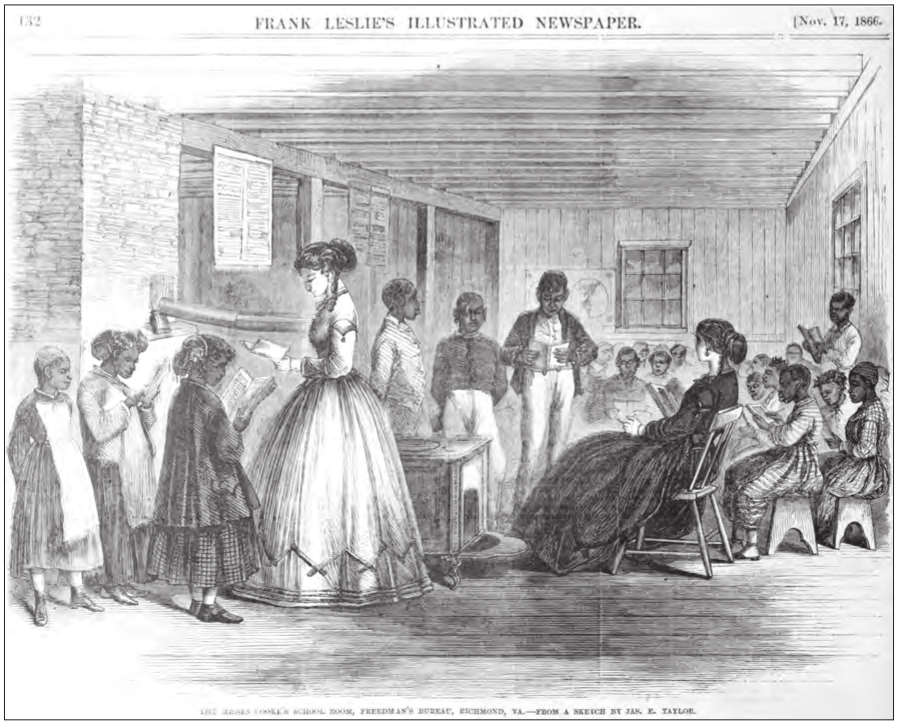
An illustration of “Misses Cooke’s” schoolroom at the Freedmen’s Bureau, Richmond, Va., 1866. As our nation prepares to celebrate America250, commemorating the 250th anniversary of the Declaration of Independence, Americans will rightly reflect on the ideals of liberty, equality and self-government. Massachusetts and Boston will stand at the center of these celebrations as the birthplace of the American Revolution.
Yet for descendants of American Freedmen, this anniversary presents a more profound question:
Two hundred and fifty years of independence — for whom?
The Declaration of Independence boldly proclaimed that “all men are created equal” and are endowed with the unalienable rights of “Life, Liberty and the pursuit of Happiness.” Yet when those words were written in 1776, hundreds of thousands of Africans and their descendants remained enslaved throughout the colonies. The very document that became America’s promise of freedom excluded many of the people who helped build the nation.
Our ancestors lived through this contradiction.
They labored without compensation, built the economic foundation of the United States, fought in every American war and contributed immeasurably to the growth of Massachusetts and Boston while being denied the full rights of citizenship. Here in Boston, Crispus Attucks — the first person killed in the Boston Massacre — became one of the first martyrs of the American Revolution. He died for a cause that would not immediately extend liberty to people who looked like him.
For American Freedmen, the story of America is one of extraordinary patriotism alongside extraordinary exclusion.
The end of the Revolutionary War did not end racial discrimination. Emancipation did not end inequality. Reconstruction was
followed by Jim Crow. Generations of discriminatory laws and practices
affected housing, education, employment, voting rights, health care,
wealth accumulation and political representation.
Those consequences continue to shape opportunities today.
That is why Juneteenth holds such profound significance for American Freedmen.
Juneteenth
commemorates June 19, 1865, when the last enslaved people in Galveston,
Texas, learned they were free — more than two years after the
Emancipation Proclamation. It represents not simply the end of legal
slavery for many Americans, but the beginning of a long struggle to
secure the rights that had been promised for generations.
For
descendants of American slavery, Juneteenth is not only a celebration
of freedom achieved — it is a reminder that freedom delayed is justice
denied. It honors the resilience, sacrifice, perseverance and hope of
those who survived slavery and laid the foundation for future
generations despite overwhelming obstacles.
As
Boston continues implementing its reparations initiative, it is
essential that descendants of American Freedmen remain at the center of
those discussions. Reparative policies are most effective when they
address the specific historical harms they are intended to remedy.
For
more than three years, organizations such as the United Sons and
Daughters of Freedmen (USADOF) and SoliDarity Community Engagement Group
have advocated for the recognition of American Freedmen in Boston’s
reparations process. Through community organizing, public testimony,
legislative advocacy and policy proposals, we have worked to ensure that
descendants of American slavery are not overlooked in conversations
about repairing the enduring consequences of slavery and its aftermath.
Today,
Massachusetts has another opportunity to demonstrate leadership through
H.4351, legislation establishing an Office of American Freedmen
Affairs.
Such an office would provide a dedicated framework for historical
research, genealogy, policy coordination, educational opportunity,
economic development and community engagement focused on descendants of
American slavery.
Likewise,
Boston should establish a municipal Office of American Freedmen Affairs
to ensure that the recommendations of the Boston Reparations Task Force
lead to lasting action rather than becoming another report left on a
shelf.
America250
should not simply commemorate our founding ideals — it should also
acknowledge where the nation fell short of those ideals and celebrate
those who struggled to make them real.
The Declaration of Independence established the promise.
Juneteenth reminds us of the cost of fulfilling that promise.
The
work before us now is to ensure that the descendants of those who
endured slavery are not merely remembered during commemorations but
included in the policies, institutions and investments that will shape
the next 250 years.
Only then can we truly say that the ideals proclaimed in 1776 belong to all Americans.
Antonia Edwards is
a board member of United Sons and Daughters of Freedmen, and CEO of the
SoliDarity Community Engagement Group.