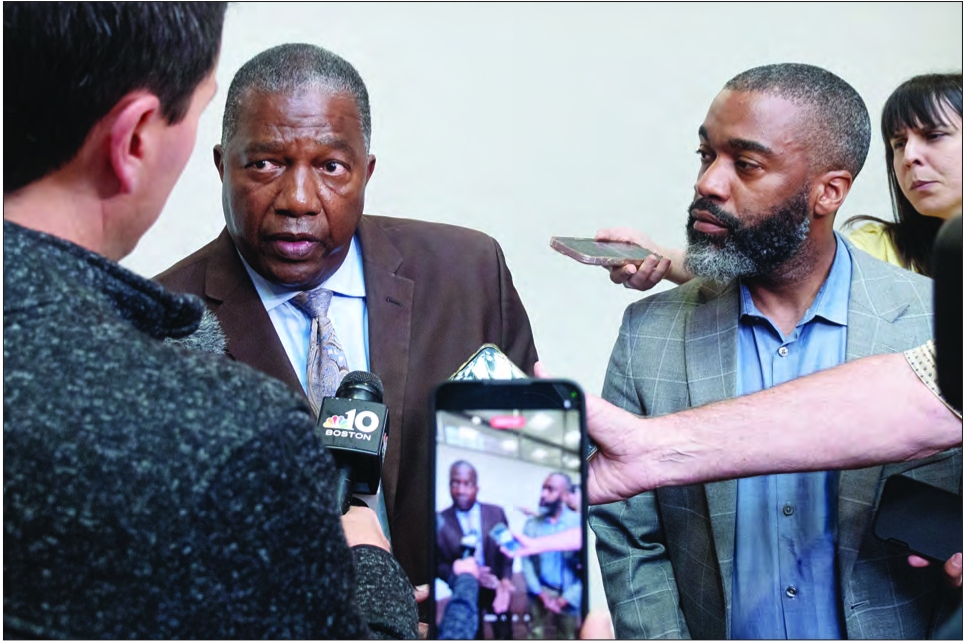
District
7 City Councilor Miniard Culpepper (left) and District 4 City Councilor
Brian Worrell host a press conference outside of the Massachusetts
Department of Transportation headquarters, June 23. At the press
conference, they announced a proposal to create a new branch of the
Orange Line that would run through Roxbury and Dorchester to Mattapan,
replacing a controversial city plan to install a center-running bus
lane.
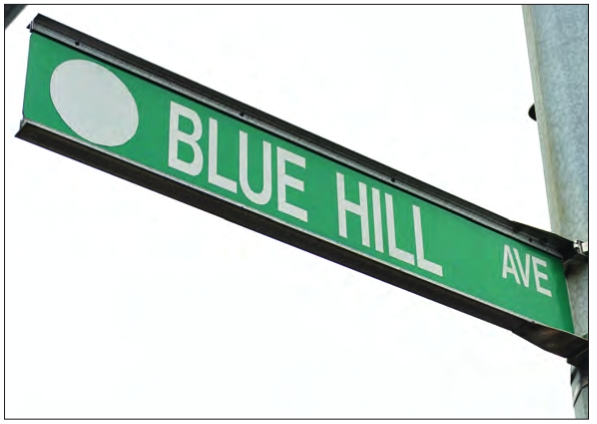
The center-running bus lane proposal has been championed by the administration of Mayor Michelle Wu.Center-running bus lane plan faces ongoing community opposition
Two Boston city councilors see opportunity for bold solutions in the ongoing community fight over the city’s proposal to build a center-running bus lane down Blue Hill Avenue.
At a June 23 press conference, District 4 Councilor Brian Worrell and District 7 Councilor Miniard Culpepper asked officials to consider an extension to the Orange Line that could run from Ruggles to Mattapan Square as an alternative to rapid bus transit design championed by the city and the MBTA.
The city councilors said the extension would bring much needed transit improvements to the area while providing an alternative to the proposed bus lane proposal, which has faced intense community pushback due to concerns that it will increase traffic and negatively impact local businesses.
“This is a train desert,” Culpepper said. “There’s no train that goes through the Black community from Mattapan to Grove Hall to Nubian to Ruggles.”
The press conference followed a meeting where the councilors pitched their proposal to Phil Eng, general manager of the MBTA and the state’s interim transportation secretary. Culpepper said Eng agreed to study the proposal and Worrell called it a “very productive meeting.”
The
MBTA declined to comment on the proposal or the meeting and referred
the Banner to a Massachusetts Department of Transportation spokesperson.
That spokesperson confirmed the MBTA would incorporate studying the
proposed extension into its Program for Mass Transportation process, a
25-year vision that evaluates the major infrastructure projects
proponents wish to see built in the future.
The
center-running bus lane plan that Culpepper and Worrell are looking to
replace has faced growing community opposition since it was announced in
February 2024. A final design of the city’s proposal has yet to be
released but has been anchored by a pair of bus lane that would replace
the median on Blue Hill Avenue and include efforts to improve access for
pedestrians and cyclists alongside general maintenance and
beautification work.
The
project would also require a reduction of lanes for cars or the removal
of parking space. Opponents have raised concerns that those changes
would increase traffic and could impact business along the major
corridor.
“We just
want no center bus lane,” Culpepper said. “Not only do we want to pause
[that plan], we want to take [it] off the table, we want to pull it
down.”
The
center-running bus lane proposal has been championed by the
administration of Mayor Michelle Wu. Wu did not attend the meeting with
Eng, but Culpepper said he had discussed the proposal with her and that
she said she liked the idea but considered it a longterm plan. He said
her absence from the meeting didn’t indicate a lack of support and
described the meeting with Eng as the first step of a process Wu could
be a part of later.
“We
will sit down and talk with the mayor; we will sit down and talk with
the governor,” Culpepper said. “But this is the first step in the
process, and it’s a successful first step in the process.”
At
least off the bat, buy-in from the Wu administration for a plan that
would use an Orange Line extension instead of other Blue Hill Avenue
work may be an uphill battle. In a statement, a city spokesperson said
that it is “always looking to expand public transit access” in
partnership with the MBTA but suggested that the timeline and price tag
for an Orange Line extension posed challenges.
“Digging
new miles of subway tunnel under city streets would take many years of
evaluation and likely well over a billion dollars in federal
investment,” the spokesperson said. “Today, Boston has an opportunity to
deliver more immediate improvements and beautification of the Blue Hill
Avenue corridor with nearly $150 million secured in state and federal
funds.”
If
the MBTA decided to pursue the process, it would probably be a long
one. For reference, the Green Line extension, which saw service on that
line extended on existing commuter rail rights of way from the existing
Lechmere stop to Union Square and to Tufts University, took more than 40
years from when research first began through its completion in 2022.
A
separate proposal to extend the Orange Line from its current Forest
Hills terminus to Roslindale Village using existing commuter rail tracks
could take more than 15 years to complete, according to a 2017 brief
from the City of Boston. A spokesperson for the Massachusetts Department
of Transportation said the department, in partnership with the MBTA, is
conducting a feasibility study for that extension proposal, which could
include running Orange Line trains or more frequent commuter rail
trains for future rapid transit options. The spokesperson said the team
expects to release a report detailing an analysis of the proposal by the
fall.
In contrast,
Culpepper and Worrell’s Orange Line extension proposal would require the
construction of a new underground rail path, where other extension
projects have touted the ease of converting existing railways for subway
service.
The price, too, could be hefty.
The
Green Line extension to Somerville and Medford had a price tag of $2.3
billion. The city’s estimate for the Roslindale Orange Line extension
was, in 2017, priced at $500 million.
In
a 1978 report, the MBTA estimated a version of a Blue Hill Avenue
Orange Line extension along a similar route would cost up to $800
million — more than an estimated $4.3 billion today.
That
large cost would come as the regional transit system faces potential
shortfalls of $239 million by the end of this budget cycle and a
potential funding gap of $732 million in fiscal year 2028.
With
their proposal, Culpepper and Worrell have revitalized a decades-old
idea of extending rail service into Dorchester and Mattapan.
When
state officials looked to take down the Orange Line from the aging
elevated train infrastructure that ran down Washington Street and
planned to move it to the Southwest Corridor, where the Orange Line runs
now, officials promised a reliable transit alternative to serve the
communities that were losing access.
Those
promises never panned out. Ultimately, the MBTA launched the Silver
Line with dedicated bus service down Washington Street between Nubian
Square and South Station. That service has long faced concerns and
complaints.
“We’re
saying we want them to live up to the promise from 40 years ago, so that
we can have the same efficient transportation,” Culpepper said.
He
pointed to a 1979 report released by the Boston Redevelopment Authority
tracking development history and opportunities along the Blue Hill
Avenue corridor, as the city and state considered how to move the Orange
Line and what the impacts might be.
That
report referenced a proposed option underground extension of the Orange
Line but identified fixed-rail trolley service at street level — like
what runs along the Green Line branches on the southwestern side of
Boston — as its preferred solution instead.
An
underground tunnel would bring higher costs and disruption in
implementation, it predicted. The 1979 report also predicted that, with
most of the infrastructure underground and more space between stops,
there would be less community revitalization outside of the areas
directly around the stations.
It
ultimately called for a replacement to be selected “promptly,” to be
implemented shortly after the closure of the elevated rail — which never
happened. The MBTA instead opted to pursue an above-ground trolley line
that would have connected to the Green Line, but in 1987, the federal
government declined to fund it. The project died.
A separate feasibility study produced for the MBTA in 1978 also considered tunnel
transit replacement along the route, but determined ridership probably
wouldn’t be high enough and an underground subway most likely wouldn’t
be faster enough to merit the significantly higher cost.
A
spokesperson for Culpepper said that the key point in highlighting the
report is that neither the Boston Redevelopment Authority nor the MBTA
ruled an Orange Line extension as impossible. The spokesperson said the
councilors believe Roxbury, Dorchester and Mattapan should have the same
opportunity to imagine bold transportation futures that other parts of
the region have had, without cost being an immediate dealbreaker.
“To
dismiss the Orange Line extension based on outdated assumptions would
be a great disservice to residents who have already faced 40 years of
broken transit promises and unreliable services,” Culpepper said in a
separate statement regarding the two reports from the 1970s. “The
residents of Roxbury, Dorchester and Mattapan deserve the same standard
of modern analysis given to any other major project.”
As
the pair of city councilors push for their Orange Line expansion plan, a
separate community push is looking to slow progress on the city’s
proposal to add a center-running bus lane to Blue Hill Avenue. A
coalition of community members sent a letter to the U.S. Department of
Transportation asking it to withdraw $80.3 million in funding the
department obligated, and Congress awarded, to the MBTA in February to
pursue the project.
In
the May 26 letter, its 14 signers said their outreach to the federal
government was spurred by a lack of communication or reception from the
city government. It also pointed to the center-running bus lane on
nearby Columbus Avenue, suggesting that change in infrastructure has
made pedestrians less safe and affected businesses in the area. The
letter linked to a petition opposing the Blue Hill Avenue center-running
bus lane that was signed by more than 2,100 residents over the past two
years.
The letter
called the city’s Blue Hill Avenue plan “the most wrongheaded,
destructive and universally opposed federal project proposed in Boston
since the failed I-95 highway project of the 1960s.”
Dianne
Wilkerson, a former state senator and one of the signers of the letter,
said it was spurred after community members felt that they weren’t
being heard by the Wu administration and they felt the mayor wasn’t
willing to meet with their city councilors as well. She called the plea
to the federal government “an act borne out of exhaustion … and
frustration.”
“Lord
knows that to get to a point where a group of almost totally Black and
brown people write a letter to this current federal administration under
the secretary of transportation saying, ‘Help,’ you must know is the
result of some major disconnect here,” Wilkerson said. “We have gotten
to the point where we have to go ask the Trump administration for
assistance, because our own city government mayor will not speak to us.”
The
funds were awarded by Congress in the February spending bill that
partially ended the partial government shutdown. Because the funds were
signed into law by Congress, the U.S. Department of Transportation may
be limited in its ability to withdraw the funds.
Culpepper
and Worrell, alternatively, proposed that the $80 million be used to
fund their rail proposal, but transportation experts have said that
shift most likely would not be allowed.
Wilkerson
said she views an underground Orange Line extension as a reasonable way
to expand service to the area but recognizes that some people have
concerns about the feasibility of the idea. If neither the
center-running bus lane nor an underground train line were to move
forward, she said she thinks a compromise should be able to exist
between the two.
A
city spokesperson said the city is “working closely with community
leaders, residents, and the MBTA” to deploy the $80 million in funding.
The spokesperson pointed to priorities concerning beautification,
speeding up commutes and expanding opportunities for small businesses,
and said “designs for the roadway improvements will continue to evolve.”
In
a March interview with the podcast DotLife, Wu said when it came to the
redesign plan, including the center-running bus lane, “nothing is set
in stone.”
However,
since the city announced its proposed plan for a center-running bus lane
in February 2024, it and the MBTA have largely kept that lane at the
heart of its work. The joint memorandum of understanding the city and
MBTA submitted that launched the process for the $80 million submitted
to the federal government highlighted a center-running lane as a
priority.
A
spokesperson for the U.S. Department of Transportation said the
department had received the letter and was reviewing it. Wilkerson and
other signers of the letter are scheduling a time to meet with the
federal government.