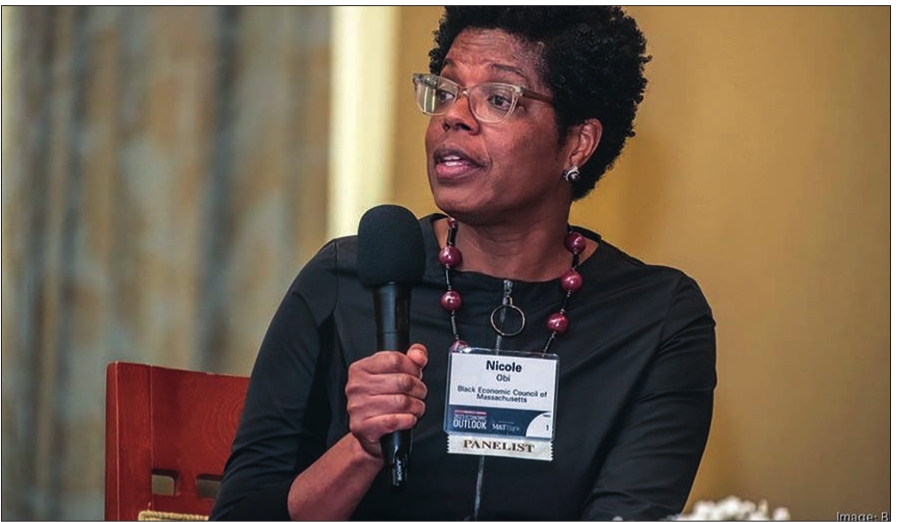
Nicole Obi, President and CEO of the Black Economic Council of Massachusetts, has been the head of BECMA since January 2022. Nicole Obi, president and CEO of the Black Economic Council of Massachusetts, has been the head of BECMA since January 2022. Under her leadership, the advocacy group has supported hundreds of Black-owned businesses in the Bay State, including 400 in 2023 alone.
The organization provided $680,000 in direct support, via capital grants and professional services, during the first half of the year.
Obi has also worked to expand the organization’s reach across Massachusetts, hosting events from Springfield to Martha’s Vineyard, and has worked to amplify the voices of Black business owners.
In addition to serving on several nonprofit boards, Obi was appointed this year to the Governor’s Advisory Council on Black Empowerment, where she advises Gov. Maura Healey on the economic prosperity of the state’s Black community.
The Black Economic Council of Massachusetts has invested $325,000 to help roughly 50 Black- and brown-owned businesses take advantage of Boston’s highly anticipated spike in economic demand this summer.
The member-based nonprofit distributed $40,000 in grants and $200,000 in additional loans to businesses that have secured contracts to provide event-related services — from security to floral arrangements — specifically during World Cup matches and Sail Boston celebrations for America’s 250th birthday.
With the remaining $85,000, BECMA said it provided 150 “digital devices” across all participating businesses, as well as other resources as needed, such as accountants, lawyers and marketing advisers.
The initiative, which prioritized BECMA’s member businesses, is called “Ready, Set, Contract.”
“A lot of times, these contracts are coming in really late. We don’t want people to have to scramble and do things like put expenses on their credit card — especially with the World Cup, because the launch of that has been really behind,” Obi said. “Businesses with contracts were No. 1 priorities.”
Most of the participating businesses are food vendors, such as restaurants and food trucks, that are less dependent on contracts, Obi said. Some of those business owners plan to cater Boston’s tourism-driven events, while others just strive to meet demand and maximize the opportunities that come with an unprecedented tourism period. Instead of grants and loans, BECMA mainly supplied food vendors with technology to boost their operational efficiency, from tablets to hotspots to point-of-sale systems.
Obi emphasized that without such targeted investment in minority-owned businesses, those businesses would lack the resources and capital to leverage the influx of economic activity expected across Massachusetts this summer.
She discussed how Healey enabled bars to stay open as late as 3 a.m. this summer and local establishments’ plans to televise World Cup matches and host watch parties.
“In order for them to take advantage of an opportunity like that, it doesn’t just happen because the rules change,” Obi said.
“It happens because they have the capacity to take advantage of opportunities, and our smallest businesses are not often well positioned to take advantage of an opportunity like that.”
Foxborough hosted its first World Cup match Saturday night, after the Boston Fan Fest commenced the day before at City Hall. Iraq and Norway’s teams will compete in Boston Stadium tomorrow night. Meanwhile, hotel rates are plunging, and although the MBTA will run extended hours for subway lines and some bus routes late on match days, some transit riders will face detours and schedule changes until next month.
This article first appeared in the Boston Business Journal.