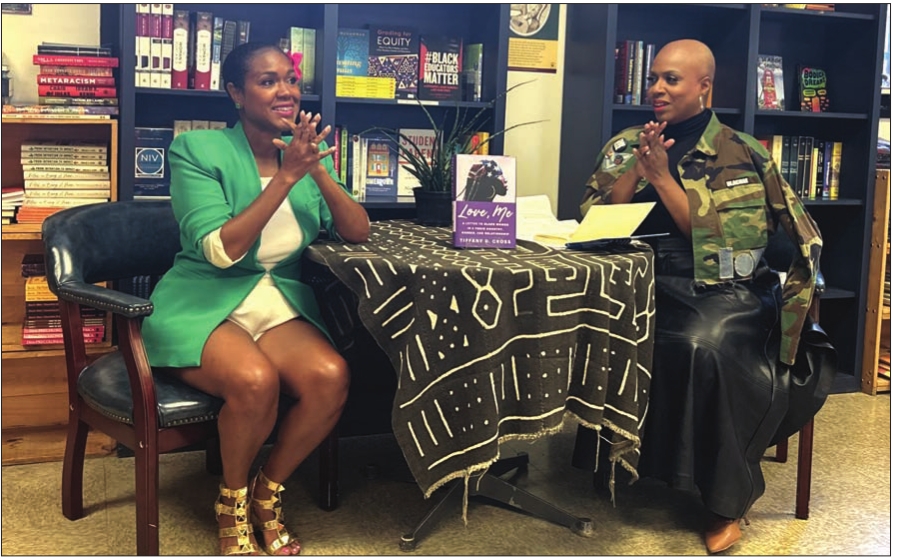
Author and commentator Tiffany Cross discusses her new book with Rep. Ayanna Pressley at the Frugal Bookstore in Roxbury.It’s clear that media maven and journalist Tiffany D. Cross has taken the “when life gives you lemons, make lemonade” mantra seriously.
Her business acumen is outstanding. Highlights include hosting her previous news show, The Cross Connection on MSNBC, which averaged 4.6 million viewers a month, being a former co-host of IHeart Podcast show, Native Land Pod with Angela Rye and Andrew Gillum, which debuted in 2024 on Apple as the number one downloaded podcast in America across all categories, where she helped to break down news and culture of the week, authoring her first book Say It Louder: Black Voters, White Narratives, and Saving Our Democracy, and so much more.
Now she’s stepping into the author seat with her new second book, Love Me: A Letter To Black Women in a Toxic Country, Career, and Relationship, published in May 2026.
Hosted by Frugal Bookstore, Cross recently came to the city for her book tour in conversation with City Councilwoman Ayanna Pressley to talk about how her latest book came to be.
Cross spoke about the cynicism of her latest book in its beginning stages by her former literary agent, as they were not able to grasp her goal and intention for this book, which she said is for Black women to see themselves and feel seen.
“When I’m with my people, I’m home, and if y’all see me, you should feel safe. If something’s going on, we [have] got to get into this mindset: they mess with you, they mess with us. So I feel I wanted to convey that in the book. I talk about a lot of the challenges with self love in the book for black women in general, but for me as well,” she said.
She also spoke about many Black women mourning and grieving over being pushed out of their careers and jobs, coupled with the present state of the world -- including sharing her story of her experience being pushed out of MSNBC by some co-workers and former president Rashida Jones.
“I highlight very specific examples in the book of things that happened to me, from somebody throwing money at me to my subordinates mistakenly thinking that they had equal say in what was going to happen on my show…I talk about at that time the president of MSNBC was a Black woman…it never occurred to me that out there somebody would be so intentional about my destruction, things that I couldn’t imagine, [that] I don’t have a heart for,” she said.
“I was going through navigating bullets coming at me from [co-workers], but the bullet that was hurting the worst was coming from one of my own, and I didn’t have the privilege to publicly dislike her at the time. I still exalted her, so uplifted her in interviews, just consistently trying to be the bigger person.”
Cross also talked about Black women’s careers being central to their liberation, as they live in service for the betterment of the Black community at large.
“I know none of us, as Black women, ever got into any career to build an empire to ourselves. Oftentimes, the career choice we make is to meet a community need…We don’t even have the freedom of dream, even our dreams are handicapped by white supremacy and the oppression that we have, and how can we disrupt it? And so, in liberation, I’ve been thinking, who would I be if not in response to this thing? To me, that’s freedom. Who would I be if I got the ability to just be, and it’s something that my mind can’t even conceive of,” she said.
During the question and answer portion of the conversation, an audience member shared that she missed her perspective on the Native Land Podcast. Cross said that she enjoyed her time there and while she still is in close friendship and connection with her co-hosts -- it was not quite the right fit for her as a journalist.
“It was challenging for me because I’m a journalist and I was the only one who had never worked for [a [political] party. I had never been a party operative, and so they had friendships [with these individuals]. I’m not friends with a lot of elected officials, and when I am…I would try to be very apparent, like I’m gonna tell you, I’m biased here, like this is my girl…,” she said.
She added that when there were individuals who would appear on the podcast who she was not familiar with, she focused on asking them questions on behalf of the constituents they wanted to represent.
“I don’t know [them]. I’m not hostile, but I’m asking you questions. Sometimes at the end of the interview, Angela, Bakari [Sellers] and Andrew [would be] like ‘okay, we love you. We’re praying for you,’ and I’m like, ‘no I’m not’…I’m trying to press them on some things… or even with my cohosts, I want to challenge them on things, and it just didn’t feel like a good fit for me anymore.”
Lastly, Cross shares her personal healing journey of working daily to like and love herself everyday, especially as a Black woman navigating workspaces, relationships and the country at large that consistently tries to tell her and other Black women the lie that they are not enough.
During an individual therapy session talking about her romantic relationship with a former partner, she said that her therapist asked her whether she loved herself.
“I was shocked that I couldn’t answer immediately. I just got so choked up, and the tears just came… I started asking myself, damn, do I love myself? Am I showing up in the world like I love myself? Am I dating like I love myself? Am I spending my time, like I love myself, and really the answer was no,” she said.
“In writing this book, I didn’t want to sound like I’m some sort of spiritual guru: here’s how you do self-love. I’m really just trying to take people on a journey with me. Most days I love myself, some days I wake up and it’s a struggle, but through the process, more days I love myself than I don’t, and more days I find myself worthy and deserving of love than I don’t.”