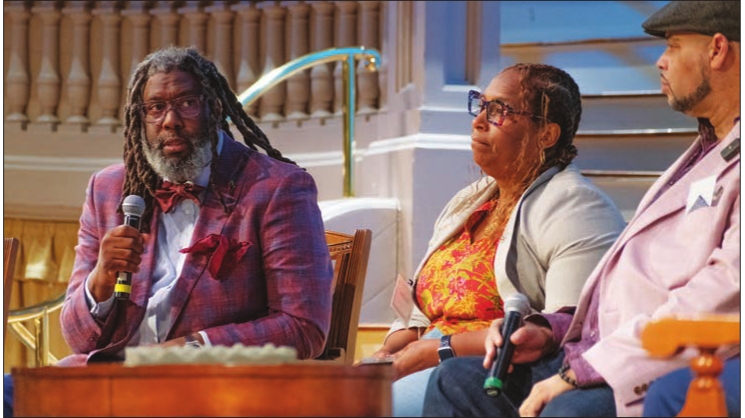
Dwaign Tyndal, executive director of Alternatives for Community and Environment; Stacy Seward, executive director of the Dream Network; and John Lewis, executive director of Blackshires Community Empowerment Foundation discuss community perspectives on environmental justice at a state-organized summit at Worcester’s Mechanics Hall. 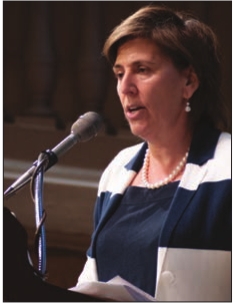
MEE Secretary Rebecca Tepper speaks at the summit.
Environmental justice for the communities most affected by climate change and exposure to pollution is front of mind for state officials who met at a first-of-its-kind summit last week, with a focus on expanding language access, supporting engagement with the state’s Indigenous tribes and pursuing litigation to preserve environmental protections.
At a summit on June 17 in Worcester’s Mechanics Hall, officials from the Massachusetts Attorney General’s (AG’s) Office of Environmental Justice and Equity (OEJE) and from the Healey-Driscoll administration’s Executive Office of Energy and Environmental Affairs (EEA), touted ongoing efforts to push forward on environmental justice initiatives, despite ongoing federal headwinds.
The summit, the first one jointly held by the two offices, allowed the state to expand scale of the event, according to Maria Belen-Power, Massachusetts undersecretary of environmental justice and equity.
It’s also a collaboration she said the state would hopefully repeat.
“I would say together, the EJ team at the attorney general’s office and our EJ team is sort of the perfect combination of bringing together law with policy and programs and funding,” Belen-Power said. “There’s a lot of parallels but also coming together is much more powerful.”
The daylong event featured panel discussions throughout the morning and smaller breakout discussions throughout the afternoon.
Last year, the AG’s office hosted a smaller summit focused on its own scope of environmental justice work and on supporting residents in understanding the systems that impact their environmental exposure. The EEA, on the other hand, is focused on developing new state environmental justice policies and programs to support those communities nearest to polluting facilities and those most impacted by climate change.
One priority for her office, Belen-Power said, is increasing language access for diverse communities when it comes to things like the siting and permitting of energy and other environmental infrastructure.
She recalled an instance from when she worked as an organizer in East Boston and Chelsea. A group of Spanish-speaking community members showed up at an event hosted by the Department of Public Utilities (DPU). Despite requesting an interpreter, one wasn’t provided.
“We got there, and for the four hours that residents sat there, they did not understand, because the [DPU] did not provide that access,” she said.
It’s an occurrence she said she and the EEA are committed to avoiding in the future.
That work has involved developing a language access plan across the state government, hiring language access coordinators and determining what the language access needs in each office and secretariat are.
Belen-Power said she’s also focused on encouraging greater engagement with the state’s Indigenous tribes. When she joined the Healey-Driscoll administration, the commonwealth had been working on developing an environmental justice strategy, but tribal leaders said they felt left out of that plan.
In response, Belen-Power and her office worked to pursue a similar strategy focused on collaboration with tribal groups.
During a plenary discussion at the summit, a panel of Indigenous leaders said that among Indigenous communities, considerations around environmental justice are not only about recent decisions but also historic harms.
“We have to remember that when we talk about environmental justice, we have to remind ourselves that it’s not only about pollution,” Melissa Ferretti, chairwoman of the Herring Pond Wampanoag Tribe, said at the summit. “It’s also about the long patterns of decisions that separated our Indigenous people from the land, from our governance and our identity in many ways.”
What that specific engagement should look like will vary from community to community, she said.
“Theres no one and done,” Ferretti said. “Every tribal community is unique from the other. We all have very different capacity.”
Belen-Power said she is also looking to expand the state environmental justice grant program, which was launched in 2025 and in its most recent round offered about $1.4 million to organizations across the state to support local environmental justice initiatives like expanding access to community gardens, providing professional development for youth in green jobs and expanding capacity needs at local environmental justice organizations. Those funds are up from the nearly $500,000 in its first round.
Even still, there’s room to grow the program. In its most recent round, the state received applications totaling about $11 million, she said.
“Clearly, there’s a big need out there that communities don’t have access to these resources, and really also lost the federal funds that a lot of the organizations were getting,” Belen-Power said.
That’s because the landscape around environmental justice has been complicated by a pullback in support from the administration of President Donald Trump.
“We know that advancing climate justice, particularly through an EJ lens, is not easy,” said Attorney General Andrea Campbell in video remarks. “And during this moment in time, it has become incredibly challenging, given what’s happening at the federal level.”
Since the Trump administration reclaimed office in 2025, the federal government has cut funds for many environmental justice efforts, including the Justice40 initiative, a Bidenera push to direct at least 40% of federal climate investments toward frontline communities.
That’s in addition to steps that the administration has taken to limit environmental action generally, including rolling back environment protections, pulling down federal climate data and the U.S. Environmental Protection Agency (EPA) rescinding its endangerment finding. That move concerned a 2009 determination by the agency that identified greenhouse gas emissions as air pollutants that endanger public health or welfare. The EPA decision has been challenged in a March lawsuit brought by the Massachusetts AG’s office alongside a coalition of 24 states and 12 cities and counties.
“We know that climate change poses an existential threat to our planet and is already hitting vulnerable communities first and worst,” said Amy Laura Cahn, special assistant attorney general in the Massachusetts AG’s Energy and Environment Bureau.
Cahn touted several efforts by the AG’s office to push back in the courts on Trump administration policies. Those legal efforts by the AG’s office have been “largely harm reduction,” however, she said
The attorney general’s office in 2015 also launched an environmental justice fund, that uses civil penalties and settlements in state environmental enforcement cases, to support efforts to restore natural resources, support the health and well-being of disadvantaged communities or contribute to academic or government projects to address environmental protection and conservation in disadvantaged communities.
Cahn said the fund, which provided $475,000 in its first round, will help prioritize the voices of communities most impacted by climate change and greenhouse gas emissions.
“Where we go next will be led by fenceline and frontline communities — our leaders in environmental justice,” Cahn said. “We have [an] opportunity to be partners and allies in that work, while maintaining momentum in advancing and enforcing environmental justice and civil rights laws, and supporting the community’s opportunity to thrive.”