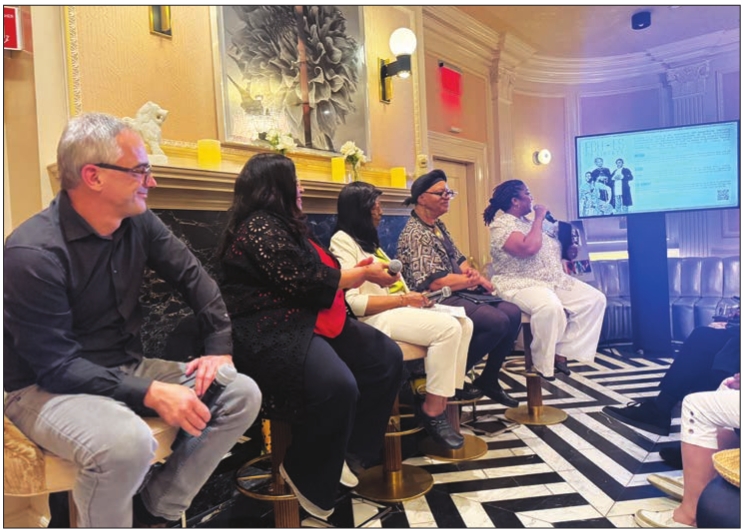
Panelists at the ‘Quin House on June 17 discussing the new, augmented reality historical experience “Echoes of Liberty.”Nerissa Williams Scott was a child when she learned about Crispus Attucks, the Black sailor and dockworker widely remembered as the first person killed in the Boston Massacre.
Except she had a nagging question: “Why would anyone willingly go out of their way to be shot?” she wondered. For years she searched for an answer.
What she discovered was a larger story, one that stretched beyond Attucks to include generations of Black men and women such as the abolitionist and founder of Black freemasonry Prince Hall and Elizabeth “Mumbet” Freeman, the first woman to sue and win her freedom from enslavement. Their lives intersected with the nation’s founding but rarely occupied more than a few paragraphs in textbooks, Williams Scott found.
“As I got older, I recognized that [Attucks] didn’t just decide one day to pick up a fight with the British and go get himself killed,” she said of Attucks. “There was more to his story.”
That realization sent her deep into historical research, which formed the basis of “Echoes of Liberty,” a new augmented reality experience that uses mobile technology, historical scholarship, theatrical performances and location-based storytelling to bring Revolutionary-era Black history into the present.
The launch comes as part of the Massachusetts250 commemorations, a statewide effort marking the 250th anniversary of the signing of the Declaration of Independence. And while the semiquincentennial is having people look back on the country’s history through reenactments and battlefield tours, museums, historical organizations and cultural institutions across the commonwealth are also grappling with a central question: Who gets remembered in the story of America’s founding?
The project, which was formally launched June 17 during a panel at the ‘Quin House in the Back Bay, is rooted in places that remain central to Black history in Massachusetts such as locations in Nantucket. Future experiences are planned around sites connected to Boston’s Black Heritage Trail, the African Meeting House on Beacon Hill and Revolutionary-era landmarks in Lexington and Concord.
Organizers envision the experience eventually stretching across the commonwealth, allowing residents and visitors to encounter Black history not only in museums but on the city streets, village greens and waterfronts where many of these stories first unfolded.
Along with Williams Scott, a panel of local leaders in the Black community, including Dr. Noelle Trent, president and CEO of the Museum of African American History Boston & Nantucket and Dr. Joyce Hope Scott, clinical professor of African American and Black Diaspora Studies at Boston University, spoke at the launch.
For Boston’s Black cultural institutions, the project represents another effort to connect contemporary audiences with a history that predates the city’s better-known abolitionist era.
Long before the Civil War, Black Bostonians, Nantucket residents and others in Massachusetts were shaping the colony’s economy, fighting in its conflicts and challenging contradictions around liberty and enslavement.
“The moment you open the box to tell the stories of one of these ancestors, they start to arrive and start saying, ‘What about me? What about me?’” Williams Scott said. “It was that first ‘What about me?’ that landed us here today.”
The first phase of “Echoes of Liberty” focuses on Attucks, Hall and Freeman.
Through the Hoverlay augmented reality platform that powers the experience, audiences can use smartphones to access immersive experiences and watch performances — such as Golden Globe-nominated actor Blair Underwood as Attucks — unfold in the spaces where history occurred.
Nicolas Robbe, CEO and co-founder of Hoverlay, said the technology creates a different relationship between people and history. Unlike virtual reality, which transports users into a fully digital environment, augmented reality overlays digital content onto existing places.
“Your brain starts to realize that you’re standing right where something happened, where people walked, where history took place,” he said. “Your physical body reconnects with history.”
The platform also offers museums and cultural institutions to reach audiences accustomed to consuming information through digital platforms. Robbe noted that immersive storytelling can help museums and educators compete for attention in a crowded digital landscape.
“You can have great content and great stories, but if you don’t get attention, people won’t experience them,” he said.
For historians on the panel, the larger mission is historical recovery.
Hope Scott described memory as essential to understanding communities whose histories have often lacked the political power necessary to enter mainstream narratives.
“We need to ask whose narrative is at the forefront and whose narrative is missing,” she said.
She encouraged audiences to look beyond individual heroes and consider the broader communities that shaped them.
“The important thing to remember is that they came from somewhere,” Hope Scott said. “They represented communities. They represented people.”
Trent challenged the idea that Black Revolutionary-era history disappeared altogether. Instead, she argued at the launch, Black communities have long preserved these stories, even when broader institutions have failed to elevate them.
She pointed to generations of Black historians, educators, church leaders and community advocates who documented Revolutionary-era Black patriots long before such stories gained wider recognition.
“The problem was who defines whose history is worth knowing and preserving,” Trent said. “That history was never lost.”
But as advanced as the project’s vision is, it’s still in need of financial support to fulfill that vision.
The project still needs roughly $680,000 to complete additional stories and experiences featuring Revolutionary-era figures from across Massachusetts, Williams Scott said.
Many of those attending the launch emphasized that preserving history is not solely the responsibility of scholars or institutions.
To illustrate that point, Williams Scott recalled filmmaker Steven Spielberg’s reasoning for making the Holocaust film “Schindler’s List.”
“He simply said, ‘Because if I don’t remind you, who will?’”
Trent highlighted the importance of physical places in preserving history, including Boston’s African Meeting House, built in 1806 and recognized as the oldest Black church building still standing in the United States. Nearby stands the Abiel Smith School, the nation’s first building constructed specifically for the education of Black children.
She said projects such as “Echoes of Liberty” help connect those historic sites to modern audiences. “Black people have always been here,” Trent said. “They lived here. They worked here. Their descendants are still here.”
That message resonated with Lynn DuVal-Luse, executive producer of the show, whose career has included leadership roles at the Museum of African American History in Washington, D.C. , and the Bay State Banner.
“It was by design that people did not know,” DuVal-Luse said, referring to the systematic exclusion of Black contributions from history books and educational curricula.
As debates over history education, public memory and cultural representation continue nationwide, she said projects such as “Echoes of Liberty” provide an opportunity to broaden understanding.
“Black history is American history,” DuVal-Luse said. “If we don’t leave this project knowing, feeling and loving that fact, then we’ve missed something.”