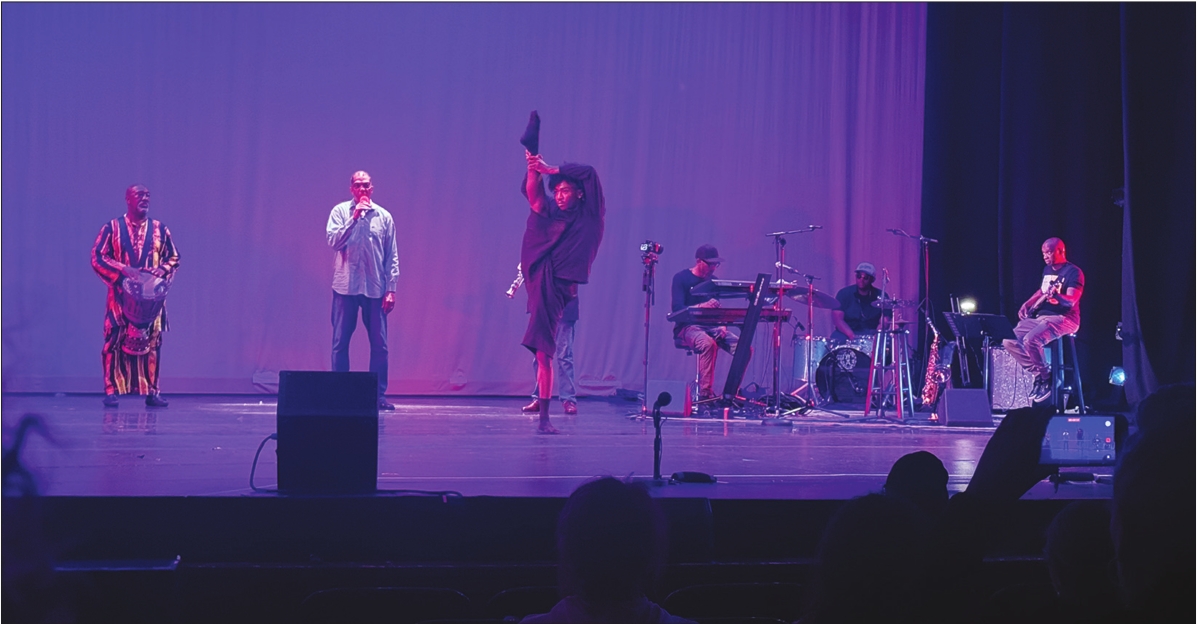
Wyatt Jackson, Aiden Williams, Pat Loomis and Stephen O’Neal perform a scene from “We Move in Color” during “Harmony & Healing” at the Strand Theater in Dorchester on June 18. 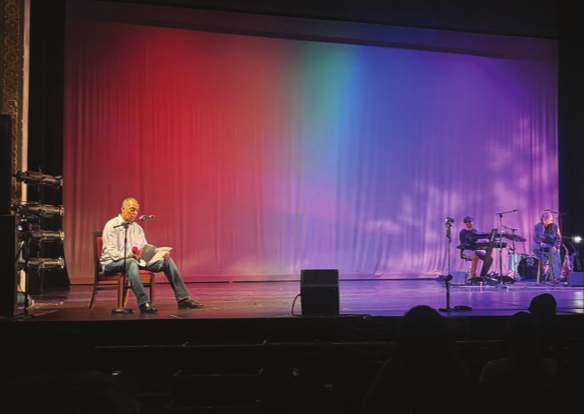
Wyatt Jackson leads the audience in affirmations and meditations with a live band during “Harmony & Healing” at the Strand Theatre on June 18.
Boston community leaders are bringing together artists, activists and residents for a two-day wellness and arts event at Dorchester’s Strand Theatre in celebration of Juneteenth.
Now in its second year, Harmony and Healing is a celebration that uses the arts — from music to dancing to storytelling — to help individuals and communities process trauma. The two-day event will be co-hosted by the nonprofit We Move in Color Collaborative and the Social Impact Center of Roxbury Presbyterian Church on June 17-18. Panel discussions, community conversations, artistic performances and wellness services are designed to promote healing and connection for Boston’s communities.
“When we cannot sometimes express the emotional pain and traumas that we feel, these artistic thought forms give us a chance to express to express ourselves in different ways, and that has a healing and therapeutic value to it,” said Robby Thomas, chief financial officer and co-founder of We Move in Color Collaborative.
According to Wyatt Jackson, executive director of We Move in Color Collaborative, the event grew out of “Can We Talk…” a conversation-based program launched by Roxbury Presbyterian Church in 2014. The program provides a safe space for those experiencing grief or loss to share their experiences with peers without judgement — or “fixing.”
“A lot of times, people come with the assumption to church that they’re going to be fixed,” Jackson said. “We didn’t want people to think…that we’re here to fix you. We wanted them to know that we’re here to hold your stories and allow for your story to be the thing that is the focus of the night, as opposed to our solutions being the focus of the night.”
Instead, Jackson said, simply holding space and listening without judgment is one of the most meaningful forms of support.
“When a woman has lost a son to gun violence and she’s traumatized, it means quite a bit for her to just feel like she can talk about what she’s feeling,” Jackson said. “We understand, and we listen.”
Over the years, “Can We Talk…” expanded beyond Roxbury Presbyterian Church to other congregations in Greater Boston, then to communities across the country and internationally.
Still, Jackson said he felt the program could reach more people.
“I thought, ‘Why don’t we take this outside of the four walls of the church basement and do it in a public space that’s bigger?’” Jackson said. “And I came up with the idea of Harmony and Healing.”
The first evening of the event will feature a panel discussion moderated by Rev. Liz Walker focused on community engagement, cultural resilience and the role of the arts in community healing. Walker will also facilitate a “Can We Talk…” session, giving attendees an opportunity to share their trauma, experiences or feelings.
The second evening will showcase music, spoken word, dance and other artistic performances celebrating the creativity and cultural expression of Black and brown communities. The program will include affirmations, guided breathing exercises and other activities intended to facilitate healing.
According to Jackson, healing through art has been a long-standing tradition in communities of color.
“African American and Black and brown people in this country have used the arts to heal as we were dealing with racism, oppression, poverty,” Jackson said.
“You’ll find that the arts have helped people to move through history in colorful and vibrant and positive ways.”
In addition to performances, attendees will have access to wellness-focused offerings including tai chi, acupuncture and massage demonstrations.
For Thomas, the event comes at a moment where community healing is particularly important.
“There is collective trauma in our community, whether it’s violence-related trauma [or] economic trauma,” he said. “Especially today with the rhetoric around the social and political narratives … sometimes we be re-traumatized as a result of hearing some of the same refrains over and over again.”
Events like Harmony and Healing can push back against that negativity by creating spaces where people feel supported and empower.
“We know that when people feel better, they do better,” Jackson said. “The arts in this form, in the way that we’re doing it, is about promoting a sense of positive energy.
The event’s coincidence with Juneteenth week also holds significance.
“The stories that we hear shift during Juneteenth week, Jackson said, “because people go into their family histories and they talk about all the beautiful and wonderful things that their families have been about. And they think about the music, they think about the dancing.”
The event offers an opportunity to honor the resilience that has sustained Black and brown communities for generations.
“There was a time where we were told, ‘Don’t do that, don’t celebrate,’” Jackson said. “Now, we’re doing it because we can.”