
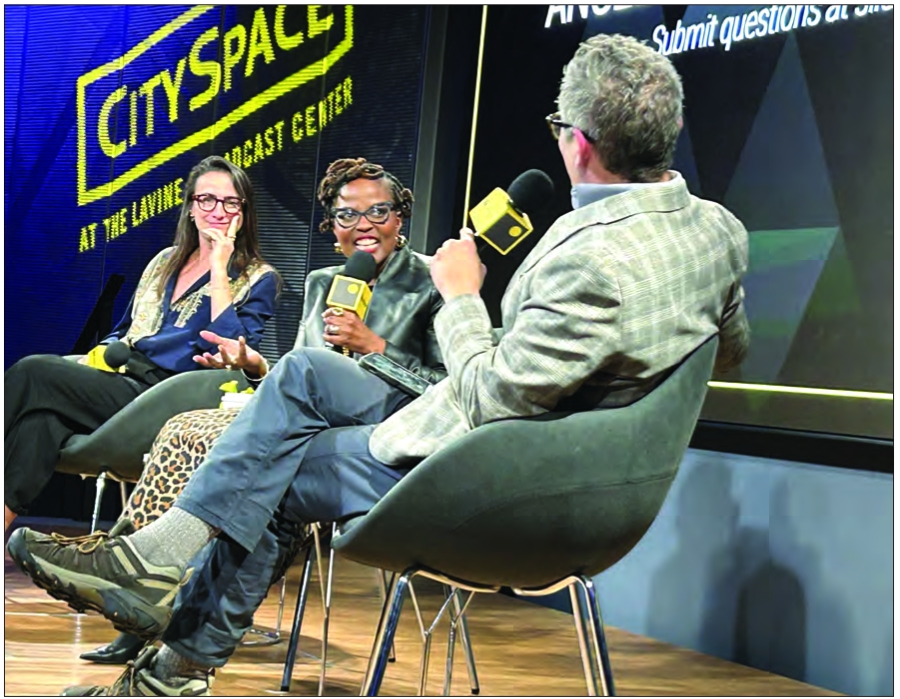
Filmmaker Natalie Rae, Girls For A Change CEO Angela Patton and WBUR reporter Simón Rios discuss “Daughters.”
Speaking at a keynote on the first night of Boston University’s Power of Narrative Conference, Angela Patton, CEO of the Girls For a Change nonprofit, emphasized the importance of building trust with community.
The conference, now in its 28th year, brings together nonfiction writers, journalists, editors and others in creative fields to a weekend of events aimed at sharpening their narrative craft. Patton was present with filmmaker Natalie Rae to talk about their documentary “Daughters.”
The film chronicles the lives of four young girls as they prepare for a special Daddy Daughter Dance program with their incarcerated fathers in a Washington D.C. jail. According to the filmmakers, the film offers a look at “the only opportunity these girls will have to hug their fathers during their sentences, many of which are up to 20 years.” The documentary has earned several accolades since its 2024 release, including being named Festival Favorite at the Sundance Festival and the Documentary Achievement Award at the Miami Film Festival.
The film came out of a talk that Patton had given at a TEDx-Women event in 2012. In it, she described her nonprofit’s work facilitating a one-of-a-kind father daughter dance with young girls at Camp Diva, a Virginia leadership academy for Black girls hosted by her nonprofit, Girls for a Change. To ensure campers with incarcerated fathers were not left out, the father daughter dance expanded, and became a way to strengthen relationships. “Because a father is locked in does not mean he should be locked out of his daughter’s life,” said Patton, as she ended her talk nearly 15 years ago.
At the Boston University conference last week, Patton described how that talk led to an onslaught of interest, from people and storytellers who wondered if she was going to share more via book or movie. Many sought access to the prison system. In that sea, Rae’s message stood out.
Rae was the only one that mentioned wanting to meet the girls, Patton shared. “It was just something about her...she saw the girls, and she saw me,” she said.
It wasn’t long after that their collaboration was cemented. “Natalie literally came, I think, within seven days,” Patton said. “It was very short and immediately, she was actively listening and really just taking all of it in … I just thought that that was special, and it already felt like more of a collaboration than someone just hijacking your story or your experiences.”
Conference goers at the Friday keynote saw roughly 34 minutes of the nearly two hour documentary, after which WBUR reporter Simón Rios moderated a conversation and Q&A session about the film.
A major theme of questions posed by audience members was around building trust with the families depicted, for instance, how did Patton and Rae help the families in the film feel comfortable?
“They all cared before the camera,” said Patton, about Rae and the team of cinematographers, producers and the crew that worked on the film — all of whom got to know the families before filming. “So when there were days that [the participants] just didn’t feel like [filming], no one pressured them. No one said, ‘I just flew all the way here from LA, and I’ve been up all night,’” she said.
The approach offers lessons for journalists and others’ whose works rely on people sharing their stories.
“Allow people time, give them grace, and stop chasing the story,” Patton added.“They will come to you if you have a relationship, and [if] you are doing the truth telling with them, not for them,” she said.
Rae underscored Patton’s point by adding, “Coming into it, I know that I haven’t been living these lives, and this isn’t my story. So, it’s not my job to put together my interpretation of it or my ideas for you, it’s my job to get proximity and trust so that you guys can feel and…really connect to these girls and their fathers,” she said.
The duo also fielded questions about maintaining distance from their subjects and balancing emotions amid the process of working on the film.
Patton was unequivocal that no one, not even the correctional officers — as they often join the girls on the dance floor — succeeded at that.
She added that there have been times where she has had to excuse herself while filming during a dance, as she feels so many emotions. “I am not excited about going into a correctional facility and seeing my brothers live that way … especially if you have experienced [incarceration in] your own family.”
At the end of the day, “It is about the girls, but I do leave for a moment, wipe my face, get myself together, and then go back and fall into my ‘why.’...understanding why am I purposefully there and what I’m supposed to do to make sure that the girls have a life changing experience.”
The film took eight years to produce. In conversation with Patton, Rae emphasized the importance of taking time to build trust and tell stories slowly, even though things that take so long are not often valued, while tearing up. “It’s been so much of my life.”
“There’s no shortcut for time … I was really lucky in a way, that it was so independent and we didn’t have too much financial backing,” Rae said, “because we got to just do it, and we got to follow these girls grow up.”