
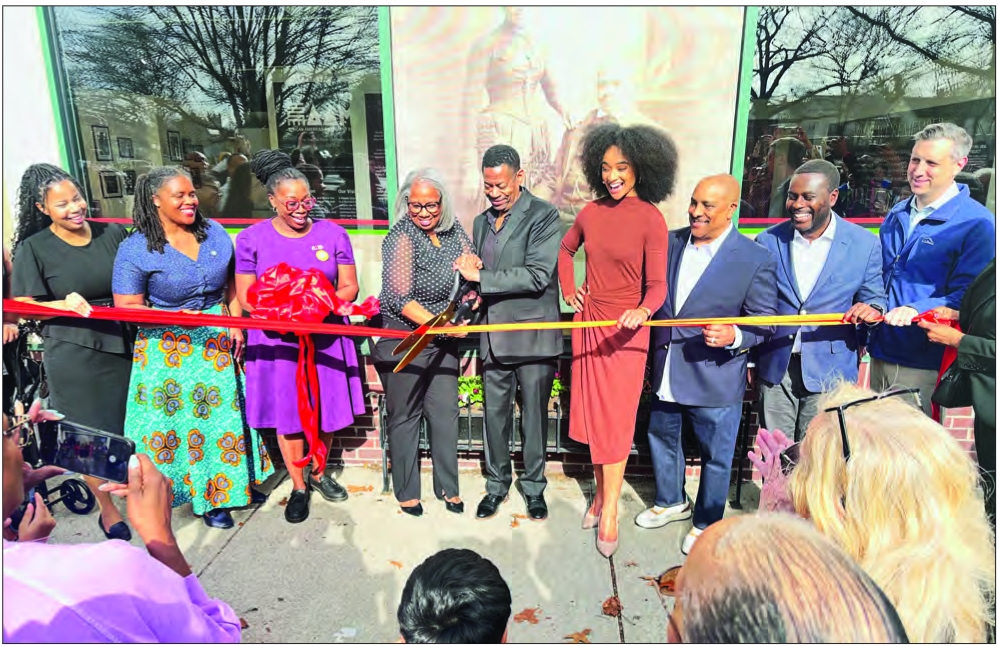
Wendy
Wallace, Sen. Tiara Mack, Angie Bannerman Ankoma, Helen Dukes, Dr.
Christopher West, Dr. Melaine Ferdinand-King, Robert L. Bailey V, Rep.
Gabe Amo and Rep. Seth Magaziner gather for the AAMRI opening.
Prioritizes the grassroots history of South Providence
The launch of the African American Museum of Rhode Island (AAMRI) at the Oasis International Center was more than a ribbon cutting. It was a long overdue homecoming for a narrative often sidelined in the broader New England historical record.
As the crowd swelled beyond expectations and required a quick move to a larger space, it became clear that Providence was hungry for a repository of its own stories. At the heart of this new institution is a philosophy that shifts away from distant, “European institutionalized” curation. Instead, as Inaugural Curator Dr. Melanie Ferdinand-King explains, there is a focus on the “black quotidian”: the extraordinary significance of everyday Black life.
The museum aims to encompass this idea and the breadth of the state’s Black history. Its visual and emotional anchor is rooted in the five-generation saga of the Bailey family. For board member Richard Bailey, the museum’s “face” is quite literally his own ancestry. A professionally framed photograph of his great-great-grandfather, Robert L. Bailey Sr., now serves as the institution’s central emblem.
Robert Sr.’s story is the quintessential American struggle and triumph.
Born in Greensboro, North Carolina, he migrated to Providence and established himself as a produce peddler. The city streets once echoed with his calls of “watermelon” and “vegetables” as he navigated a horse and buggy. From these humble entrepreneurial beginnings, the Bailey line branched into every facet of civic and intellectual life.
That mantle passed to Charity Bailey, a pioneer educator. In the 1950s, she brought a courageous lawsuit against the State of Rhode Island after being denied a teaching position because of her race.
Her husband, Robert L. Bailey IV, was a “revolutionary” civil rights leader and assistant superintendent. He navigated the turbulent waters of 1960s desegregation. His political savvy was legendary. He famously brokered a deal with Mayor Buddy Cianci that secured significant resources for the community. Today, his legacy is immortalized in the Robert L. Bailey IV Elementary School.
Dr. Evans Crawford, a relative by marriage, served as the Dean of Chaplains at Howard University for 40 years. He mentored figures such as Reverend Jeremiah Wright and maintained close ties with leaders such as Vernon Jordan.
For Richard Bailey V, the last living male of this specific line, the museum represents a spiritual “stream” that refuses to run dry. By turning his family’s private archive into a public institution, the Bailey legacy transitions from a personal memory to a permanent pillar of Rhode Island history.
If the Baileys provide the history, Ferdinand-King provides the vision. With a Ph.D in Africana Studies from Brown University, Dr. King’s approach to curation is intentionally grassroots.
The inaugural exhibition, “Welcome to the Neighborhood: Mapping Black Providence in our Archives 1940s–1970s” focuses on the South Side, specifically the Broad Street corridor.
The choice of location was a deliberate ode to the Black community in the heart of the Renaissance City. By housing the museum in South Providence, the board ensured that the institution was accessible to the residents whose histories it celebrates.
King argues that, for too long, academic “text on paper” has failed to convey the gravity of Black theory and life. Curation, therefore, serves as a bridge. It translates deep research into an immersive experience that community members can “feel.”
“It is the everyday Black person that makes up the fabric of history, instead of necessarily highlighting the same people who are always given a platform.”
This focus on the “micro-scale” is a strategic choice. Rather than chasing big-name acquisitions or “high art” sculptures, the museum is prioritizing community-based curation.
The goal is to teach families how to establish their own personal archives. This ensures that today’s records are not lost in the attics of tomorrow.
AAMRI is currently in its “first chapter,” operating out of a single room. However, King and the board are following a prestigious institutional lineage. They look to the Studio Museum of Harlem, which began in a rented loft above a liquor store. They also look to the Smithsonian National Museum of African American History and Culture (NMAAHC), which existed for years without a permanent home.
The immediate objective is to demonstrate that Rhode Island can sustain a dedicated Black museum with professional archives.
This involves three efforts. First, form a Collaborative Coalition: work with other underrepresented groups, including the Asian American Pacific Islander Museum, the Cape Verdean Museum, and the Tomaquag Museum.
Second is Youth Engagement: weaving Providence’s youth into the archival process. This ensures they see themselves as active participants in history rather than just observers.
The third tenet is Expansion. AAMRI is moving toward a dedicated collections and acquisitions department to house the artifacts of Rhode Island’s Black trailblazers.
Executive Director Dr. Christopher West explains, “Our intention, and the first intention, is to create a space so that you can come together, and more importantly, to know what we have done and what we will continue to do.”
The launch of the African American Museum of Rhode Island is a testament to the power of persistence. It is an institution built on the backs of produce peddlers, educators, and revolutionaries. By elevating the “black quotidian” to the level of formal museum study, West, King, Helen Dukes, and the Bailey family are ensuring that the story of Providence is finally told in full—not from the outside looking in, but from the front porches of Broad Street looking forward.
As the museum grows from one room to a regional landmark, it serves as a reminder that history isn’t just what happened; it’s who we choose to remember.