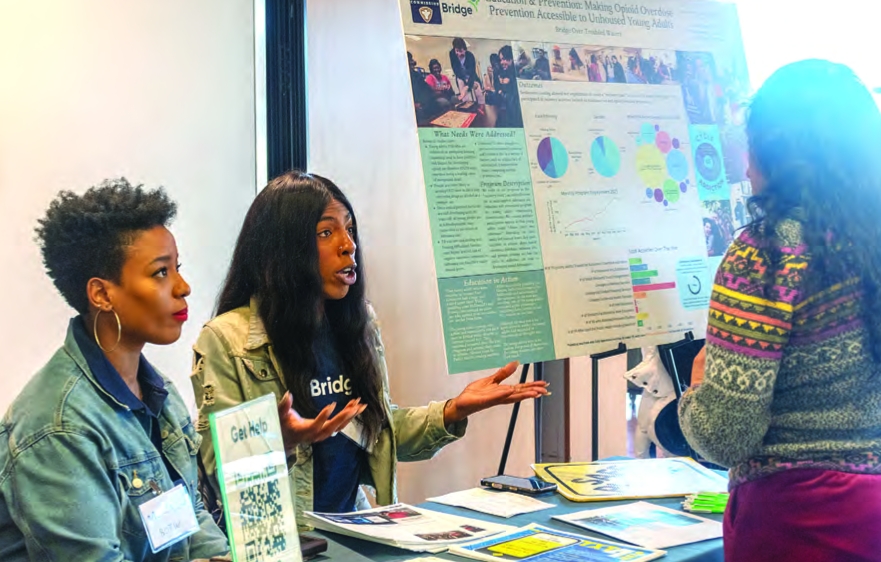
Eli Perry (center), recovery specialist at Bridge Over Troubled Waters, speaks with a community member at a showcase of city-sponsored projects funded by settlements with opioid producers and distributors, March 25. Bridge Over Troubled Waters, a Boston-based nonprofit that works with homeless and at-risk youth, was one of 11 initiatives presenting on the way they’ve used the opioid settlement dollars to address substance use disorder and opioid overdoses.On the second floor of the Bruce Bolling Building in Nubian Square, a crowd milled around, stopping to look at posterboards propped by tables and chatting with the teams behind them.
The posterboards, representing 11 initiatives, also represent more than $18 million worth of active and planned investments through 2028 to address the epidemics of opioid use and substance abuse disorder in Boston.
Beginning in 2021, those efforts have been funded through settlements reached by the commonwealth of Massachusetts with pharmaceutical companies and distributors, including Johnson and Johnson, Walmart, CVS and Walgreens. As of August 2025, Boston had received more than $15.3 million and will continue to receive more than $1 million per year through 2038, according to the city. Those funds are part of a larger pot of settlement money —more than $340.8 million as of June 2025 — that was funneled to the commonwealth. Now, the city has begun to make investments, including in the projects at the showcase, to ensure the money reaches its intended goals.
That’s because state guidelines mandate that the funding allocations go toward actually addressing the opioid epidemic. Christian Arthur, senior policy and strategy specialist at the Health Commission’s Recovery Services Bureau, drew a contrast to settlements paid by tobacco companies in the 1990s. Without guardrails, much of that funding ended up falling through the cracks and went to states to address general needs like filling potholes.
“This time around, the public health folks involved and many community partners, said, ‘No, we don’t want that to happen,’” Arthur said, during remarks at the event.
The projects on display at the March 25 showcase reflected a spectrum that is a far cry from the tobacco settlement model. One of them, through Roxbury-based substance abuse support nonprofit Metro Boston Alive, offers meetings led by individuals in substance use recovery and helps connect people to treatment programs. Another program through community support nonprofit Torchlight Recovery services offers on-the-ground outreach in hotspots like Nubian Square and Massachusetts Avenue and workforce development programming.
Bridge Over Troubled Water, a downtown day shelter for youth, shared information about its existing outreach programming as well as about a new effort to teach the teens about identifying an overdose and administering naloxone, which can reverse the effects of an opioid overdose. Other programs through local health centers extolled their work to connect patients to mental health and primary care services.
At the heart of the projects is a goal to support community-centered efforts that meet residents where they are.
“The … interventions really look at getting funding directly at the community level, so that the solutions are right there … reaching people on the ground,” said Michele Clark, deputy director of programs and services at the Boston Public Health Commission.
That vision was realized after the city undertook a community engagement process in 2023 to inform its use of the settlement funds. Through surveys and listening sessions, the city identified overdose education, the distribution of naloxone, connecting community members to treatment and providing housing and work support as key priorities for the funds.
Clark said that the commission views events like the showcase, which included feedback forms, as well as other outreach around its substance use disorder efforts as a continuation of that process and a way to inform future work through the settlement funds.
That same kind of individualized focus is crucial, those involved with the different initiatives say. Eli Perry, recovery specialist at Bridge Over Troubled Waters, said they believe that the city’s focus on community voices in this process is going to make the results more effective.
“How do we know how to best serve people if we’re not meeting with them, if we’re not meeting with that population and asking them how we can help them, or how they can help us?” Perry said.
Clark said the initiatives at the showcase are well positioned to add to the progress the city has made on the issue of opioid abuse. That progress includes reductions in overdose deaths — 38% decline in 2024 compared to the year before — helped in part by the rollout of programs such as the Community Overdose Response Grants program, a $1 million fund for community-based organizations to provide overdose education, increase connections to treatment programs and expand access to naloxone. That progress was especially pronounced among Black and brown communities, which have historically also been affected the most — the opioid-related mortality rate fell by 59% for Black men in 2024 compared to the previous year and 52% for Latino men.
At the time, Dr. Bisola Ojikutu, executive director of the Health Commission, attributed those declines to efforts like the ones supported by the settlement funds: work done in partnership with community-based organizations, residents and local health organizations.
One of the initiatives on display, the Family Overdose Support Fund, was something the city of Boston launched last year. It directed $250,000 from the settlement to individuals and families impacted by the overdose crisis to pay for things like funerals, mental health support, childcare and legal services. That fund is now being managed by Healing After Loss to Overdose Initiatives, a nonprofit that provides financial support to families, in collaboration with the Public Health Commission.
Over the past year, the group has helped 50 families — a more than threefold increase from its previous reach of 16 families — because of the settlement funds. Most of those families were Black and from Dorchester, Mattapan and Roxbury, and received help to help pay for funeral expenses, behavioral health and counseling services, and childcare.
Brendan Little, one of the co-directors and co-founders of HALO, said that being able to expand at the scale they have was exciting and “very heartening.”
“We always believed in this work,” Little said. The settlement dollars have also created a proving ground for some of the efforts.
In October, the Mosaic Opioid Recovery Partnership — a private-public partnership between the state and RIZE Massachusetts, a nonprofit organization focused on addressing the opioid epidemic — awarded HALO a $1.25 million grant to expand its efforts to communities across the state. Little said they plan to expand to five new cities and towns but are still determining which ones they’ll plan to work in next.
Elsa Gomes Bondlow, HALO’s other co-founder and co-director, said that shift is also bringing adjustments to help the program run better. For example, they’re raising the amount of financial support they can offer from $5,000 to $7,500 for funeral services, having found that the higher amount is closer to the actual average cost to families. They’re also expanding what’s known as the “lookback period” — the duration after a family member’s death when they are eligible for support funds — in recognition of the long tail the opioid epidemic has had.
With the city expecting a total of up to $40 million by 2038, Clark said it plans to continue putting the dollars toward equitable and data-driven programming informed by community input.
“Data-driven equity informed and sustained community-based investments, including those through the opioid settlement funds, are key to sustaining and continuing the decline in opioid overdose deaths in our city,” Clark said. “We still have a lot of work to do, and we know how we can build on the strategies we know work.”