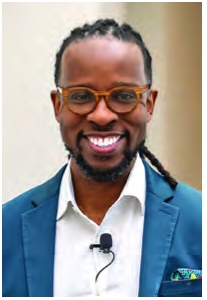
Ibram X. Kendi
Ibram X. Kendi discusses his new book examining global authoritarianism
As the U.S. president and his administration move to replace democracy with the practices of authoritarianism, it pays to ask: how did we get here? And how do we get out of here?
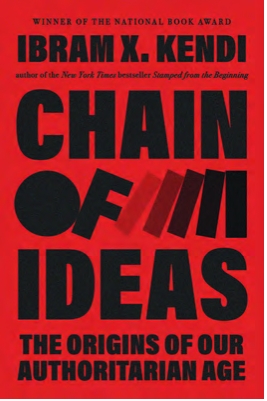
“Chain of Ideas: The Origins of Our Authoritarian Age,” Dr. Ibram X. Kendi’s latest book, identifies “the great replacement theory” as the singular ideology that, nation to nation, is used by leaders to create anxiety. Once anxious, the population is then manipulated by misinformation and propaganda. The goal, Kendi writes, is to convince people that only an authoritarian leader can prevent the majority population from being replaced.
Kendi makes extensive note of how replacement theory was used by the German government and its collaborators in the 1930s, and during World War II, to create the legal conditions for the Holocaust. He describes how in these modern times, Asian, South American, European and North American leaders — such as Vladimir Putin (Russia), Benjamin Netanyahu (Israel), Nayib Bukele (El Salvador) and Marine Le Pen (France) — try to convince their majority populations that without their authoritarianism, they will be replaced. The idea is to scare people by demonizing others, describing them as an existential threat to their way of life.
Looking at wellsprings of fear and showing readers how it is cultivated by misinformation and propaganda can encourage critical thinking. Kendi’s book is as much a manifesto or polemic as it is an academic work.
Currently the director of the Institute for Advanced Study at Howard University, Kendi is an activist and an educator. As a historian, he has been at the forefront of antiracism efforts. Porter Square Books will host Kendi in conversation with congresswoman Ayanna Pressley at First Parish Church in Cambridge on March 31.
The Banner spoke with Kendi about his work last week.
Banner: “Chain of Ideas” has as its historical interpretation of global authoritarianism — the great replacement theory. How would you define that theory?
Kendi: I define great replacement theory as a political theory that suggests the powerful elites are enabling people of color to displace the lives and livelihoods of white people who now need authoritarian protection from them. Through phrases such as, “Black and brown people are invading the country,” or “Black criminality will end in white genocide” or “Diversity is discrimination.” So we first have to answer the question of where we are getting information. What are the sources? We need to identify sources that can be trusted, ones that are not necessarily seeking to yield a political outcome. The more we can recognize and understand this conspiracy theory, the propaganda used to spread it, the more we can protect ourselves from it.
What are the structural economic issues that create conditions for the rise of authoritarianism?
As an example, in the last 30 years there has been a growing amount of inequality within white America. A growing divergence between the super wealthy and those with middle and low income. The super wealthy white Americans who are racist find that it’s better for them to distract from their companies, policies and politics that cause white people to struggle. The distraction is to blame Blacks, Muslims and immigrants, not the true source of the challenges.
You also add to your views of displacement by identifying authoritarian figures like President Nayib Bukele of El Salvador — what are some other strategies used by authoritarians to attain and hold onto power?
The purpose is to make the majority group the threatened group.
To say that their status is slipping away or being lost without an authoritarian savior or protector. Rights and freedom are stripped away “to protect” them. The current administration in Washington, D.C., went after every right in the name of, “protecting America.” The future of great replacement theory can be seen in El Salvador: by positioning gangs as an entity that wants to destroy society, Bukele makes it possible for anyone who does not support him to be seen as being in cahoots with the gangs. As in, the gangs are replacing the good people, which he defines as, “everyone who supports me.”
You note euphemistic language used a lot by replacement theorists, for example, “global elites” and “CRT.” What are other examples?
In 2011, in his book, “The Great Replacement,” the French writer Renaud Camus termed Africans and Arabs in France as “invaders.” We have other euphemisms, such as, “anti-whiteness in programs that promote equal opportunity and diversity.” And “re-migration,” which is actually the mass deportation of people of color.
What are some “red flags” in identifying disinformation?
In “Chain of Ideas,” I write about super wealthy people who have been buying up social media platforms and gaining control of legacy media so that they can spread great replacement theory. We need to identify sources of information with track records of secure information, and take everything said to us with a grain of salt.