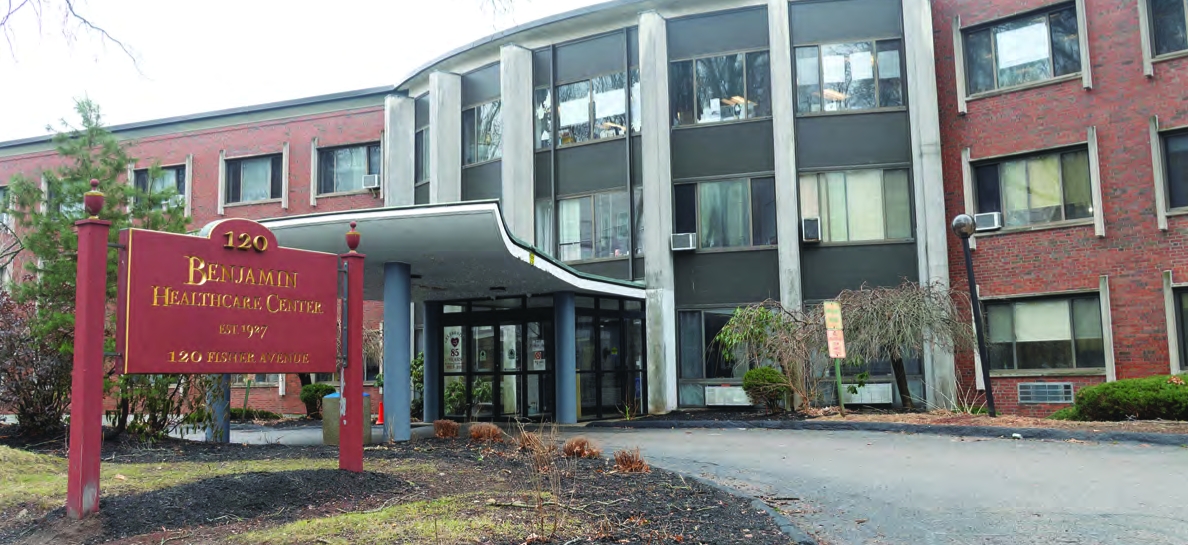
The Edgar P. Benjamin Healthcare Center on Mission Hill, shown March 6. In a court proceeding March 11, staff overseeing the receivership of the Edgar Benjamin said the sale of the facility to Allaire Health Services was nearly ready to be finalized. The sale of the nonprofit Edgar Benjamin Healthcare Center in Mission Hill is nearly complete.
As of March 20, Joseph Feaster, the court-appoint receiver overseeing the $6.5 million sale of the Edgar Benjamin to Allaire Health Services, said the receivership and Allaire were waiting for Judge Christopher Belezos to sign an order approving the transfer and post-transfer plan in order to finalize the sale.
The Suffolk Superior Court established the receivership in 2024, after guardians of Edgar Benjamin residents sued for court oversight saying the center’s then-administrator Tony Francis intended to shut the facility amid “insurmountable financial challenges.”
Francis also faces allegations of mismanaging the facility’s finances.
In April 2025 Feaster announced his plan to sell the facility and its operations as the best way to keep it operational but his choice of Allaire has faced scrutiny from community members, including about its for-profit status and out-of-state headquarters in New Jersey.
As the sale is poised to close, a handful of issues still face the 100-year-old nursing home, primarily concerning cases surrounding roughly $800,000 in outstanding funds owed to the Edgar Benjamin for services it rendered in recent months, and, separately the fate of more than $1 million in leftover funds from the sale. The facility is also in a wage dispute — a civil suit against Francis.
Those lingering issues might be handled by a new receivership, as attorneys representing the commonwealth and the receivership suggested at a March 11 status conference to keep tabs on the progress of the sale. The attorneys also suggested that a new court-appointed receivership be formed under a separate authority after the current receivership ends.
But Belezos wasn’t keen on the idea, citing the complications of setting up another receivership.
“What I don’t want to do is replace one receivership with another receivership,” Belezos said, adding that the cases needed to “get to the endpoint.”
He said the court would rather see the Edgar Benjamin’s outstanding needs resolved through a continuation of the existing receivership or through a volunteer board, created by the facility, to hold that responsibility.
The latter was a concept he had previously pushed for, but representatives for the receivership said their efforts to recruit volunteers to serve were unfruitful, citing hesitant community members.
“Your Honor is aware of the tentacles and the hair all over this,” said Timothy Fraser, an attorney representing the receivership, to Belezos during the status conference. “[It] has just been very difficult to find three people to step into the shoes and wind this up.”
One of the thornier issues that any new management of the Edgar Benjamin wind down will face, especially since the sale to Allaire will not include responsibility for the center’s legal cases, is the suit against Francis. That suit involves allegations that he stole and embezzled over $3 million from the facility. The documents collected by the receivership for that suit have separately led to two federal criminal charges of misappropriation of federal funds, which Francis pled guilty to in February and towards which he could have to pay $44,000 in restitution.
Still, the receivership and Francis have been locked in a back-and-forth over other compensation, including over whether Francis is still owed any part of his salary because his final paycheck bounced.
“We can litigate this, but the bottom line is Mr. Francis is owed a good deal of money and there’s nothing in the [law] that precludes [that] just because he pled guilty to misappropriation of funds,” Valerie Samuels, Francis’ attorney in the civil suit, said at the status conference.
Belezos, who is not overseeing that suit, seemed skeptical about that argument.
At the prompting of the Attorney General’s Office and the Department of Public Health, Belezos sided with the state and ruled that once the sale closes, it will no longer be responsible for advancing funds through Mass-Health to support operations and receivership costs at the facility, something it had previously been required to do.
In a court order, Belezos also extended the receivership through April 15, calling for another status conference on April 13 to check in on the process of shuttering the nonprofit.