Between 2019 and 2024 East Boston, Jamaica Plain, South Boston and West Roxbury saw the largest gains in canopy acreage. Mattapan and Hyde Park experienced net losses.
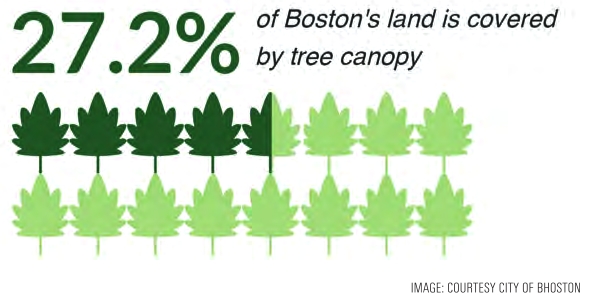
Boston’s canopy is thriving and growing, according to a five-year report assessing the tree cover over the city.
The report, prepared by the University of Vermont’s Spatial Analysis Lab, is the first since the city launched its urban forestry plan in 2022.
Overall, the March 5 report found that between 2019 and 2024, the city’s tree canopy grew by 1,064 acres. At the same time, it also lost 913 acres, for a net gain of 151 acres overall, a 0.5 % increase since 2019. While that may seem small, that is equal to about 114 football fields.
“We want to see how things change over time with the understanding that ultimately, we’re running a marathon; this isn’t a sprint,” said Todd Mistor, director of the city’s Urban Forestry Division. “There’s always this balance at play, but I do think that this is a good indication that some of the places where we’ve invested resources are paying off.”
Those resources include the development of the city’s 2022 Urban Forest Plan, a manual for how the communities can work together to maintain and expand Boston’s tree canopy, and for a more than $11 million grant the city received through the U.S. Forest Service.
Despite the improvements, a point that wasn’t missed by the report was how access to tree canopy across the city hasn’t been uniform, nor was it during the report assessment period. Between 2019 and 2024 East Boston, Jamaica Plain, South Boston and West Roxbury saw the largest gains in canopy acreage. Mattapan and Hyde Park experienced net losses.
City efforts to expand canopy have already focused on adding and protecting trees in geographic priority areas, identified as such based on four factors: limited existing tree coverage, high urban heat impacts, historic marginalization and which census blocks qualify as environmental justice communities. The new report will help shape focus areas moving forward, city officials said.
Still, the city is continuing its investment in further greening the city. Around the same time as the report was published, the city also announced nearly $520,000 in six new grants through the Boston Tree Alliance, a Mass Audubon-affiliated coalition of organizations and individuals focused on tree planting and care.
Those grants represent the latest, and to date largest, round aimed at working with community-based organizations to foster the planting and care of more trees on private property across Boston, said Zoe Davis, a senior climate resilience project manager with the city.
But they also represent a consistent challenge the city faces, which is the balance of trees on private vs. public land. According to the report, over half the city’s tree canopy is privately owned, highlighted by the fact that residential properties contained the largest share, about 3,000 acres or 35 %, of the city’s canopy, but also saw the greatest loss, roughly 116 acres, between 2019 and 2024.
There are examples of successes on the land the city does control. City-managed right of ways — publicly owned areas for transportation like roads and sidewalks — and open spaces like parks saw a growth of 67 acres and 104 acres of canopy respectively.
Officials hope that city funding grantees like the Longwood Collective, which aims to remove about 600 feet of pavement to make room for new trees in privately owned but publicly accessible areas in the Longwood Medical Area, will offer another opportunity for a successful public-private project. Given how built-up the area is, however, it won’t be easy.
“You’re working in Boston, where we have a lot of built infrastructure and also impervious surfaces that make it really difficult to find a place to plant a tree,” said Amara Chittenden, Mass Audubon’s project manager for the Boston Tree Alliance.
That project also points to another conundrum in the city’s urban forestry efforts, which is the division between maintaining existing greenery and planting new trees.
Chittenden called maintenance and care funding “equally, if not more important, sometimes as the actual costs of the tree planting.”
It’s also why the Tree Alliance is requiring tree planting grantees to report back on the health of newly planted trees for two years after planting.
“We’re encouraging those maintenance costs when we review grants,” Chittenden said. “It’s a really important part of what we’re looking at; is there a really solid plan in place for how the trees are going to be cared for as they’re in their newly established home?”
It’s a focus that Mistor also emphasized. Maintaining the city’s 50,000 trees involves proper care and pruning, making sure they get enough water and protecting them from pests like the emerald ash borer beetle that can infest and kill ash trees.
All that effort seems to have paid off, as Boston’s existing tree canopy is getting larger, and not the planting of new trees, was the greatest contributor to overall canopy gains.
And all the urban forestry work, whether new plantings or caring for older ones, is directly related to other climate and resilience efforts the city is pursuing, Davis said. She pointed to the city’s climate action plan, a municipal document updated every five years to govern and guide the city’s mitigation and resilience efforts, as another piece of the puzzle that is connected to the tree canopy expansion efforts.
She called Boston’s canopy a critical part of planning for the future.
“It’s a huge part of long-term resilience for a city, particularly from a cooling perspective,” Davis said. “It is one of the key ways that a city can support cooling itself.”
Such efforts also represent a more direct way community members interact with climate resilience, Mistor said. Compared to something like sea level rise, which residents might interact with periodically, trees are there consistently.
“Trees that are in our environment are something that people interact with in almost every aspect of their day,” he said. “From that respect, it’s of great importance.”