Author Rhae Lynn Barnes ‘Darkology’ explores history of blackface
The sordid history of blackface and minstrelsy is in many ways the history of popular American entertainment. As far back as the early 18th century, white supremacists utilized this song and dance and storytelling to ridicule and belittle Black Americans.
That form of entertainment also served the function of creating a white American identity among disparate groups of whites. Whites could now identify as white, rather than different ethnicities. The dominant culture had created an “inferior” other to whom whites could compare themselves as superior due to the objectification of Blacks made explicit in blackface and minstrelsy.
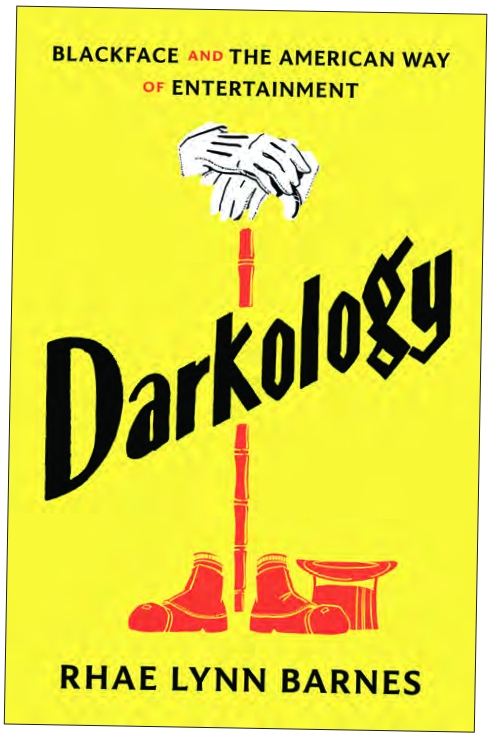
Rhae Lynn Barnes, an assistant professor at Princeton University, examines these complex, painful matters in “Darkology: Blackface and the American Way of Entertainment,” her book to be released March 24. She is speaking at Porter Square Books at 7 p.m. on Mar. 25.
Barnes was born and raised in Anaheim, California: “I grew up a few blocks from Disney world,” she told the Banner. She went on to earn a doctorate in history at Harvard. Barnes brings to this book a sensibility cultivated in scholarship and experience. She confronts the normalization of racism that existed at the core of creating American identity in minstrelsy and blackface. By doing so, she adds a lens to how we look at modern entertainment.
In “Darkology” readers can see racist undercurrents once used overtly to validate white supremacy. Minstrelsy and blackface were used by white supremacists to try to create a consciousness of superiority among non-Black audiences, as well as to try to diminish agency in the Black population.
The Banner spoke with Barnes about her work last week.
Banner: “Darkology” is about the history of blackface and minstrels in the United States. People of course know these terms, but what is your definition of them in the context of your book?
Barnes: Blackface and minstrelsy are two separate concepts, and they often converge or are used together, but they are separate. Blackface simply means the act of a person, usually white, but also Black or Japanese, I mean, all kinds of groups of ethnic or racial diversity applying black soot or paint to their face to mock Black Americans, specifically onstage for racial performances. In the United States, it was the most popular form of entertainment in the 18th century.
Minstrelsy is a three-act play or production to mock Black people comically.
You refer at times in “Darkology” to “fear of displacement,” an anxiety that white Americans “were losing their grip on power.” How do the minstrel shows historically fit into that?
That history begins in the 1840s and 1850s when blackface goes viral; it became not only the most popular entertainment in the United States, but also America’s first cultural export. That moment is critical. You have two things happening: abolition and very successful uprisings by enslaved people; and mass emigration from Ireland due to the famine and failed revolution in Germany.
So white America is scared, and who white America is at this moment is very unclear. Minstrelsy was a way for white people to prove themselves to be white Americans. A way to assimilate. Blackface was part of a white supremacist and proslavery ideology. This continued into the 20th century. For example, the WPA (Work Progress Administration) introduced minstrelsy to the 120,000 Japanese Americans incarcerated during World War II; it was to create a cultural citizenship.
You describe minstrel shows as an ironic unifier of disparate groups of white and Japanese groups — by creating a false narrative of the Black experience and making Black individuals into others. Say more.
Part of what blackface does is that no matter what a Black American has achieved, you can be a professor, a physician, an actor, a politician, you are relegated culturally to backwardness.
Two foils in minstrelsy are Zip Coon and Jim Crow. Jim Crow is shown as happy and submissive. Zip Coon tries to be successful, but in the shows, he gets everything wrong: damned if he does, and damned if he don’t. You’re still mocked. The NAACP created a term: “a thing apart.” That is, blackface creates a thing, not a person.
How does minstrelsy live on these days? Despite bans, and successful action led in part by the NAACP. Not necessarily as overt blackface, but as an undercurrent informing modern entertainment?
One important distinction: it was also the mothers in the Civil Rights movement who helped shut it down. But what I tell my students is about observations that inform pop culture. Thomas Jefferson, in his “Notes on the State of Virginia,” wrote that when he watched his enslaved people, ‘I see that they are excellent at singing and dancing.’ White people observing Black people. But the culture observed takes different forms. West African, Caribbean and so on. Twenty different language groups, different cultures enslaved and working together. Black people created a unique, global culture to communicate, resist and entertain. The innovation is staggering.
ON THE WEB
Learn more at wwnorton.com/books/9781631496349